
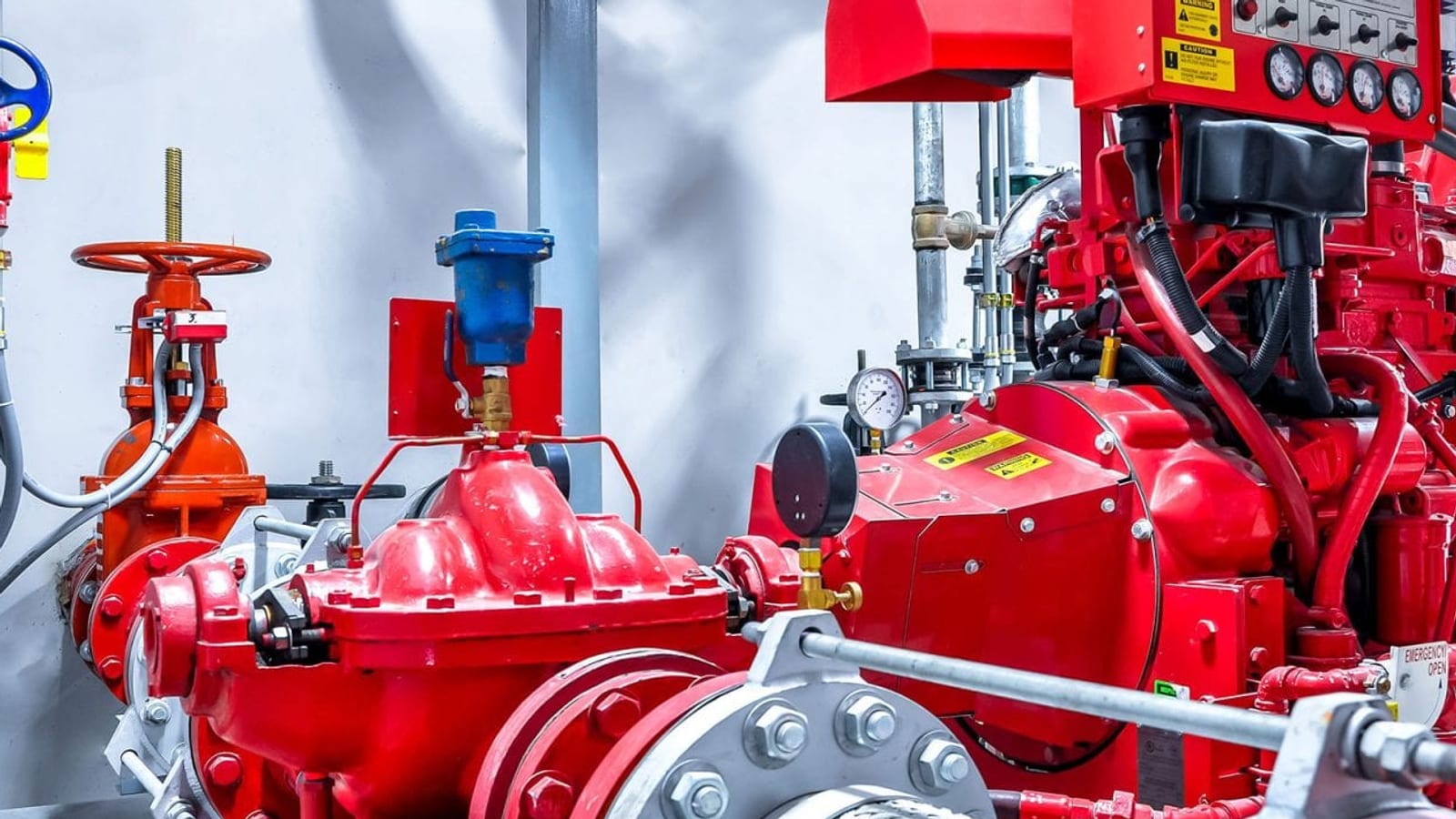
ASO 1. We perform fire system maintenance on medium to large-scale facilities along the Sincan and western Ankara industrial corridor, which includes OSB. This page explains how maintenance is planned in a three-shift operating factory without interrupting production, and why the emphasis in this document is on sprinkler installation and the pump room .
We perform periodic maintenance of fire detection, sprinkler, fire pump, hydrant and gas suppression systems at facilities in Sincan Organized Industrial Zone (ASO 1. OSB) and the western Ankara industrial corridor — from the Etimesgut industrial zones through to Başkent OSB, Anadolu OSB and the ASO II-III corridor toward Temelli. Our center is located in Yenimahalle, at the beginning of this corridor; Surveys within Ankara are free of charge and can be scheduled the same dayA zone monitoring module connects an entire conventional detector line to the addressable loop. Critical areas are renewed with addressable devices while secondary zones continue to operate with their existing wiring. This provides significant cost advantage in capacity upgrade and renovation projects.
Night shift maintenance turnover: opening the window according to production schedule
In a medium to large-scale factory, the primary difficulty in fire system maintenance is not technical but calendrical. If the press line runs three shifts, no one can say "let's stop production for maintenance"; we don't say it either. During the survey we obtain the facility's shift schedule, planned shutdowns and critical process hours; maintenance is then fitted into that schedule:
- Sprinkler zones individually: only one zone valve is closed at a time; its duration and supervision during that period are documented in advance, and at job completion the valve's reopening and sealing are confirmed.
- Pump tests according to process hours: startup and flow tests, pressure fluctuation tests are scheduled for times when pressure variations will not affect production — typically during shift changeover or weekend shutdowns — at most facilities.
- Detection tests start from idle areas: mold changes, line cleaning or planned shutdowns — whatever maintenance period they fall into — detector and button tests are scheduled accordingly.
- Siren scenarios during shift changes: personnel are informed in advance; on-site there is no uncertainty as to whether it is real or a test.
The output of this plan is documented: which system remained out of service for how long at which hour, when it was restored. Since a single valve that is closed but not reopened can leave a facility unprotected for months, reopening confirmation is a non-negotiable item in the report.
In this structure, maintenance weight falls on: sprinkler piping and pump room
The facility structure of the western Ankara corridor — metal processing, machine manufacturing, plastics, food, warehousing — carries fire load primarily on sprinkler and pump group systems; in our contracts, the weight of work is also there.
What is inspected in the pump room?
NFPA 25 divides pump group control between operations and service: short-cycle periodic startup tests can be conducted by facility personnel; annual flow test, extraction of pressure-flow curves and testing of safety equipment are service tasks. The most common scenario we observe on-site is the jockey pump starting and stopping dozens of times per day — indicating a line leak or pressure switch staging problems — and this going unrecorded by anyone. In maintenance, jockey startup frequency, pressure switch stages, the fuel-battery-cooling triad in the diesel pump and pump room temperature are each individually recorded.
Two factory-specific risks on the sprinkler side
TS EN 12845 defines a graduated arrangement extending from valve status monitoring to annual comprehensive inspection. On top of this, two local risks apply in the factory environment: material subsequently stacked in front of sprinkler heads in high-bay storage and freezing in unheated canopies, loading areas and auxiliary storage. We specifically look for both during the survey; for areas where freezing risk is identified, we recommend dry-pipe or appropriate protection solutions. A significant portion of heads, valves and pump spares emerging from maintenance come from our catalog are covered.
Who determines the period? Not regulation, but standard
Do not look for the basis of the maintenance schedule in the regulation text: the Regulation on Fire Protection of Buildings requires that systems be kept in working condition, but defers the question of period to each system's own standard and the manufacturer's maintenance manual. We also write the frequency in our contracts by reading from these sources:
| System | Source standard | Detailed page |
|---|---|---|
| Sprinkler piping | TS EN 12845 / NFPA 25 | Sprinkler maintenance |
| Fire pump group | wheeled devices must have | Fire pump maintenance |
| Fire detection | TS CEN/TS 54-14 | Detection maintenance |
| Gas suppression (transformer, panel, server) | wheeled devices must have | Gas suppression maintenance |
| Canteen hood suppression | NFPA 17A / NFPA 96 | Hood suppression |
| Portable extinguishers | Portable fire extinguishers: | Extinguisher maintenance and refilling |
Factory environment stresses detection too
Dust, forklift exhaust and welding fumes contaminate detectors far more rapidly than in office buildings; the control arrangement anticipated by TS CEN/TS 54-14 is tightened in these environments. In high-ceiling halls, beam-type detector alignment and contamination compensation; in transformer-panel-server rooms with gas systems, agent quantity and pipe integrity; in canteen hoods, nozzle openings and detection line — all are inspected. From detection to gas suppression, all these items can be bound to a single contract; if camera maintenance is requested we add it to the same visit.
Sincan, Etimesgut, Temelli direction: same corridor, same day
Our center is in Yenimahalle; we reach ASO 1. OSB, industrial zones in Etimesgut and OSBs toward Temelli via the same main artery. The "same-day survey" statement on this page is not marketing language but corridor geography. During maintenance intervals, for breakdowns we first perform telephone pre-diagnosis: a photo of the panel screen message or pump panel status is usually sufficient to assess the urgency of most calls from a distance. How the contract scope is structured maintenance contract on that page, our service arrangement throughout Ankara Ankara fire systems maintenance is explained on the page.
For survey and planning you can call You can call or write from the write to us; surveys within Ankara are free of charge.
To Set Up Your Maintenance Program
One contract, a solution for everything: we provide end-to-end maintenance to fire detection, gas suppression, sprinkler, hydrant, and pump units in their entirety; if you wish, camera (CCTV) system maintenance can also be added to the same contract.
If you do not have the brand, age, and last maintenance record of the existing system on hand, that is not a problem; the first step is anyway inventory and current condition assessment. Setting up an annual program without seeing what is there in the field means selling maintenance for a system that does not exist.
You can examine your system brand's product equivalents in our product catalog ; for requirements specific to your facility's use class, you can visit our sectoral solutions pages.
For survey and quotation you can or send your plan through our write or directly You can call call the number. Survey is free within Ankara; for facilities throughout Turkey, the visit plan is established jointly before contract.
Frequently Asked Questions
Do we need to stop production for maintenance?
No. During the survey, shift schedule and planned shutdown calendar are obtained; sprinkler zones are closed individually and under supervision, pump tests are scheduled at times when the process will not be affected, detection tests start from areas where production is already shut down. Which system will be out of service at which time and for how long is documented in advance; upon completion of work, each item's restoration is confirmed in writing.
Can our own personnel perform pump tests, and what will you undertake?
NFPA 25 already foresees this division: short-term periodic run tests and daily visual inspection of the pump room can be conducted by facility personnel. Annual flow test, derivation of pressure-flow curve, verification of pressure switch stages, and testing of safety equipment are service tasks. We also provide a simple checklist for inspections that facility operating personnel may perform, if desired.
When can you come to Sincan for a survey?
Our headquarters is in Yenimahalle; the Sincan-Etimesgut-Temelli line is our nearest working area. Surveys within Ankara are free of charge and can often be completed the same day. During the survey, system inventory, pump room condition, and zone schematics are documented; the quote is prepared based on this inventory.
Are you an authorized service center for our sprinkler or fire panel brand?
We do not claim to be an authorized service center for any brand; our role is clear — we supply products from these manufacturers, conduct periodic maintenance and repair services on-site. If a device is under warranty, we identify and clarify with you any work that could affect the manufacturer's warranty before commencing; for those items, the conditions in the product's warranty certificate apply.
Will sprinklers freeze in unheated warehouses and canopies?
A wet-pipe system carries freezing risk in an unheated space, and a frozen pipe often goes undetected until a fire occurs. During the survey, we specifically check these areas; the solution depending on the space is a dry-type system, dry pendant heads, or appropriate protective measures. For existing dry systems, the compressor, low-point drains, and valve room temperature are separate maintenance items.
Will your maintenance report be sufficient for OSB or insurance inspection?
Our reports are measurement-based: pump test results, battery load test durations, number of devices tested, items taken out of service and restored, and applicable standards are included in the report. Retention of records for presentation at inspection is part of proper procedure; we do not consider a statement consisting merely of "maintenance was performed, system is operational" as sufficient either.