
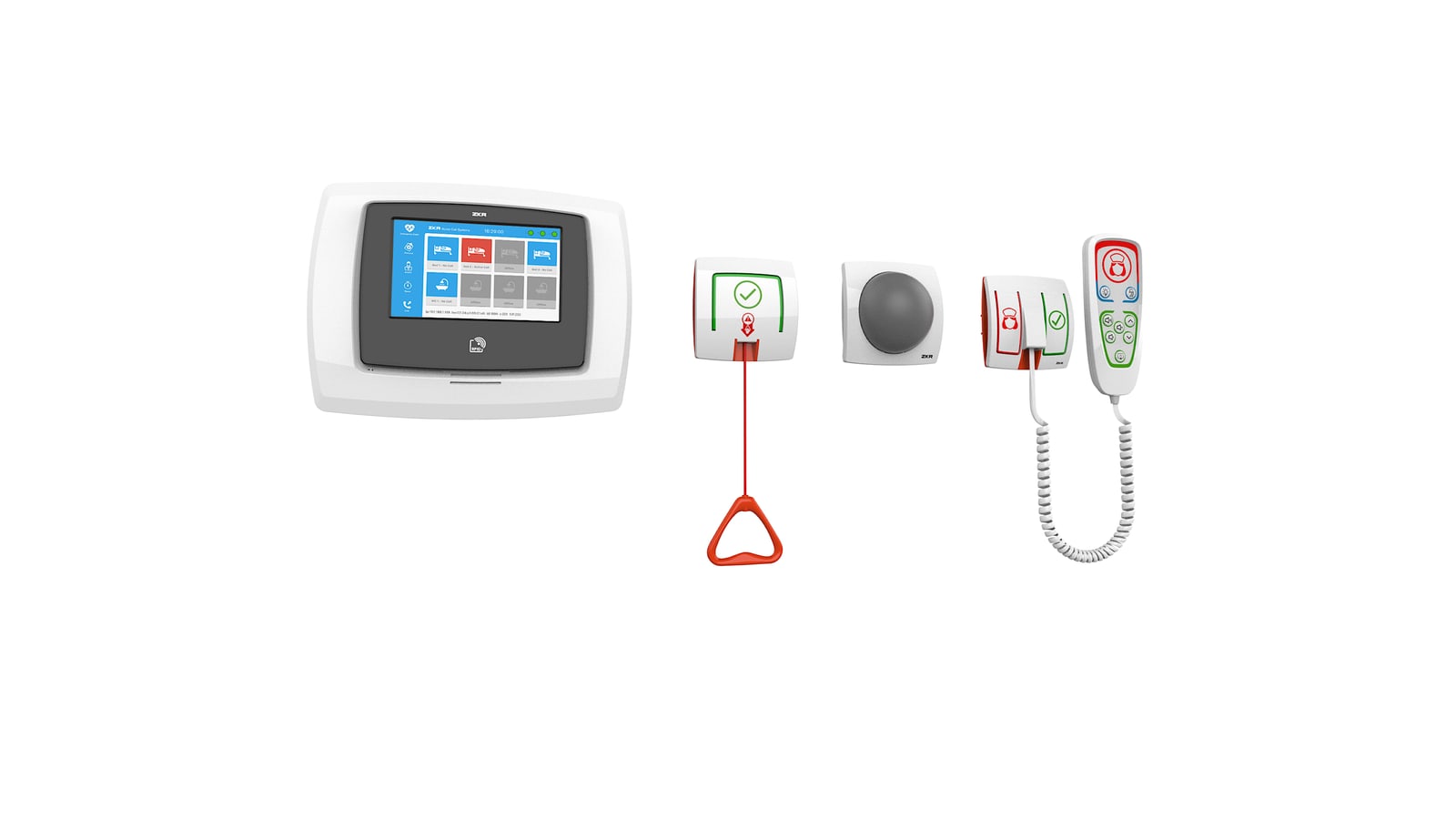
Nurse call system: a system that patients can reach and staff can hear
A nurse call system transmits a patient's or care recipient's help request to staff. On paper, this simple task depends on two details in the field: the call button must be within the person's actual reach and the call must be audible where staff are located. In systems we install in hospitals, nursing homes, and disability-accessible facilities, we focus on these two points.


Selection guide and FAQ
System components
| Component | Where | Function |
|---|---|---|
| Bedside call unit | At each bedside | Patient call initiation; typically accompanied by pear/pendant remote control |
| Bathroom/WC pull cord button | In bathroom and toilet | Cord is routed from ceiling to near floor — a fallen person must be able to reach it from the ground. This is the most critical component |
| Room internal cancel button | On the inside of the room door | Staff only operation; indicates that the call has been acknowledged and the room has been entered. The patient must not be able to cancel their own call |
| Door header lamp | Above the room door | Indicates which room is calling from the corridor; color distinguishes call type |
| Corridor end lamp | Corridor entrance | Displays remotely which corridor the call is from |
| Nurse desk / center | At the nurse station | Lists all calls audibly and visually; arranges them in priority order |
| Staff presence button | In the room | Notifies that staff is in the room; calls coming to that room are directed to the staff |
Call priority
A good system does not treat all calls the same; priority order ensures staff runs to the right location
| Priority | Standard | Meaning |
|---|---|---|
| Normal call | Bedside button | Patient requesting assistance |
| Bathroom call | Bathroom pull cord button | High priority — person may have fallen, distinguished by separate tone |
| Emergency / code blue | Emergency button activated by staff | Highest priority; additional staff call, announced to entire unit |
| Staff call | Staff in room | On-duty staff requesting assistance |
Critical items not to be omitted in project
- The bathroom pull cord is left with its end approximately 10–15 cm from the floor. Leaving the cord too short causes the system to fail to function when needed most (when the person is on the ground); this is the most frequent error we correct in the field.
- Call cancellation must be possible only from within the room. A system that can be silenced remotely from the nurse station cannot document whether the call was actually answered.
- Call records must be maintained: what call came in, when it was received, how quickly it was answered. This record serves both as a measure of service quality and protects the institution in case of any dispute.
- In locations where staff is not continuously present at the nurse station, calls should be routed to DECT phones or mobile devices; a system relying solely on corridor lighting is noticed late on floors that operate with minimal staff at night.
- In elderly care facilities and nursing homes, wireless pendant/wristband buttons provide coverage outside the room as well; coverage should be planned for common areas and outdoor spaces.
- The system must perform fault monitoring on its own wiring: a broken line or faulty unit should be detected when it occurs, not when needed.
- The system must continue to operate during power outages; the central unit is powered by an uninterruptible power supply.
A nurse call system may go unused for days and for this very reason its failure goes undetected. A button not working is only discovered at the moment someone truly needs help. For this reason, the system must be tested at regular intervals and the tests must be recorded. For the systems we install, we provide a periodic test checklist and maintenance plan as part of the handover documentation.
Frequently asked questions
Can we expand our existing system without replacing it?
If the central unit capacity and wiring permit, adding rooms is often possible. With very old conventional systems, however, expansion becomes difficult because spare parts are unavailable; in such cases, we plan a gradual transition: the new section is installed on a IP basis, the old section continues to report to the same desk via an interface module.
Can calls be received on a mobile phone?
Yes. In IP-based systems, calls can be routed to DECT phones, in-house mobile devices, or an application. The important consideration here is that the corridor lamp and desk alert must not be disabled as a backup for the possibility that the phone may be on silent — mobile notification is an additional layer, not a replacement solution.
Is there a difference between a care home and a hospital system?
The basic logic is the same, but in care homes, individuals are not fixed in their rooms: they need to be able to call from common areas, gardens, and corridors. For this reason, pendant/wristband-type wireless buttons and wide coverage planning are emphasized. In hospitals, bedside units, code blue, and the recording/reporting side carry more weight.
Should the system be linked to the fire alarm?
The two systems are kept separate — nurse call does not replace fire detection and must not be confused. However, visibility of the fire alarm at the nurse desk also makes sense from a evacuation plan perspective. This is achieved with a separate indicator panel.
Does installation disrupt patient care?
In an active facility, we work section by section: while one corridor remains in service, cabling and installation take place in another; transitions are planned for night or low-occupancy hours. You are accustomed to installing in this manner in operating facilities.