
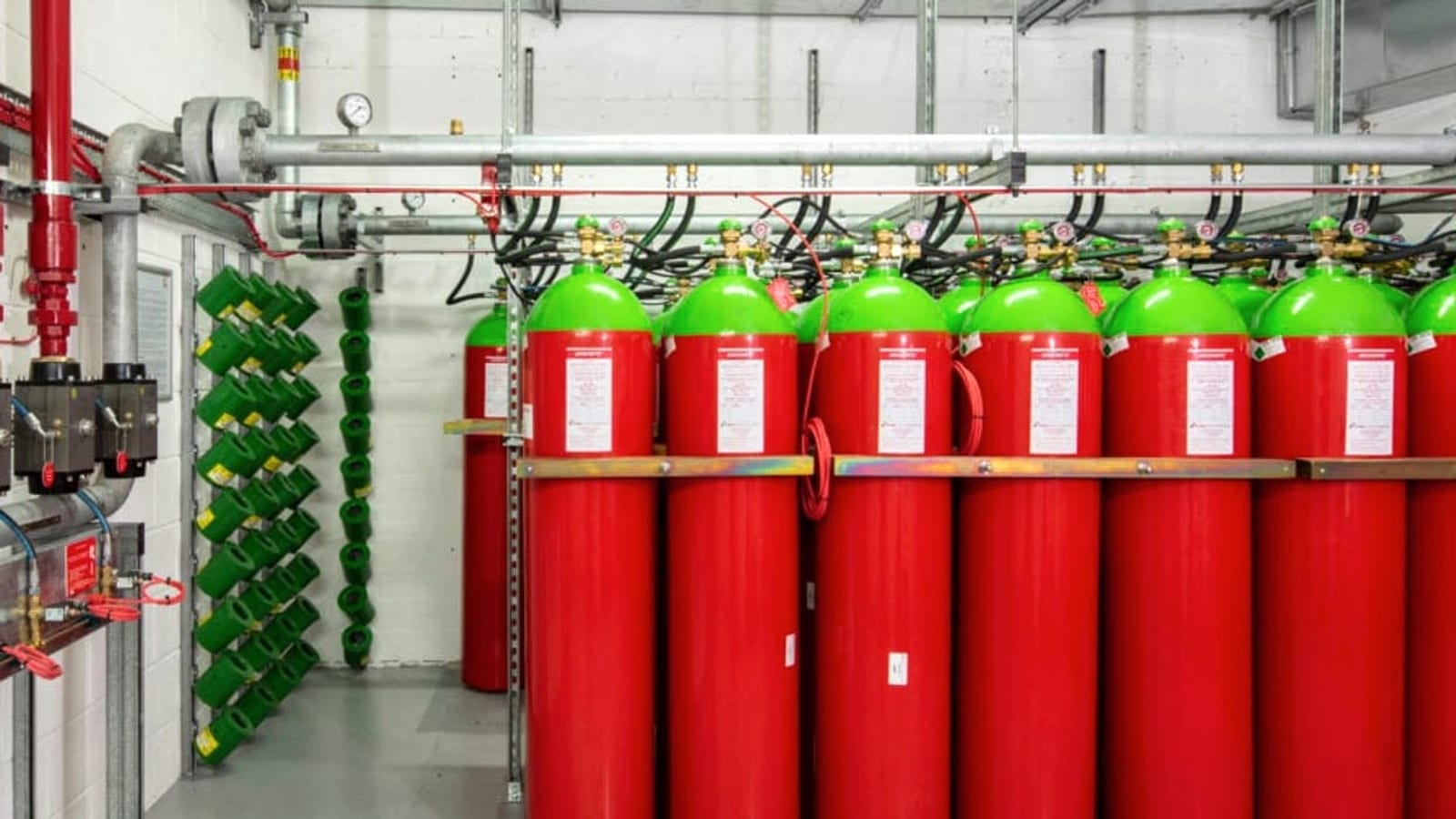
The fact that cylinders are full does not indicate that the gaseous suppression system will work. Gas is discharged, reaches concentration — and if the room is leaking it escapes within minutes. When the gas level drops while hot surfaces have not yet cooled, the fire reignites. Room leakage testing is the only method that measures rather than estimates this risk.
What does the test measure
In gaseous suppression, there are two distinct requirements. The first is reaching the design concentration: this is achieved through cylinder quantity and pipe calculations. The second is maintaining that concentration for a specific duration: this is called hold time and depends entirely on the compartment's airtightness.
Why is hold time necessary? After the fire is extinguished, equipment surfaces are still hot. If the gas escapes early, oxygen returns and the hot surface reignites. This is why applicable standards require the gas to remain at an effective level in the compartment for a certain period.
Room leak test pressurizes the compartment with a calibrated field fan and calculates the total leakage area from the pressure-flow relationship obtained. This area, evaluated together with compartment volume, gas type, design height, and design concentration, determines how many minutes the gas will hold.
Where it becomes mandatory
- In every newly installed gaseous system — it is part of acceptance and commissioning.
- After modifications — when cable penetrations, ducts, partition walls, doors, or raised floors are altered.
- Periodically — it is recommended to repeat at regular intervals because unnoticed changes accumulate in the compartment.
- Upon insurance or inspection request — this measurement is what documents that the system truly protects.
- When system brand changes or gas type is converted — different gas has different hold behavior.
The test is valid in halocarbon systems such as FM-200 and Novec 1230 as much as in CO₂ and inert gas systems ; the calculation method varies according to gas type.
The most common leak points we find in the field
| Location | Why it is overlooked |
|---|---|
| Cable and pipe penetrations | Fire-stop sealant appears applied but is hollow behind or was breached when new cable was pulled later |
| Beneath raised floor | Floor cavity below is open to adjacent compartment; room is sealed but underside is shared |
| Above suspended ceiling partition gap | Partition wall ends at suspended ceiling, above it connects with adjacent volume |
| HVAC and ventilation duct | No damper to close during discharge or damper does not close |
| Door bottom and perimeter | Gasket is missing, aged, or door does not close completely |
| Pressure relief damper | Oversized damper causes premature gas escape |
| Duct and shaft covers | Left unclosed after maintenance |
If the test fails
The report does not end with "failed." The real benefit is identifying and prioritizing leak points during measurement. Typical improvement sequence is as follows: first, large leaks concentrated at single points are sealed (duct, shaft, floor penetration), then door gasket and closure adjustment are performed, after which fire-stop sealant in cable penetrations is renewed. The pressure relief damper size is checked separately — an undersized damper strains the compartment during discharge, an oversized damper shortens hold time.
After improvements, the test is repeated. Sealing leaks is usually significantly more economical than adding cylinders; increasing cylinders without measurement is a frequent and ineffective approach.
Performed together with the test
During the same visit, we also inspect other items affecting the compartment's suitability for gaseous suppression: free movement of the pressure relief damper, functioning of ventilation shutdown signal, operation of door closers, discharge warning signs and internal-external alarm arrangement, and real-condition testing of delay and manual abort scenarios. These items gaseous suppression system maintenance can be planned together with scope.
LOCATION BASISFrequently Asked Questions
What is a room leakage test (door fan test)?
It is a test that measures the tightness of a gaseous suppression area. A calibrated fan placed in the door opening pressurizes the space, the total leakage area is calculated from the pressure-flow relationship, and the time during which the gas remains at an effective level in the space (retention time) is determined with this value.
Why is retention time important in gaseous suppression?
After the fire is extinguished, equipment surfaces are still hot. If the gas escapes early, oxygen returns and the hot surface can initiate reignition. For this reason, standards require the gas to remain at an effective level in the space for a specified period; whether this duration is achieved can only be known through leakage measurement.
How frequently should the test be repeated?
It is performed upon acceptance of a new system and repeated when there are changes to cable passages, ducts, partition walls, doors, or raised floors in the space. Since undetected changes accumulate over time, repetition at regular intervals is recommended; it should also be renewed when the gas type in the system is converted.
What should be done if the test fails?
Leakage points found during measurement are prioritized: large passages such as ducts, shafts, and under-floor areas are sealed first, then door gaskets and closure adjustment are made, followed by renewal of fire-stopping sealant in cable passages. The size of the pressure relief damper is verified and the test is repeated after improvements.
Is adding cylinders a solution if there is leakage?
Generally not, and it is expensive. Leakage reduces the retention time of gas in the space; adding cylinders increases initial concentration but does not stop the escape. The correct approach is to first seal the leakage points, then repeat the measurement.