
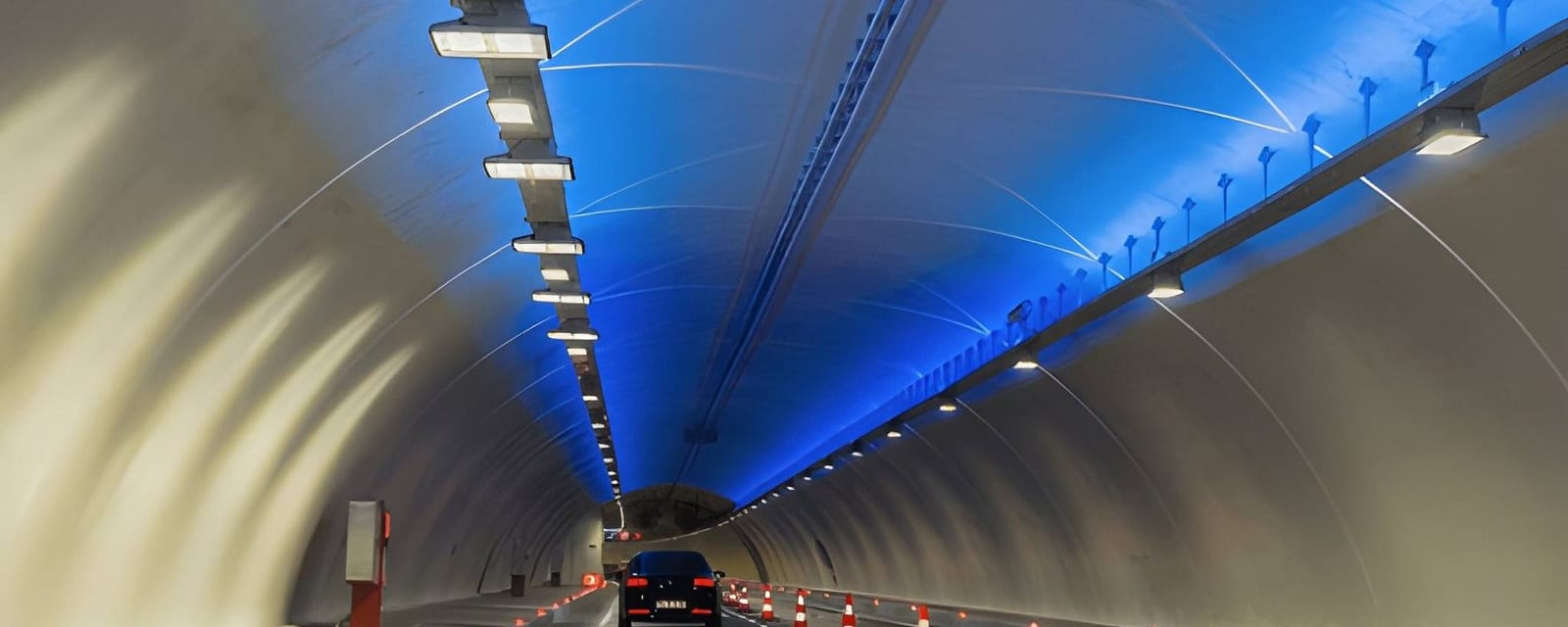
Knowing the fire location in a tunnel with meter precision means correct guidance of ventilation direction and response teams. The only practical technology capable of doing this over kilometers of line is fiber optic distributed temperature sensing (DTS).
Fire risks in this environment
- Rapid smoke propagation in enclosed volume
- High heat load from vehicle fire
- Fire location unknown → incorrect ventilation direction
- Evacuation over long distances
- Conventional detector failure due to exhaust and dust
Regulations and standards
Tunnel fire safety is subject to all applicable tunnel regulations and statutory provisions; linear heat sensing EN 54-22 is evaluated within this scope. The ventilation scenario must be integrated with the detection system.
Recommended technologies
Tunnel Fire Safety — the right solution combination and the reasons behind it.
Fiber Optic Temperature Sensing (DTS)
Meter-basis temperature and location over 8–10 km line via Raman backscattering. How it works: Fiber Optic DTS guide.
Related products →Linear Heat Cable (LHD)
Cost-effective line-type heat sensing in short tunnels and galleries.
Related products →Zoned Water Suppression / Water Mist
Since DTS indicates at which meter the fire is located, not the entire tunnel but only the affected zone is wetted: heat drops, smoke settles, and evacuation and firefighter access become possible.
Related products →Fire Cabinet & Hydrant
First response and firefighter water supply points at regular intervals along the tunnel.
Related products →Typical system architecture
Fiber optic sensor cable is routed along the tunnel ceiling; the DTS unit continuously monitors the temperature profile and transmits the alarm along with location to the SCADA/fire panel. The scenario manages jet fan direction, traffic lights, and zone announcements together.
Common field mistakes
- Establishing a ventilation scenario with a system that cannot provide fire location
- Routing fiber line in a manner exposed to mechanical damage
- Failure to perform DTS calibration and zone definition
- Failure to integrate detection with SCADA
Frequently Asked Questions
Why fiber optic (DTS) in tunnels?
Provides location and temperature with meter precision over kilometers of line; ventilation direction and response are based on this information. Conventional point detectors do not function in tunnels.
Which standard does DTS comply with?
As linear heat sensing, EN 54-22 is evaluated within this scope; tunnel-specific applicable tunnel safety regulations also apply.
Tunnel Fire Safety — request a quote for your project
Engineering, installation, commissioning and maintenance — from a single source. Free site survey within Ankara.