
Fire suppression system selection is not a budget preference, to the type of burning material This page explains why specific systems are used in particular locations and the reasons behind those choices. The wrong extinguishing agent will not extinguish the fire — in many cases, it will make it worse.
How to Select a Suppression System?
The correct question is not "which system is better?" "what is burning here and what does the extinguishing agent do to it?" The selection depends on three inputs:
- Fire class — Is the burning material solid, flammable liquid, gas, metal, or cooking oil?
- What is in the premises — Can water be applied? Is there a value that cannot be recovered with water, such as electronics, artifacts, or archives?
- Is there human presence — If the premises are continuously occupied, evacuation delay, evacuation warning, and gas breathability are determining factors.
Fire Classes and Suitable Extinguishing Agents
| Class | Burning material | Suitable | Not used |
|---|---|---|---|
| A | Solid (wood, paper, textile, plastic) | Water, sprinkler, foam | According to BYKHY, |
| B | Flammable liquid (gasoline, solvent, paint) | Foam, gas, dry chemical | Water — sinks below the liquid, carries it and spreads the fire |
| C | Flammable gas (natural gas, LPG) | Cutting off gas flow is essential | Extinguishing without cutting gas — accumulates and explodes |
| D | Flammable metal (magnesium, aluminum powder) | Special D powder | Water — causes severe reaction |
| F | Cooking oil (deep fryer, hood) | Wet chemical (saponification) | Water — instantly vaporizes and splatters the oil |
| According to BYKHY, | Energized electrical equipment | Clean gas, aerosol, CO₂ | Water — destroys equipment, conductivity risk |
The "not used" column in the table is the heart of the design. If multiple classes exist in one premises (e.g., factory: A + B + electrical), a single system is not sufficient; the premises is divided into zones and each zone has its own extinguishing agent.
System Family: What Does Each Do?
Water Suppression — Sprinkler
Sprinkler systems are the most common and most misunderstood system. Each sprinkler head contains a liquid-filled glass bulb; the heat of the fire breaks the bulb and only that head discharges water. For solid fires (Class A), it is the most economical and reliable solution. BYKHY makes sprinklers mandatory in many buildings, especially high-rise structures.
Gas Extinguishing
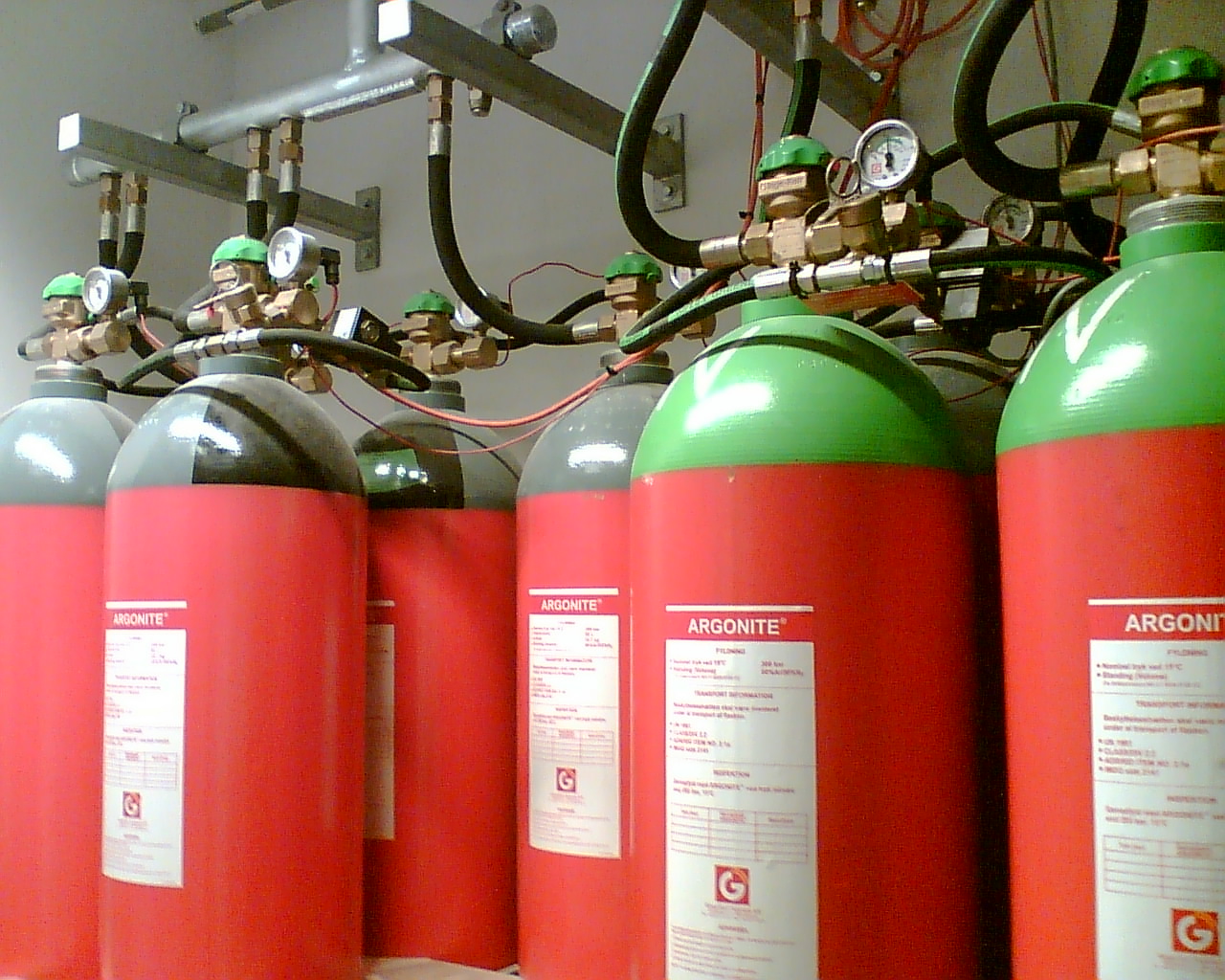
Gas suppression systemsare for places where water cannot be used: data center, server room, archive, museum, transformer and control rooms. Clean gas leaves no residue, does not damage equipment, and is removed by ventilation after discharge. In return, the premises must be airtight — if gas leaks, suppression fails.
Foam Suppression
In a flammable liquid fire (Class B), what feeds the flame is not the liquid itself, but the vaporrising from its surface. Foam creates a blanket over the liquid, traps the vapor, and cuts off oxygen. It is mandatory in tank farms, fuel stations, paint and solvent warehouses. Foam suppression products →
Kitchen Hood Extinguishing
Hot cooking oil (Class F) cannot be extinguished with water; water instantly vaporizes and splatters the oil everywhere. Wet chemical creates a soapy layer on the oil surface (saponification), cutting off vapor and cooling the oil. At the same time, gas supply is automatically shut off. Sprinkler cannot replace this system. Hood suppression products →
Aerosol Suppression
When the solid component in the generator is triggered, it produces a cloud of very fine potassium salt particles; this cloud breaks the chemical chain reaction of the flame. Does not require pressurized cylinder and pipe installation — a single generator mounted on the wall is sufficient. In panels, transformer rooms, and small technical spaces, it is much more economical than gas systems. Aerosol suppression products →
Water Mist
By breaking water into very small droplets, it both cools and displaces oxygen as it vaporizes. Compared to sprinkler, uses much less water ; it is preferred in places where water damage is unacceptable but gas is also unsuitable (historic buildings, engine rooms, tunnels).
Which System for Which Premises?
| Location | Typical solution | Why |
|---|---|---|
| Data center, server room | Clean gas (NOVEC / FM-200) | Water destroys equipment; gas leaves no residue |
| High-rise building | Sprinkler (BYKHY mandatory) | Fire brigade cannot reach upper floors; fire must be contained within the floor |
| Enclosed parking garage | Sprinkler | Vehicle fire spreads to neighboring vehicles |
| Warehouse, storage | Sprinkler (calculated according to fire load) | High fire load, rapid vertical spread |
| Refinery, tank farm | Foam | Class B — water spreads fire |
| Hotel / shopping mall / hospital kitchen | Hood (wet chemical) | Class F — water splatters oil |
| Panel, transformer, generator room | Aerosol or gas | Energized equipment; piping not desired |
| Historic building, archive | Gas or water mist | Artifacts cannot be recovered from water damage |
Suppression is a Continuation of Detection
Nearly all systems other than sprinkler are triggered by a detector. Gas system does not discharge without cross-approval from two independent zones; deluge system is triggered from flame detector; hood is dependent on heat detector.
The practical consequence is this: the suppression design cannot be considered separately from the detection design. If detection is incorrectly installed, suppression either does not work at all or discharges at the wrong time — both are expensive. Details: Fire Detection Systems
Sprinkler is the exception to this rule: the head opens with its own bulb, never asking the panel. The panel only receives "water flowing" information from the flow switch and sounds the alarm.
Regulations
Suppression systems BYKHY (Regulation on Fire Protection of Buildings) are regulated under its scope; which system is mandatory is determined based on building type, height, and fire load. Design and calculations are based on relevant European and NFPA standards: EN 12845 for sprinkler, EN 15004 and NFPA 2001 for gas suppression, EN 13565 for foam.
Calculation is the only acceptable verification. Statements such as "sprinkler was installed" or "gas was discharged" are not sufficient; water flow rate and pressure calculations, gas concentration and discharge calculations, and premises airtightness test must be requested as documentation.
ASPEK Fire Suppression Services
- Design and calculation — fire load and hazard class determination, hydraulic calculation, gas discharge calculation
- Installation and commissioning — piping, pump room, cylinder battery, acceptance tests
- Periodic maintenance — pump test, head inspection, cylinder weighing and pressure check, reporting
Frequently Asked Questions
In which buildings is a fire suppression system mandatory?
BYKHY determines this based on building type, height, intended use and fire load. Sprinkler is mandatory in high-rise buildings; automatic suppression is also required in enclosed parking, warehouses, shopping malls and accommodation facilities depending on conditions. The correct answer is specific to the project; survey and calculation are required.
Is sprinkler or gas suppression better?
They are not comparable things; they are for different fires. For ordinary combustibles (office, warehouse, parking) sprinkler is both more reliable and far more economical. In places where water would destroy equipment or assets (data center, archive, museum) a gas system is used. What is "better" is what suits the burning material in that location.
Can a sprinkler malfunction and flood the building with water?
A sprinkler head opens only by heat — smoke, alarm or panel command does not open it. For the bulb to burst, there must be actual fire heat beneath the head. Water damage concerns usually stem from the misconception that "all open at once when the alarm sounds"; no such thing happens.
Does gas suppression harm people?
Clean gases (FM-200, NOVEC 1230) and inert gases are approved for spaces where people may be present at design concentration; however, delay time and evacuation alarm are mandatory. CO₂ is different: it is lethal at suppression concentration and must not be used in occupied spaces.
Why is water not sprayed on flammable liquid fires?
Water is heavier than flammable liquid; it sinks beneath it, raises and spreads the liquid. The burning liquid spreads with the water, enlarging the fire. In Class B fires, foam covering the surface is used.