
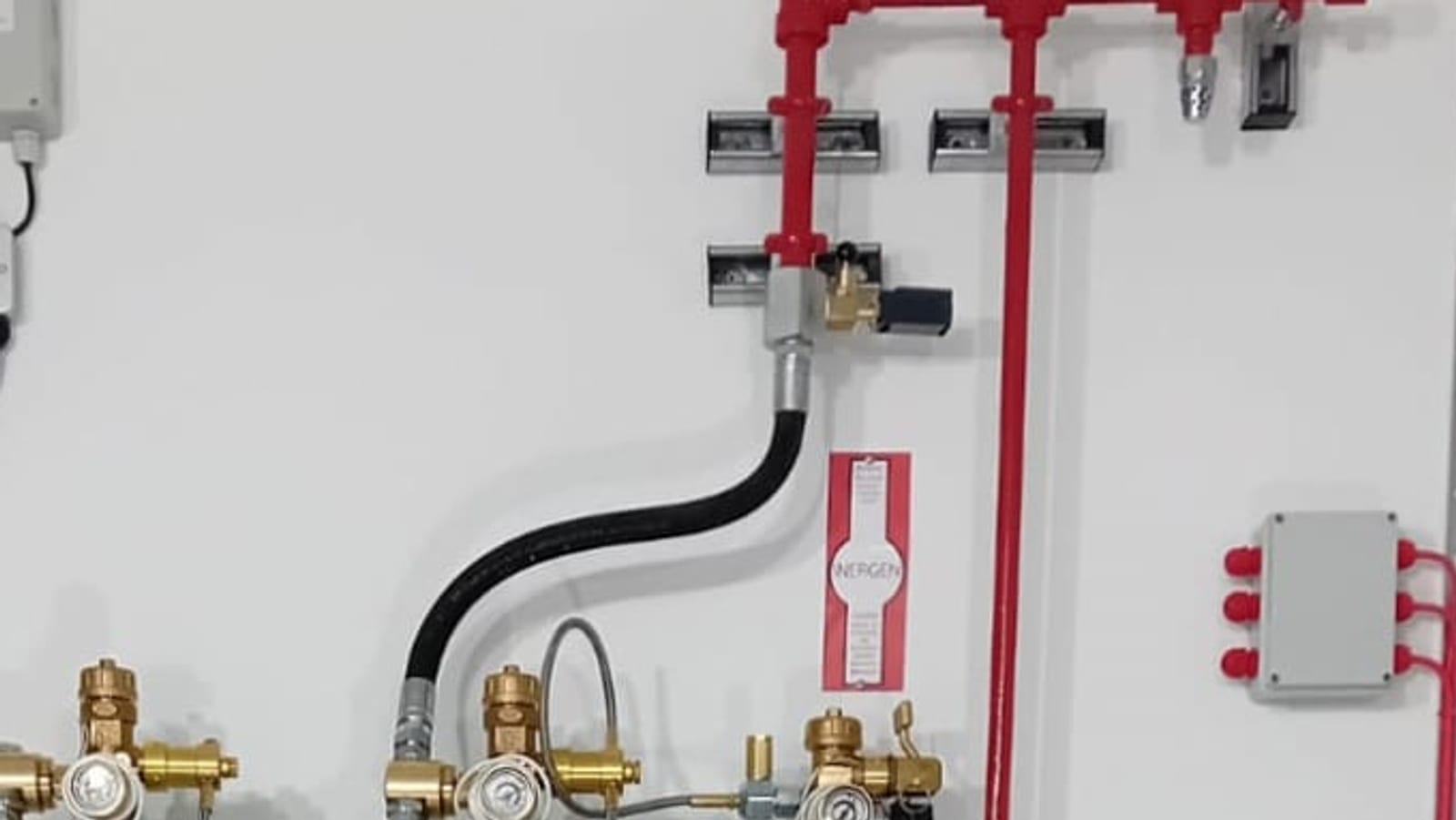
CO₂ and inert gases are from the same family: both extinguish not by chemical reaction, but by reducing the oxygen in the environment to a level at which combustion cannot be sustained. The difference between them is vital — inert gas mixtures can be designed at levels where humans can be present, whereas the CO₂ extinguishing concentration is lethal to humans. Therefore, the design, alarm arrangement, and interlocking logic of the two systems are established separately from each other.
Two technologies, one principle
Both systems stop combustion by reducing the oxygen ratio in the volume. The difference is the level to which it is reduced and whether humans can be present in the environment.
| Topic | CO₂ | Inert gas mixtures |
|---|---|---|
| Composition | Carbon dioxide | IG-01 (argon), IG-100 (nitrogen), IG-55 (argon+nitrogen), IG-541 (argon+nitrogen+CO₂) |
| Personnel | Not used in occupied premises | Can be designed to allow humans to be present for short periods at design concentration |
| Storage | Liquefied; low or high pressure | Gas phase at high pressure; more cylinders required |
| Space requirement | Less | Significantly more; separate volume required for cylinder battery |
| Discharge time | Depending on application; generally long | Gradual and relatively long to limit pressure load |
| Environment | Greenhouse gas; natural component | Natural components of atmosphere; ozone and warming effects disregarded |
| Visibility | Dense white cloud during discharge, visibility obscured | Less effect on visibility |
Personnel safety in CO₂ systems
CO₂ extinguishing requires a high design concentration for surface fires, and this level creates a vital hazard to humans. Therefore, in places where CO₂ system is installed, the following are part of the design, not accessories:
- Delay time. Between alarm and discharge, a delay is defined sufficient for evacuation of personnel that may be present in the premises.
- Audible and visual warning. Inside the premises and at entrances, separate warning is given before discharge and during discharge.
- Manual abort. Push-and-hold abort device to allow personnel remaining in the premises to delay discharge.
- Door and entrance locking, warning signs. Prevention of unwanted entry to the premises after discharge.
- Ventilation plan. The sequence and persons responsible for ventilating the premises after discharge must be documented in writing.
In practice, CO₂ systems are more often preferred in volumes with no continuous personnel presence: cable galleries, enclosed machine and turbine enclosures, paint booths, generator rooms, printing machines, and internal volumes of some process equipment.
Pressure management in inert gases
Inert gases enter the volume in gas phase and add a large volume in a short time. This has two consequences:
- Pressure relief damper is mandatory. The damper is calculated according to volume and discharge flow rate. An undersized damper cannot relieve pressure; an oversized damper causes gas to escape and shortens retention time. This calculation is the most frequently overlooked item in system design.
- Discharge is performed gradually. To limit pressure load and ensure uniform mixing of gas in the volume, discharge is completed over a longer period compared to halocarbon systems.
Retention time and room leakage test
The success of a gaseous system depends on how long the gas remains in the volume. Achieving concentration at the moment of extinguishing is not sufficient; the gas must remain at effective level for a specific period to allow hot surfaces to cool and prevent re-ignition.
The measure of this is room leakage test (door fan test). The volume is pressurized using a calibrated fan placed in the door opening, leakage area is measured, and gas retention time is calculated. This test is performed at initial commissioning and must be repeated when cable penetrations, ducts, doors, or suspended ceilings are modified in the premises. For details of our test service, see room leakage test you can visit our page.
System components
- Cylinder battery and manifold. In inert systems, the number of cylinders is high; the placement, securing, and access clearance of the battery must be planned in the design.
- Main and backup cylinder arrangement. Backup battery is provided if a second intervention is required after discharge.
- Pressure reducer and flow restricting orifices. Manages pressure in the pipe network.
- Pipe network and nozzles. Flow calculation is performed using manufacturer-approved software; pipe class is selected according to discharge pressure.
- Suppression control panel. Manages cross-zoning detection, delay, abort, locking, and feedback signals.
- Pressure relief damper and ventilation shutdown. Air conditioning and aspiration must be stopped at the moment of discharge.
Maintenance
In periodic maintenance, cylinders are weighed or pressure is read, flexible hoses and connections are inspected for aging, triggering chain (detection, panel, solenoid, pilot cylinder) is tested end-to-end, free movement of pressure relief damper is checked, and delay-abort scenario is operated under real conditions. Hydrostatic test periods of cylinders are tracked separately.
For detailed maintenance scope, see CO₂ and inert gas suppression maintenance, and for cylinder filling and hydrostatic testing, see cylinder filling and testing pages. For comparison with halocarbon systems, see our gaseous suppression systems guide; for brand-independent specification example, see CO₂ suppression specification page.
Project and proposal
For gas type selection for your premises, cylinder and damper calculation, room leakage test, and comparative quotation contact us.
Frequently Asked Questions
Can a CO₂ gas suppression system be used in occupied spaces?
As a rule, it cannot. The concentration required for suppression with CO₂ poses a vital hazard to humans. In cases of necessity, discharge delay time, audible and visual warning, maintained-pressure manual abort, door locking, and post-discharge ventilation plan are established as integral parts of the design. CO₂ is generally preferred for spaces with no continuous personnel presence.
What is the difference between inert gas mixtures?
IG-01 is pure argon, IG-100 is pure nitrogen, IG-55 is an argon and nitrogen mixture, and IG-541 is a mixture of argon, nitrogen, and a small proportion of carbon dioxide. All reduce oxygen to a level where combustion cannot be sustained; the differences between them lie in storage, pipe sizing, cylinder quantity, and supply. Selection is made according to the protected space volume, site constraints, and project specifications.
Why is a pressure relief damper mandatory?
During discharge in an inert gas system, a large volume of gas enters the space and room pressure rises rapidly. Without a properly sized damper, doors, suspended ceilings, and light partition walls can be damaged. The damper is sized according to the volume and discharge rate; if undersized, it cannot relieve the pressure, and if oversized, gas leaks out and the holding time is shortened.
Why is a room leakage test performed on a gas suppression system?
Reaching the design concentration at discharge alone is not sufficient; the gas must remain at an effective level in the space for a certain duration to allow cooling of hot surfaces and prevent re-ignition. A calibrated fan placed at the door opening measures the leakage area and the holding time is calculated. The test is performed on initial commissioning and is repeated whenever there are changes to cabling, ducting, doors, or suspended ceilings in the protected space.
Should CO₂ or inert gas be selected?
If the space has continuous personnel presence, inert gas is preferred. If the volume is unoccupied, space is constrained, and cost is the determining factor, CO₂ is favored. In inert gas systems, the cylinder quantity and consequently the space requirement are significantly higher; this is a practical constraint that can alone determine the selection.