
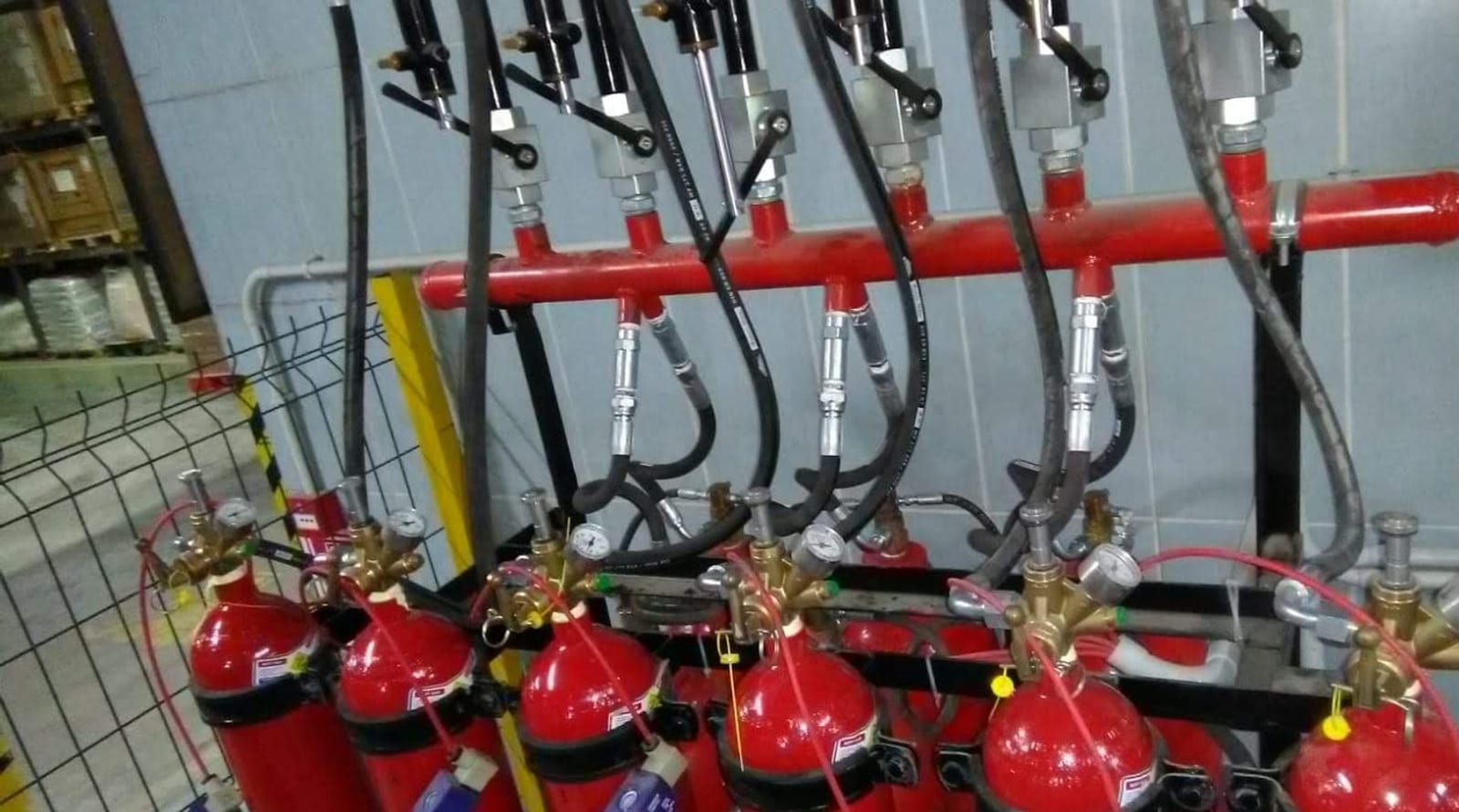
The FM-200 cylinder requires filling in two instances: when the system is discharged and when the loss threshold is exceeded during periodic weighing. In both cases, the critical aspect is not the agent itself, but the entirety of the process — disassembly, transport, filling, weighing, and recommissioning chain: if any link in this chain is skipped, the system will appear "full" but will not provide assurance. We execute this chain end-to-end under single responsibility.
FM-200, chemical name HFC-227ea, is a halocarbon extinguishing agent stored in liquefied form and pressurized with nitrogen. Refill requests reach us in two ways: either the system has been discharged in a fire or accidentally, or periodic maintenance weighing has shown that the gas quantity has fallen below threshold. The subject of this page is the process itself; for the system's six-monthly and annual inspections, see the gaseous suppression system maintenance page.
When Is Refill Required?
| Situation | What is done | Urgency |
|---|---|---|
| System discharged (fire/accident) | Cylinders removed, refill + discharge inspection + commissioning carried out together | High — area unprotected |
| 5% weight loss in weighing | Leak source sought (valve, hose, regulator), cylinder refilled | Planned — linked to maintenance findings |
| 10% pressure loss (temperature-corrected) | Nitrogen top-up alone insufficient; gas quantity verified by weighing | Planned |
| Hydrostatic test interval expired | Gas recovered, body tested, then refilled | Scheduled — dependent on test |
The basis of threshold values and why weighing is more reliable than pressure gauge see the cylinder filling and hydrostatic test is detailed on page.
How Does the Refill Process Work?
In Turkey, pressurized vessel filling is not an unregulated activity: SGM-2015/2 Notice Article 6permits filling only at Refill Certificate of Competence facilities. We have the actual gas charge performed at a filling station holding this documentation; inspection, disassembly, safety isolation, transport, post-fill weighing verification, assembly, and commissioning are carried out by our own team. From your perspective, the difference is this: you deal with us, not the facility; the responsibility chain remains with one company, and you receive a single report at the end of the work.
The discharged system remains unprotected during the on-site refill period. This is why we plan the schedule to minimize the time cylinders spend at the facility: if body testing is required, it is combined with the refill visit; the transport vehicle is held ready on the disassembly day, and upon return, assembly and commissioning are completed in the same visit.
The Future of FM-200 Gas: Decide Knowingly
HFC-227ea is a fluorinated greenhouse gas with high global warming potential (GWP) and is subject to the HFC reduction schedule under the Kigali Amendment. Today its use and filling remain legally permissible in Turkey; however, as the reduction schedule progresses, the gas price is expected to rise and its availability to become more difficult. If you are at the threshold of a high-volume refill expense, it is worthwhile to weigh both options side by side: refill the existing system, or transition to a low-GWP FK-5-1-12 (Novec 1230) based system? The transition is not a one-to-one gas swap — design concentration, nozzles, and hydraulic calculations must be recalculated — therefore the decision should be made with inspection and cost comparison. We report both scenarios and leave the choice to you.
What Determines the Price?
We do not quote a single figure over the phone; because in FM-200 refill, the cost-determining line items vary from cylinder to cylinder: quantity of gas to be filled (kg), number of cylinders, whether hydrostatic testing is required, valves and parts to be replaced, facility distance. We provide preliminary assessment from label and pressure gauge photographs and submit a written quote. All line items are explained maintenance prices on page.
Related Pages
- Gaseous suppression system maintenance — six-monthly/annual periodic inspections
- Cylinder refilling and hydrostatic test — thresholds and body testing
- Novec 1230 maintenance and filling — low-GWP alternative
- CO₂ and inert gas system maintenance
FM-200 is used not only in room-type systems but also in micro systems within cabinets — for technology comparison see panel suppression page.
Why Should You Procure This Service from a Single Firm?
Fire safety is not a single system, but two interdependent engineering disciplines: mechanical side (pump unit, sprinkler, hydrant, fire cabinet, piping) and electronic side (detection, alarm, announcement, suppression triggering, control panels). Few firms in the market perform both sides together; most facilities obtain mechanical maintenance from one firm and electronic maintenance from another.
The problem starts here. What activates the system during a fire is not individual devices, but the connections between them: the flow switch will alert the panel, the panel will trigger the pump and damper, the announcement will sound before the gas system discharges, the elevator will descend to the evacuation floor. If there is a gap in responsibility between two firms in the middle of this chain, both firms may hand over their equipment as "working" while the system as a whole does not function. The most frequent fault we observe in the field is not a defective device, but an interface that no one owns.
As ASPEK Mühendislik, we are headquartered in Ankara and serve throughout Turkey. We conduct mechanical and electronic maintenance within the same team schedule; the installation, filling, and maintenance of sprinkler, hydrant, and fire pump units and FM-200 and Novec 1230 gas suppression systems fall within this scope — areas where finding a qualified technician is most difficult.
We structure our scope accordingly: from detection to gas suppression, from sprinkler and hydrant lines to fire pump units, we maintain every fire safety system in a building end to end — single contract, single point of contact, single reporting format. For facilities that request it, we also add the periodic maintenance of camera (CCTV) systems to the same contract; when fire and security infrastructure is consolidated under one roof, there is no such thing as a "fault falling between two firms."
To Set Up Your Maintenance Program
One contract, a solution for everything: we provide end-to-end maintenance to fire detection, gas suppression, sprinkler, hydrant, and pump units in their entirety; if you wish, maintenance of camera (CCTV) systems can also be added to the same contract.
If you do not have the brand, age, and last maintenance record of the existing system on hand, that is not a problem; the first step is anyway inventory and current condition assessment. Setting up an annual program without seeing what is there in the field means selling maintenance for a system that does not exist.
You can examine your system brand's product equivalents in our product catalog ; for requirements specific to your facility's use class, you can visit our sectoral solutions pages.
For a survey and quotation, write to us via our contact page or call +90 312 385 15 66 directly. Survey is free within Ankara; for facilities throughout Turkey, the visit plan is established jointly before contract.
Frequently Asked Questions
How long does FM-200 filling take?
Three factors determine the duration: cylinder quantity, whether hydrostatic testing is required, and facility location. We plan the work to minimize the time cylinders spend at the filling facility; removal and return installation are combined in a single visit. The final schedule is provided in writing following the preliminary assessment.
Do you fill cylinders from systems installed by other companies?
Yes. We do not need to have installed the system for filling; the cylinder label, capacity, and test date must be legible. Before removal, we document the system's current condition in writing so that responsibility limits are clear after filling.
Is FM-200 being banned? Will I not be able to find filling?
Today, FM-200 use and filling are legal in Turkey. However, HFC-227ea is a fluorinated greenhouse gas subject to the reduction schedule under the Kigali Amendment; price increases and supply difficulties are anticipated long-term. Filling your current system is a reasonable option today; we also provide reports on low-GWP alternatives for major investment decisions.
The nitrogen pressure appears low; has the gas leaked?
Not necessarily. Propellant nitrogen pressure varies with temperature; the reading cannot be interpreted without temperature correction. The reliable measure of gas quantity is weight: if weight loss exceeds the 5% threshold, filling is required; if pressure loss exceeds the 10% threshold, a leak is investigated and quantity is confirmed by weighing.
Is the protected area left unprotected during filling?
Yes, while cylinders are at the facility, there is no gaseous protection in that area. To shorten this time, we combine testing and filling in one visit and plan transport and return installation in advance. For critical areas, temporary measures during this period (hot work prohibition, fire watch, etc.) are recommended during the survey.