
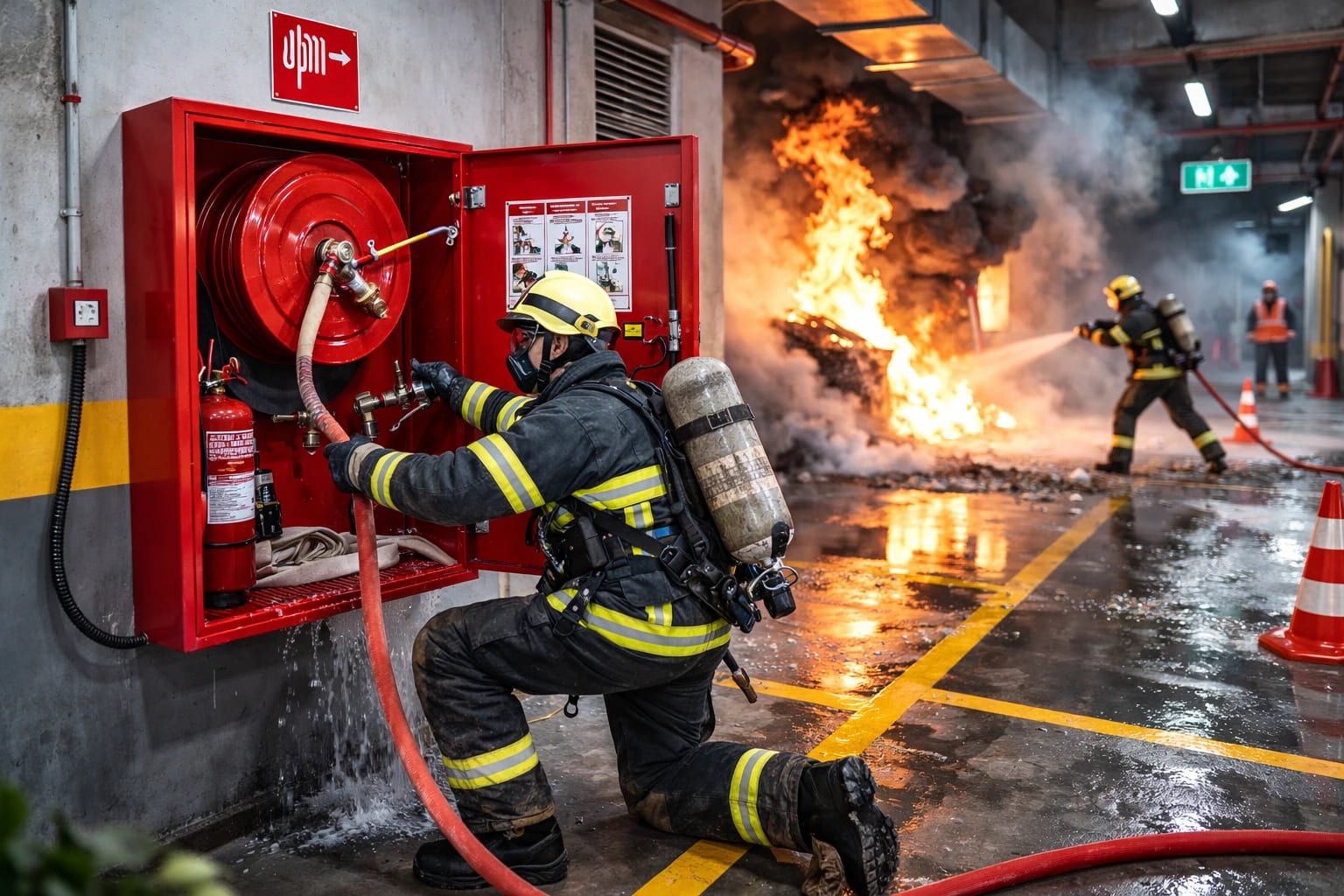
Fire cabinet and hydrant are the part of the system used by humans. This adds an entirely different dimension to its maintenance: it is not enough for the device to be robust; a person must be able to open and use it in a moment of panic is required. The most common non-compliance we find in the field is not faulty equipment, but a cabinet with its front blocked or locked.
We provide periodic inspection, pressure and flow measurement, hose testing, troubleshooting, and equipment replacement services for in-building fire cabinets, fixed piping installations, and external network hydrants.
What Is Checked During Fire Cabinet Maintenance?
Accessibility and usability
This is the heading that comes before technical checks, because any deficiency here renders everything else meaningless:
- No material blocking access in front of and around the cabinet
- The cabinet door opens easily; if locked, the key must be ready in a breakable glass box
- The cabinet is marked and visible from a distance
- Operating instructions are present on the cabinet in legible form
Hose, nozzle, and reel
- The hose must be fully extended and visually inspected — for fold marks, cracks, wear, and leaks at connection points
- The reel rotates freely and the hose can be deployed without binding
- The nozzle operates in open–closed–spray positions, blockage checked
- Fitting and seal condition, leak-free operation
- Periodic pressure testing of the hose and proper winding after testing
Hoses remaining wound at the same fold points for years is the most common silent form of damage. During maintenance, fully extending and pressurizing the hose is the only method that reveals this fatigue.
Valve and supply
- The cabinet valve opens and closes completely, no leakage from the palm rest
- Line pressure reading; must not exceed limits that a single user can safely handle
- Pressure and flow measurement at the most unfavorable point (most remote and highest cabinet)
Pressure is only insufficient if excessive also problematic: an overpressurized hose cannot be controlled by one person and the nozzle will slip from hand. For this reason, measurement is evaluated against both lower and upper limits.
What Is Checked During Hydrant System Maintenance?
- No parked vehicles, materials, or vegetation blocking access around the hydrant; fire apparatus must be able to approach
- Condition of body, cap, and fittings; blind caps in place
- Hydrant opened to supply water, pressure and flow measurement performed
- Drainage operation confirmed at underground hydrants — if water does not drain, freezing risk exists
- Position of body valve and any isolation valves on the line
- Hydrant outlet is marked and accessible without being buried under snow/mud
- Compatibility of fire water supply connection (siamese connection) fitting and accessibility
Winter preparation is a separate maintenance item for hydrants. Failure of residual water in the body to drain after water supply is the most common winter fault in underground hydrants and shows no external signs.
Fire Water Supply Connection
The connection that allows firefighters to pump water externally into the building's fixed piping is often overlooked in maintenance. Three things must be checked: the fitting must be physically compatible with the type used by firefighters, the connection inlet must be open and marked, and the check valve must be sound. An incompatible fitting is only discovered when firefighters arrive at the fire — which is the worst time to learn about it.
Why Should You Procure This Service from a Single Firm?
Fire safety is not a single system, but two interdependent engineering disciplines: mechanical side (pump unit, sprinkler, hydrant, fire cabinet, piping) and electronic side (detection, alarm, announcement, suppression triggering, control panels). Few firms in the market perform both sides together; most facilities obtain mechanical maintenance from one firm and electronic maintenance from another.
The problem starts here. What activates the system during a fire is not individual devices, but the connections between them: the flow switch will alert the panel, the panel will trigger the pump and damper, the announcement will sound before the gas system discharges, the elevator will descend to the evacuation floor. If there is a gap in responsibility between two firms in the middle of this chain, both firms may hand over their equipment as "working" while the system as a whole does not function. The most frequent fault we observe in the field is not a defective device, but an interface that no one ownsA zone monitoring module connects an entire conventional detector line to the addressable loop. Critical areas are renewed with addressable devices while secondary zones continue to operate with their existing wiring. This provides significant cost advantage in capacity upgrade and renovation projects.
As ASPEK Mühendislik, we are headquartered in Ankara and serve throughout Turkey. We conduct mechanical and electronic maintenance within the same team schedule; the installation, filling, and maintenance of sprinkler, hydrant, and fire pump units and FM-200 and Novec 1230 gas suppression systems fall within this scope — areas where finding a qualified technician is most difficult.
We structure our scope accordingly: from detection to gas suppression, from sprinkler and hydrant lines to fire pump units we provide end-to-end end to end in a building — single contract, single point of contact, single reporting format. For facilities that request it, we also add the periodic maintenance of camera (CCTV) systems to the same contract; when fire and security infrastructure is consolidated under one roof, there is no such thing as a "fault falling between two firms."
Legal Basis for This Maintenance
Regulation on Fire Protection of Buildings (BYKHY) maintenance of fire safety systems is defined not as an optional improvement, but as an obligation incumbent upon the building owner and administrator defines it as follows:
- Article 84 — Emergency lighting, signage, and fire detection and alarm systems shall be subject to periodic inspection, testing, and maintenance as required by the system specified in the applicable standards, under the responsibility of the building owner and administrator or the building official to whom they have delegated responsibilities in writing.
- Article 100 — Fire suppression systems shall be subject to periodic inspection, testing, and maintenance as required by the system specified in the applicable standards, under the responsibility of the building owner, administrator, or the building official to whom they have delegated responsibilities in writing is a requirementA zone monitoring module connects an entire conventional detector line to the addressable loop. Critical areas are renewed with addressable devices while secondary zones continue to operate with their existing wiring. This provides significant cost advantage in capacity upgrade and renovation projects.
The common aspect of both articles is this: the regulation does not prescribe the period itself, but refers it to the standard the system is subject to. In other words, maintenance frequency is set not by the regulation but by the standard the system was designed to (TS EN 12845 for sprinklers, the TS EN 54 series for detection, TS ISO 14520 for gas systems) and by the manufacturer's own manual. A specification that says "the regulation requires this frequency" is built on the wrong basis.
The Ministry's regulation guide explicitly requires retention of these records: information, documents, and records related to inspections, maintenance, and tests must be kept in a secure place by the building owner, administrator, or responsible party for submission to relevant authorities in any emergency. Maintenance being performed is not enough; it must be documented that it was performed.
Related Products and Guides
- Fire suppression products catalog
- Fire pump maintenance — the source feeding the cabinet and hydrant
- Sprinkler system maintenance
To Set Up Your Maintenance Program
One contract, a solution for everything: we provide end-to-end maintenance to fire detection, gas suppression, sprinkler, hydrant, and pump units in their entirety; if you wish, maintenance of camera (CCTV) systems can also be added to the same contract.
If you do not have the brand, age, and last maintenance record of the existing system on hand, that is not a problem; the first step is anyway inventory and current condition assessment. Setting up an annual program without seeing what is there in the field means selling maintenance for a system that does not exist.
You can examine your system brand's product equivalents in our product catalog ; for requirements specific to your facility's use class, you can visit our sectoral solutions pages.
For survey and quotation you can or send your plan through our write or directly You can call call the number. Survey is free within Ankara; for facilities throughout Turkey, the visit plan is established jointly before contract.
Frequently Asked Questions
What is done during periodic inspection of a fire cabinet?
Cabinet accessibility and marking, complete hose inspection with pressurization, nozzle and coupling control, valve operation testing, and pressure and flow rate measurement at the most unfavorable point. After inspection, the hose is properly rewound.
Can a fire cabinet be locked?
It can be locked to prevent misuse, but an arrangement that will not cause delay during a fire is mandatory: keeping the key in a breakable glass box next to the cabinet is common practice. A locked cabinet in a room is considered unusable.
When should hoses be replaced?
Based on inspection results, not calendar dates. Hoses that leak during pressure testing, show fatigue or cracks at fold points, have loose coupling connections, or have damaged inner lining are replaced. Hoses folded in the same spot for years are the highest risk group.
Why do hydrants stop working in winter?
After water is discharged from underground hydrants, the water remaining in the body must be emptied by drainage. If the drainage is clogged, the remaining water freezes and the hydrant cannot be opened. Since this condition shows no external signs, it can only be detected during periodic inspection.
Is there a problem if pressure in the fire cabinet is too high?
Yes. It becomes difficult for one person to control an overpressurized hose, the nozzle can slip from the hand and the user may be injured. Therefore, the measurement result is evaluated not only for adequacy but also for upper limits; if necessary, a pressure reducer is applied.
Who can perform fire cabinet and hydrant maintenance?
Hose and nozzle inspection, valve maintenance, line pressure measurement, and hydrant discharge control require mechanical field experience. ASPEK performs this maintenance with its own technical team; replacement of worn hoses and renewal of faulty valves are also resolved during the same visit. With our team based in Ankara, we provide service throughout Turkey.
Can the maintenance company also perform the periodic inspection?
Maintenance and deficiency correction including periodic pressure testing of hoses is handled in one place with us; TS EN 671-3 is the standard in practice. If your facility requires independent inspection, let us note: a Type A inspection body cannot remedy the deficiencies it finds due to impartiality requirements; we are both the testing party and the remedying party.
What document is provided after maintenance?
A maintenance report is prepared with an address-based list of cabinets and hydrants, line pressure, hose test results, and replaced parts; tested hoses are labeled. The report is used as a maintenance record in fire department inspections and insurance files.
What happens if I do not perform maintenance?
The most common scenario we see in the field: cabinet is opened, hose is deteriorated or nozzle is missing; external hydrant's discharge does not work, so its body froze and cracked in winter. This is the first response equipment during a fire; if it doesn't work, the critical minutes until the fire department arrives are wasted. BYKHY places the responsibility on the operator to keep this equipment ready.
Does the insurance company ask for fire cabinet and hydrant maintenance records?
In damage files, asking for maintenance records of first response equipment is common practice; we observe that experts throughout Turkey particularly examine hydrant line pressure records at industrial facilities. Policy terms vary, we do not make definitive statements; keeping records works in your favor in any case.