The fire detection system is the most neglected system in maintenance; because it fails silently when it breaks down. A blocked zone, a contaminated detector, or a depleted battery reduces the protection level without activating any indication. BYKHY Article 84mandates that these systems shall be subjected to periodic inspection, testing, and maintenance as required by the relevant standard, under the responsibility of the building owner and administrator.
We provide periodic inspection, functional testing, troubleshooting, and maintenance services for addressable and conventional fire detection and alarm systems. We are based in Ankara and serve throughout Turkey.
What Is Included in Maintenance?
Fire control panel
- Reading fault, disabled, and alarm records from event memory; investigating root cause of recurring faults
- Identification of disabled (isolate / disable) zones, devices, and outputs — this is the most critical item in maintenance
- Loop line resistance, display and keypad, printer and event logging function verification
- Communication verification with repeater panel and graphic software
Power supply and backup
- Testing switchover from mains supply to battery and under load load duration monitoring
- Battery voltage, internal resistance, and manufacturing date inspection; replacement of expired batteries
- Measurement of charge circuit and power source output values
Field devices
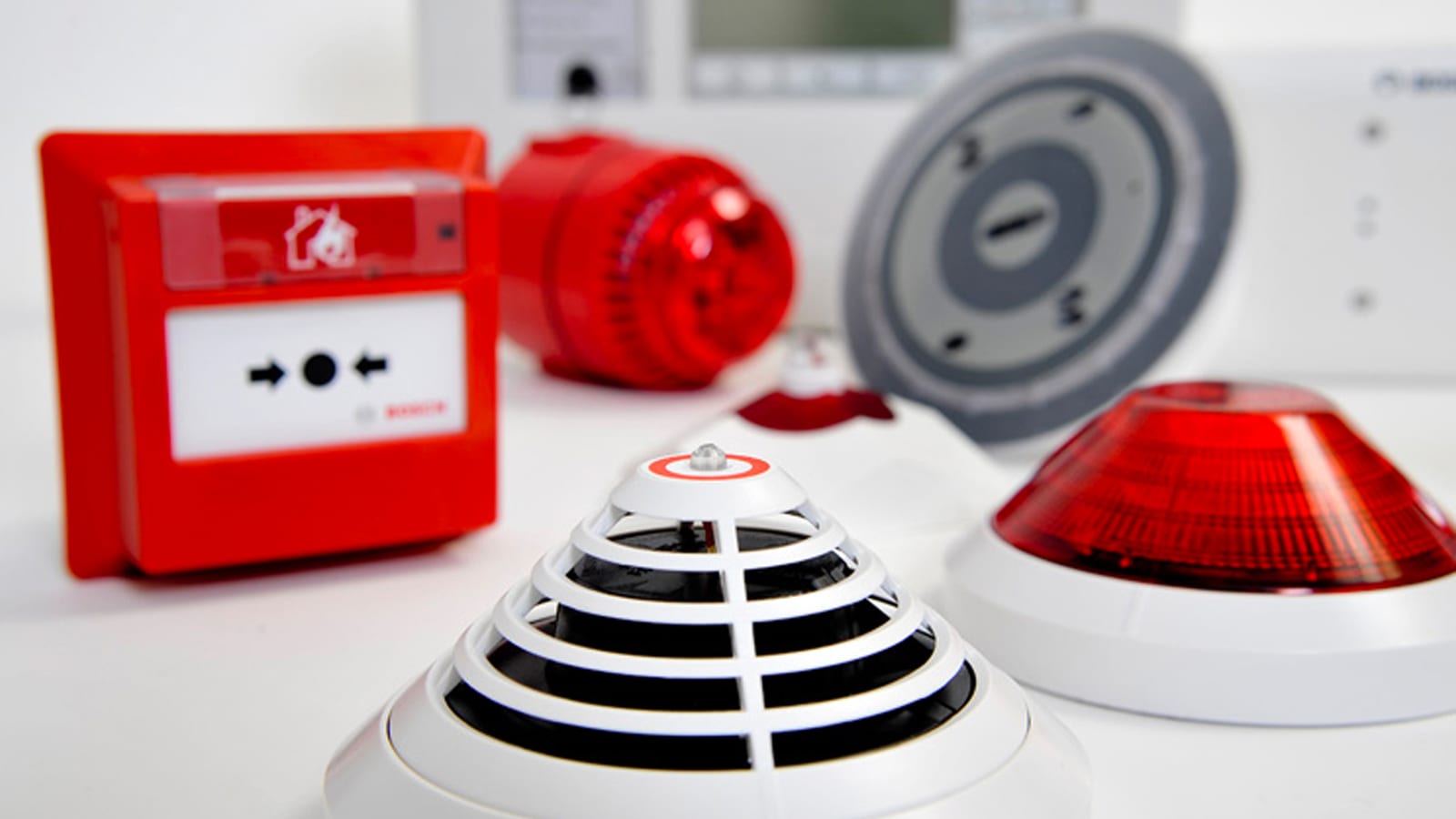
- Smoke detectors with appropriate test aerosol for actual trigger test, soiling/analog value reading, and chamber cleaning if required
- Heat detectors tested with thermal test equipment
- Fire alarm buttons operated with test key
- Beam detectors: alignment, dirt compensation, and obstruction verification
- Sounder and beacon audible/visual operation verification, on-site sound level sufficiency
- In addressable systems, devices appearing in panel with correct address and correct location name
Integration and action chain
This heading is most often omitted from maintenance specifications and is the most frequent source of field failures. Panel alarm generation alone is insufficient; every action that should be triggered by the alarm must be tested separately:
- Fire damper closure, smoke exhaust and pressurization fan activation
- Elevators descending to evacuation floor and opening doors
- Magnetic door holders release, turnstile and card access doors unlocked
- Voice evacuation / emergency announcement system activation and other broadcasts muted
- Trigger and feedback signals to gas suppression system
- Automatic notification to fire department or monitoring center
Maintenance Difference in Addressable and Conventional Systems
In addressable systems, each device communicates to the panel with its own identity; the panel can numerically report a detector's soiling level and display a faulty device by its address. This makes maintenance targeted: it is not guessed which detector needs cleaning, it is read.
In conventional systems, the panel only knows which zone something has occurred, not which device. For this reason, conventional system maintenance requires more field visits and physical testing of devices one by one is unavoidable. As the number of devices per zone increases, fault detection becomes disproportionately difficult.
Reducing False Alarms Is Part of Maintenance
False alarm is not a comfort issue, it is a security issue: recurring false alarms first undermine personnel confidence in the system, then disable the system itself. In maintenance we do not stop at testing the device alone but look at the source of the false alarm — optical detectors positioned near kitchen and parking exhaust, incorrect detector type placed in areas with steam and dust, moisture-prone ceiling voids, insect entry, and electrical noise in the power line are the most common causes we encounter. The solution is often not to replace the device, but to place the correct type in the correct locationA zone monitoring module connects an entire conventional detector line to the addressable loop. Critical areas are renewed with addressable devices while secondary zones continue to operate with their existing wiring. This provides significant cost advantage in capacity upgrade and renovation projects.
What source determines maintenance frequency?
The Regulation on Fire Protection of Buildings (Art. 84 and 100) mandates maintenance and periodic inspection makes it mandatory; ancak sıklığı kendisi yazmaz, ilgili standarda ve üretici talimatına havale eder. Yani "kaç ayda bir" sorusunun cevabı yönetmelikte değil, sistemin kendi standardında ve üreticinin bakım kitabındadır. Ankara merkezli ekibimiz Türkiye genelinde bakımını üstlendiği her sistemde takvimi bu kaynaklara göre kurar. Tablo, sahada en çok sorulan sistemler için kaynağı ve uygulamadaki karşılığını gösterir.
| System | Source determining frequency | What the source specifies | Service contract in practice |
|---|---|---|---|
| Fire detection and alarm | TS CEN/TS 54-14 + manufacturer maintenance manual | Defines a tiered maintenance calendar ranging from daily to annual (daily, weekly, monthly, quarterly, annual); the content of each tier is specified in the standard. | Daily and weekly inspections typically remain with facility personnel; service contracts are established as monthly–quarterly for critical facilities, and quarterly–annual for many buildings. |
| Sprinkler and fire pump | TS EN 12845 + NFPA 25 | Weekly pump run test comes from these standards; testing and maintenance are defined as a tiered program. | Weekly operation is performed and recorded by operations at most facilities; comprehensive pump maintenance contracts are established as semi-annual–annual, more frequently for critical facilities. |
| Gas suppression (FM-200, Novec, CO2, inert gas) | TS ISO 14520 + manufacturer's maintenance manual | Requires weighing and pressure checks on cylinders; 6-month/annual intervals determined by manufacturer manual. | At least one comprehensive annual inspection is common; for facilities with zero-downtime tolerance such as data centers, semi-annual intervals are structured. |
| Hood suppression system | NFPA 96 / NFPA 17A + manufacturer | Frequency depends on kitchen usage intensity; inspection and cleaning intervals shorten with heavy use. | Semi-annual contracts are common for hotel and restaurant kitchens; more frequent intervals are established for 24-hour operation kitchens. |
| Portable extinguisher (fire cylinder) | TS ISO 11602-2 framework + manufacturer | Defines periodic inspection, maintenance, and test tiers; refill and test intervals are determined by this framework and manufacturer instructions. | Annual general maintenance contracts are common; interim visual inspections remain with facility personnel. |
| Emergency lighting and signage | TS EN 50172 | Defines periodic functional tests and full-duration (battery autonomy) tests. | Functional tests are structured at short intervals, full-duration test annually; at most facilities combined with annual maintenance contracts. |
In practice, frequency is tied to the contract with the facility. For high-occupancy and critical facilities such as hospitals, data centers, shopping malls, contracts are structured monthly, quarterly, or 4-monthly; for many commercial buildings, semi-annual or annual is sufficient. Three factors determine this: facility risk class, device count, and inspection regime (insurance, fire department, corporate audit). Let us also state clearly: Type A inspection body cannot remedy deficiencies it finds due to impartiality requirements; ASPEK performs both maintenance and remedies deficiencies. To establish your schedule together for your facility throughout Turkey from our Ankara center, contact usA zone monitoring module connects an entire conventional detector line to the addressable loop. Critical areas are renewed with addressable devices while secondary zones continue to operate with their existing wiring. This provides significant cost advantage in capacity upgrade and renovation projects.
Brand-Specific Panel Service
We have explained maintenance and fault approach specific to your panel brand on separate pages: Blue Maxlogichistoric buildings Teletekhistoric buildings GSThistoric buildings Siemenshistoric buildings Honeywell/Notifierhistoric buildings Bosch and Cooper. For how to read product standards, see our our EN 54 guide .
Why Should You Procure This Service from a Single Firm?
Fire safety is not a single system, but two interdependent engineering disciplines: mechanical side (pump unit, sprinkler, hydrant, fire cabinet, piping) and electronic side (detection, alarm, announcement, suppression triggering, control panels). Few firms in the market perform both sides together; most facilities obtain mechanical maintenance from one firm and electronic maintenance from another.
The problem starts here. What activates the system during a fire is not individual devices, but the connections between them: the flow switch will alert the panel, the panel will trigger the pump and damper, the announcement will sound before the gas system discharges, the elevator will descend to the evacuation floor. If there is a gap in responsibility between two firms in the middle of this chain, both firms may hand over their equipment as "working" while the system as a whole does not function. The most frequent fault we observe in the field is not a defective device, but an interface that no one ownsA zone monitoring module connects an entire conventional detector line to the addressable loop. Critical areas are renewed with addressable devices while secondary zones continue to operate with their existing wiring. This provides significant cost advantage in capacity upgrade and renovation projects.
As ASPEK Mühendislik, we are headquartered in Ankara and serve throughout Turkey. We conduct mechanical and electronic maintenance within the same team schedule; the installation, filling, and maintenance of sprinkler, hydrant, and fire pump units and FM-200 and Novec 1230 gas suppression systems fall within this scope — areas where finding a qualified technician is most difficult.
We structure our scope accordingly: from detection to gas suppression, from sprinkler and hydrant lines to fire pump units we provide end-to-end end to end in a building — single contract, single point of contact, single reporting format. For facilities that request it, we also add the periodic maintenance of camera (CCTV) systems to the same contract; when fire and security infrastructure is consolidated under one roof, there is no such thing as a "fault falling between two firms."
Legal Basis for This Maintenance
Regulation on Fire Protection of Buildings (BYKHY) maintenance of fire safety systems is defined not as an optional improvement, but as an obligation incumbent upon the building owner and administrator defines it as follows:
- Article 84 — Emergency lighting, signage, and fire detection and alarm systems shall be subject to periodic inspection, testing, and maintenance as required by the system specified in the applicable standards, under the responsibility of the building owner and administrator or the building official to whom they have delegated responsibilities in writing.
- Article 100 — Fire suppression systems shall be subject to periodic inspection, testing, and maintenance as required by the system specified in the applicable standards, under the responsibility of the building owner, administrator, or the building official to whom they have delegated responsibilities in writing is a requirementA zone monitoring module connects an entire conventional detector line to the addressable loop. Critical areas are renewed with addressable devices while secondary zones continue to operate with their existing wiring. This provides significant cost advantage in capacity upgrade and renovation projects.
The common aspect of both articles is this: the regulation does not prescribe the period itself, but refers it to the standard the system is subject to. In other words, maintenance frequency is set not by the regulation but by the standard the system was designed to (TS EN 12845 for sprinklers, the TS EN 54 series for detection, TS ISO 14520 for gas systems) and by the manufacturer's own manual. A specification that says "the regulation requires this frequency" is built on the wrong basis.
The Ministry's regulation guide explicitly requires retention of these records: information, documents, and records related to inspections, maintenance, and tests must be kept in a secure place by the building owner, administrator, or responsible party for submission to relevant authorities in any emergency. Maintenance being performed is not enough; it must be documented that it was performed.
Related Products and Guides
- Fire detection products catalog
- Smoke detectors · fire alarm panels
- Fire detection systems guide — how the system works
- Aspirating systems (ASD) — filter, air flow, and transit time measurement
- Beam-type detectors — alignment signal and test filter trial
- Detection in industrial facilities — technology by process area
To Set Up Your Maintenance Program
One contract, a solution for everything: we provide end-to-end maintenance to fire detection, gas suppression, sprinkler, hydrant, and pump units in their entirety; if you wish, maintenance of camera (CCTV) systems can also be added to the same contract.
If you do not have the brand, age, and last maintenance record of the existing system on hand, that is not a problem; the first step is anyway inventory and current condition assessment. Setting up an annual program without seeing what is there in the field means selling maintenance for a system that does not exist.
You can examine your system brand's product equivalents in our product catalog ; for requirements specific to your facility's use class, you can visit our sectoral solutions pages.
For survey and quotation you can or send your plan through our write or directly You can call call the number. Survey is free within Ankara; for facilities throughout Turkey, the visit plan is established jointly before contract.
Frequently Asked Questions
Is fire detection system maintenance mandatory?
Yes. BYKHY Article 84 stipulates that emergency lighting, emergency exit signs, and fire detection and alarm systems shall be subject to periodic inspection, testing, and maintenance as specified in relevant standards, under the responsibility of the building owner and manager, or the building authority to whom responsibility has been written transferred.
Are all detectors tested at every maintenance visit?
It depends on the scope of the maintenance program. Correct practice is to test all devices sequentially within a defined period and document which devices were tested at each visit. Reports stating "sampling was performed" without specifying which devices were tested are useless during inspections.
What is the service life of detectors, and when should they be replaced?
The exact duration varies depending on the manufacturer and device type; the manufacturer's own instructions are decisive. In addressable systems, the device's analog contamination value is the most reliable indicator of replacement timing, independent of calendar time; even if a device approaching the threshold is cleaned, it will issue a warning again shortly.
Is disabling the zone that generates false alarms a solution?
No, it is the most dangerous practice. When a zone is disabled, the detection that the regulation requires in that area is effectively eliminated and this situation usually becomes permanent. The correct approach is to find the cause of the false alarm; if necessary, change the detector type or location.
What items should be included in the maintenance specification?
Panel event log review, reporting of disabled zones, battery testing with mains supply cut off, on-site device testing with actual activation, and integration chain testing (damper, fan, elevator, public address system, gaseous suppression) must be included. Integration testing is the most frequently omitted item in specifications.
Who can perform fire detection system maintenance?
A technical team proficient in panel programming, loop structure, and detector types is required; not every electrician who opens an electrical panel can do this work. At ASPEK, maintenance is carried out by our own technical staff working on low-voltage and detection systems; detector smoke testing, button testing, panel fault log reading, and battery measurement are completed in the same visit. Our team based in Ankara conducts on-site work throughout Turkey.
Can the maintenance company also perform the periodic inspection?
For us, maintenance and rectification of identified deficiencies are handled in-house. If your facility additionally requires an independent periodic inspection report, you should know this: a Type A inspection body cannot rectify deficiencies it finds due to impartiality requirements; it only reports. We both perform maintenance and close the gaps identified in the inspection report; we are accustomed to coordinated work with inspection bodies.
What document is provided at the end of maintenance, and is it submitted to the fire department or inspection authorities?
A signed maintenance report is prepared with a list of tested detectors and buttons, the panel's fault/alarm records, and the work performed. This report is used during fire department inspections, occupational safety inspections, and in insurance files as a maintenance record. For multi-branch companies, we provide reporting in the same format for all facilities throughout Turkey.
What happens if I do not perform maintenance?
According to BYKHY, keeping the system operational is the responsibility of the building owner and manager. The most common scenario we see in the field is: a contaminated detector first generates false alarms, personnel become accustomed to silencing the panel, and during a real fire, no one believes the alarm. Following damage, the insurance process requests maintenance records; if there are no records, compensation disputes begin.
Does the insurance company request maintenance records for the detection system?
It is common practice for the expert to request maintenance and test records when a damage file is opened. Scope and conditions vary depending on the policy, so we do not make definitive statements; however, we consistently see that the process proceeds faster in facilities with dated and signed regular maintenance reports.