
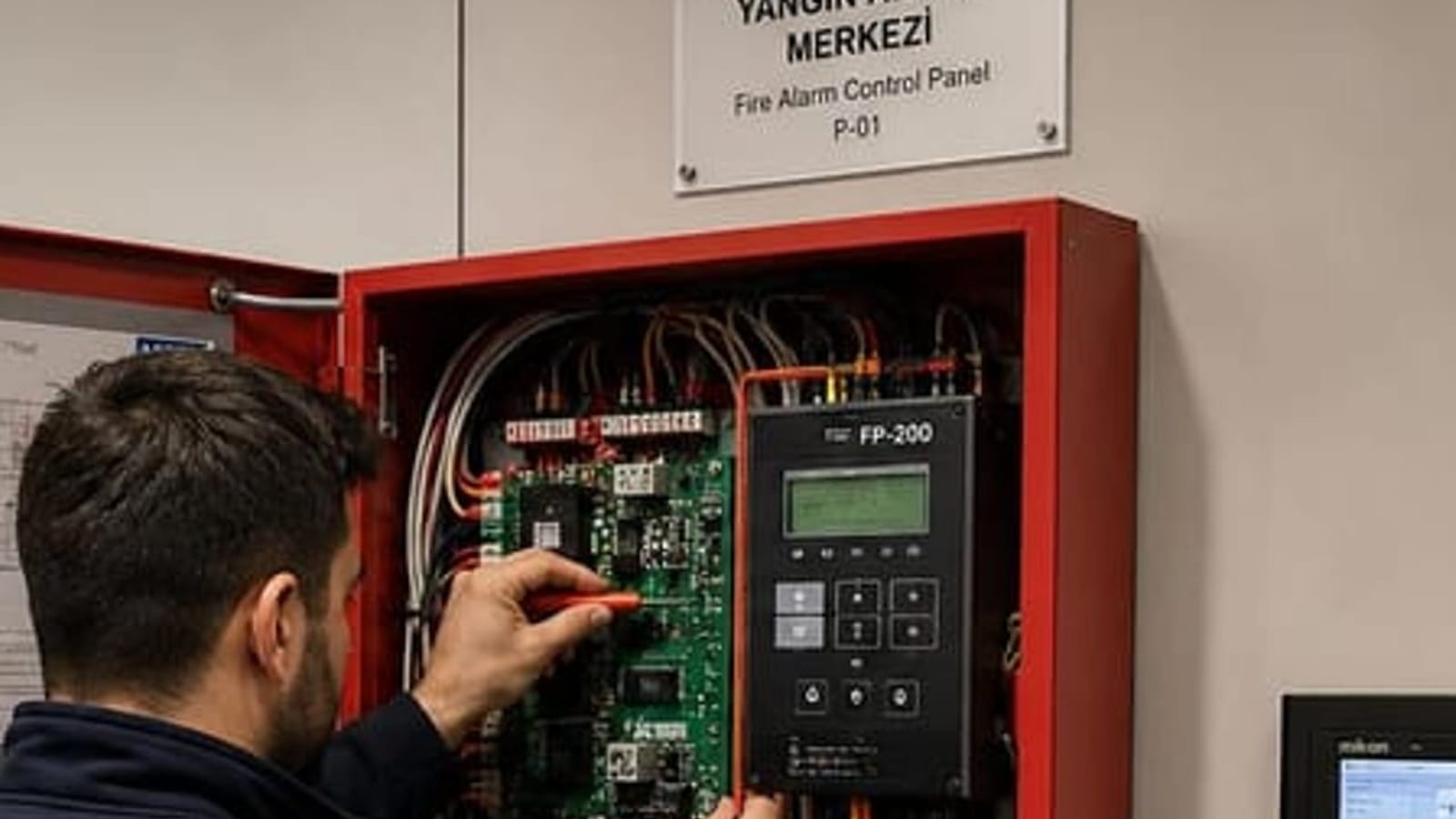
Cabinet suppression system, at the facility the only fire equipment that no one ever opens to check: behind a locked cabinet door it waits for years on its own. Yet the cylinder silently loses weight, the detection hose gets crushed under cables pulled later, the aerosol generator's service life expires. Maintenance addresses each of the three technologies with its own checklist and demonstrates that the system is still in dischargeable condition by measuring it.
Distribution and compensation panel, MCC, driver and PLC cabinet, UPS cabinet or server rack installed in-panel (micro) suppression systems we perform periodic maintenance, weighing, detection hose inspection and post-discharge recommissioning.
Installed and Forgotten System
In-panel suppression no warning escapes to the outside: it is behind a locked cover and the electrician opens that cover only when there is a fault, and then looks at the tripping switch, not the suppression. The most common scenario we see is this: the cylinder weight has dropped, the detection hose has been crushed under a cable bundle pulled in later, the generator's service life has expired, new equipment and a cooling fan have been added to the panel. None of them alarm; all of them can only when the panel cover is opened be seen.
Three Technologies, Three Separate Maintenances
The maintenance list changes from the start according to the installed technology; operational differences in-panel suppression systems page.
Condensed aerosol generator
The generator has no pressurized vessel; the suppressant is produced at discharge by the reaction of the solid compound. In this product weighing and manometer reading are not performed; the subject is body, initiator and service life:
- Corrosion, impact and deformation in the body; mounting bracket integrity
- Discharge direction and safety (standoff) distance — discharge is hot; no cable bundle or plastic conduit should have entered in front of the generator afterwards
- Initiator inspection: integrity of thermal cord or heat-sensitive bulb line, circuit continuity in electric igniter. Igniter circuit cannot be measured with an ordinary multimeter; measurement current may trigger the igniter
- Manufacturing date on the label and declared service life; expired generator is not refilled, it is replaced
Novec 1230 (FK-5-1-12) and FM-200 (HFC-227ea) micro cylinders
Micro cylinder is a miniaturized version of large gaseous system; its thresholds are the same. TS ISO 14520-1 tank contents must be checked at least every 6 months; in halogenated hydrocarbons exceeding 5% or temperature-corrected exceeding 10% pressure loss if found the cylinder is refilled or replaced. In maintenance the cylinder is weighed, manometer is read temperature-corrected; valve, actuator, safety pin, bracket and last hydrostatic test date are inspected. Manometer being in green does not show the cylinder is full: the suppressant is in liquid phase, even if there is a leak the propellant nitrogen pressure appears normal for a long time. Refilling is a separate process, its scope gaseous suppression filling and maintenance page.
Detection hose (direct and indirect systems)
In these systems there is no electronic detector and panel; detection is performed by pressurized polymer hose installed inside the panel. The hose ruptures at the temperature declared by the manufacturer (typically around 100 °C), pressure drops and the system discharges. In direct system the ruptured point is also the nozzle; in indirect system the hose only detects, discharge is done from separate pipe and nozzle.
- Line-end pressure being within manufacturer's range and no decrease according to previous maintenance record — silent leakage is caught only by record comparison
- Physical damage: rubbing on sharp sheet metal edge, point strangled by cable tie, crushing, turns below bend radius
- Thermal contact: hose resting on heated busbar or terminal — ruptures early there, system discharges without fire
- Route covering the protected volume; in indirect system nozzle direction and mouth opening
Pressure switch in most facilities is found unconnected. Yet by itself it performs three functions: gives warning, stops panel cooling fan, if necessary stops the machine it feeds. If the fan continues to run the discharged agent is swept out of the panel.
Control Items and Period Basis
The source of the obligation and the source of the frequency are not the same document. BYKHY Article 100 requires maintenance; does not write the period itself, defers to the standard to which the system is subject. The reason for the contradiction in circulating "every 3 months", "once a year" phrases is this.
| Technology | The actual control item | Period basis |
|---|---|---|
| Condensed aerosol generator | Body and mounting, initiator circuit, safety distance, service life label; no refilling, replacement at end of life | TS EN 15276 / NFPA 2010 inspection and manufacturer's service life declaration |
| Novec 1230 (FK-5-1-12) and FM-200 (HFC-227ea) micro cylinder | Weighing, temperature-corrected pressure, valve and actuator, hydrostatic test date, refill schedule | TS ISO 14520 / NFPA 2001 — contents check at least every 6 months; 5% weight, 10% pressure threshold |
| Detection hose (direct / indirect) | Line-end pressure and record comparison, physical damage, thermal contact, route, pressure switch | Agent standard and manufacturer's maintenance manual; if panel changes period is not waited |
What Changed Inside the Panel?
System is sized to the volume on the day it was installed; the panel, however, is the most frequently modified location in the facility. At each maintenance, the titles we compare with commissioning data are:
- New equipment and volume: equipment installed later changes both the protected volume and heat load; if the panel is expanded or partition added single hose or single generator will not protect the new partition
- Openings and sealing: new cable passage, removed blank plate, missing gasket. In direct systems total opening must remain below the manufacturer's design limit (common practice order of 0.1 m²)
- Ventilation: panel fan installed for heating if not connected to pressure switch leaves system inoperative
Post-Discharge Recommissioning
- Cutting power and making the panel safe, ventilating the space
- Determining the cause: actual fire or unintended discharge from hose damage or thermal contact
- If fire occurred damage assessment; soot cleaning, replacement of damaged cables and terminals
- If aerosol discharged cleanup of residue without delay — potassium salt-based residue carries corrosion risk with moisture; in clean gas this problem does not exist
- Insulation resistance measurement and connection check before power is applied
- Cylinder refill or generator replacement, renewal of hose and line-end equipment, system pressurization and seal verification
- Pressure switch test, placing to automatic mode, report and labeling
Refilling done without finding the cause will repeat the same event.
Maintenance Record, Program and Cost
Maintenance being performed is not enough, it must be documented. At each visit panel-based control checklist, weighing and pressure values, replaced parts and next check date are entered in the report, maintenance label is affixed to the system; to establish your own level periodic control forms can be downloaded. Cost-determining items are panel number and technology, cylinder kilogram value, refill and hydrostatic test time, generator service life status, hose and nozzle replacement need and facility location; details maintenance prices page.
We are based in Ankara; Survey is free within Ankara. Planned regional tours are established nationwide; remote pre-diagnosis is made with label and panel photographs and visits are made with necessary spare parts. From detection to gaseous suppression the entirety of the facility's fire systems are combined in one contract; camera (CCTV) maintenance is also added if requested.
To Set Up Your Maintenance Program
One contract, a solution for everything: we provide end-to-end maintenance to fire detection, gas suppression, sprinkler, hydrant, and pump units in their entirety; if you wish, maintenance of camera (CCTV) systems can also be added to the same contract.
If you do not have the brand, age, and last maintenance record of the existing system on hand, that is not a problem; the first step is anyway inventory and current condition assessment. Setting up an annual program without seeing what is there in the field means selling maintenance for a system that does not exist.
You can examine your system brand's product equivalents in our product catalog ; for requirements specific to your facility's use class, you can visit our sectoral solutions pages.
For a survey and quotation, write to us via our contact page or call +90 312 385 15 66 directly. Survey is free within Ankara; for facilities throughout Turkey, the visit plan is established jointly before contract.
Frequently Asked Questions
How frequently does a cabinet interior extinguishing system require maintenance?
BYKHY Article 100 mandates maintenance but does not specify the interval, deferring to the applicable standard for the system. For Novec 1230 and FM-200 micro cartridges, TS ISO 14520 / NFPA 2001 content verification is required at minimum every 6 months; for condensed aerosol, the interval is determined by TS EN 15276 / NFPA 2010 inspection and the manufacturer's declared service life; for detection-hose systems, it is determined by the applicable agent standard and the manufacturer's maintenance manual. Upon modification of the cabinet, the next scheduled interval is not deferred.
Can the aerosol generator be refilled, and what is done when its service life expires?
No, it cannot be refilled. The generator contains no pressurized vessel; the extinguishing agent is generated upon discharge through reaction of solid components, therefore weighing and manometer readings are not performed. During maintenance, the housing, mounting bracket, discharge direction, safety distance, and trigger line are inspected; when the service life on the label expires, the generator is replaced entirely.
The cartridge manometer reads green; is weighing still necessary?
Yes, it is. The agent remains in liquid form within the cartridge; nitrogen serves only as the propellant. Consequently, even if some agent is lost, the manometer may remain in the green range for an extended period—the scale is the only reliable indicator of loss. For TS ISO 14520 halocarbon gases, if weight loss exceeds 5% or the pressure loss adjusted for temperature exceeds 10%, cartridge refilling or replacement is required; weighing is the only reliable method to detect this loss.
Must the cabinet be de-energized for maintenance?
The system itself requires no external power to operate; however, maintenance is performed with the cabinet cover open. Visual inspection, discharge-line pressure reading, and label verification can be performed without stopping operations; cartridge weighing, hose routing correction, and cartridge or generator replacement require a brief maintenance window. We establish the schedule together according to your facility's shift arrangement.
The system has discharged; can the cabinet be restarted?
The procedure is defined: power is cut and the cabinet isolated to safety, the space is ventilated, the cause of discharge (actual fire, hose damage, or unintended discharge from thermal contact) is determined. If aerosol discharged, potassium-salt-based residue must be cleaned immediately; clean gas poses no residue issue. Before power is restored, insulation resistance is measured, the cartridge is refilled or generator replaced, hose and discharge-line equipment are renewed, and the system is placed in automatic mode by protocol. Refilling is not performed until the cause is identified.
We installed new equipment in the cabinet; is the system still adequate?
An assessment is required. The system was sized for the volume, openings, and layout as of its installation date. Subsequently installed switching equipment changes the volume and heat load; if the cabinet is enlarged or a partition added, a single hose or single generator will not protect the new compartment; newly opened cable entries compromise the seal; if a cooling fan installed thereafter is not connected to the pressure switch, it will purge discharged agent from the cabinet. In such cases, reassessment is performed without awaiting the next scheduled interval.
Do news about Novec 1230 production affect our refilling?
"Novec 1230" is a commercial trademark; the agent itself within the system is FK-5-1-12 and is supplied by other manufacturers independently of the brand line. Dismantling the existing system is not necessary. It is correct practice to specify the agent code (FK-5-1-12 or HFC-227ea) rather than the brand name in the specification and contract, and to explicitly ask the supplier about continuity of refilling and spare parts; we address this matter from the outset when establishing the maintenance program.