When a fire system fails, what matters is not tomorrow but today: a faulty panel cannot report fire, a pump that does not start means no water during fire, a discharged gas leaves the area unprotected. This page explains the eleven most frequently encountered field service calls in symptom → probable cause → action format — but reading is no substitute for calling; call us, let us look at it together over the phone.
We provide fault detection and remediation service throughout the complete fire safety infrastructure in a building — from fire detection panels to pump groups, from gaseous suppression to hood systems. Our headquarters is in Ankara; our response area covers all of Turkey. To report a fault, you can call directly +90 312 385 15 66 or write to us via our contact page — the list below is not meant to replace a phone conversation, but to align the language we will speak on the call.
Before Calling: Three Photographs
Remote preliminary assessment is not a screening, it is a speed tool. If you send these three, diagnosis narrows within minutes:
- A photograph of the panel screen — showing the error message, device address, and time,
- The last page of the event log — how many times which event repeated is half the diagnosis,
- An indicator in the field — a photograph of the pump panel, pressure gauge, cylinder label, or broken part.
Many faults are solved over the phone with these three photographs: we guide the building's technical staff step by step. If on-site intervention is needed, the team departs with the correct spare part — in jobs outside the city, the most expensive line item is the second visit, and the entire purpose of preliminary assessment is to eliminate it.
Symptom Table
Find your symptom in the table; the detail of each row is explained below in the same sequence.
| Symptom | Initial suspicion | If you wait, what happens? |
|---|---|---|
| Yellow fault light on the panel | Battery, ground fault, missing device, circuit | That zone remains unprotected; a second fault can bring down the system |
| Panel continuously buzzing | Intermittent (repeating) fault | Staff becomes desensitized to the panel, a real alarm is missed |
| Battery fault | Battery end-of-life, charging circuit | At the first power outage, the panel goes completely silent |
| Ground fault | Water-logged junction box, crushed cable | A second ground contact silently disables devices |
| Detector giving false alarm | Contamination, vapor/dust, wrong detector type | Detector is disabled, the space remains unprotected for years |
| Jockey pump cycling frequently | Even a small leak, tank air cushion, check valve | Jockey motor wears out, leak grows |
| Main pump not starting on automatic | Panel left in manual mode, pressure switch | In a fire, water doesn't reach the sprinklers |
| Diesel pump fails to start | Battery group, rectifier, fuel | In a power-outage fire, the last backup is also disabled |
| Line pressure dropping | Leak, freeze crack, check valve | Leak grows; in winter, freeze line bursts |
| FM-200 / Novec discharged | Real detection or false trigger | Space operates unprotected until refill is complete |
| Hood system discharged | Fire or broken fusible link | Kitchen stays closed; cooking without system is gambling |
Panel and Detection Faults
Fault / error light on panel is lit
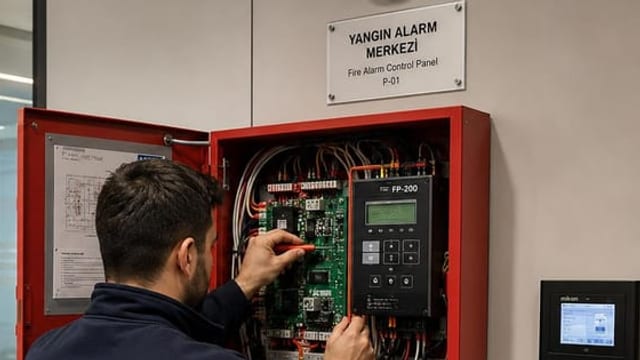
Probable cause: The yellow indicator is not a single fault, it is a family's door: battery and supply problems, ground faults, missing devices, circuit breaks, waste fuses. What it is, the message on the screen tells you. A red indicator is not a fault it is an alarm — the space is checked first.
First steps in the field: Read and photograph the message; do not press reset. Reset clears the event state but not the cause — the fault returns, and meanwhile the trace of the event is lost.
ASPEK response: Remote preliminary diagnosis via message and device address, then on-site measurement of circuit, supply, and device. If you use a Maxlogic blue central unit, you can read what the message means right away from on the Maxlogic faults and error messages page.
Panel continuously buzzes, cannot be silenced
Probable cause: The silence button silences the current event; the panel buzzes again when a new event arrives. A panel that cannot be silenced is most often a sign of an intermittent fault: loose terminal, water-logged junction box, a battery at the edge — event drops, comes back, buzzer restarts each time.
First steps in the field: Open the event log and note which event is repeating. Disconnecting the buzzer cable or shutting down the panel is not a solution; the most dangerous "solution" we see in the field is this — the panel goes silent but the building becomes deaf too.
ASPEK response: We trace the root cause of the repeating event: rather than just tightening a terminal and moving on, we measure the line; if humidity is the source, we replace the junction box and correct the routing. A one-time silence and leave works for us too; getting the same call three weeks later does not.
Battery fault
Probable cause: Batteries past end-of-life, faulty charging circuit, loose or oxidized terminal posts. Sometimes the real problem is not the battery: the panel's mains fuse has blown, the panel has been running silently on battery for days, and the battery is nearly depleted.
First steps in the field: Check the panel's mains supply (fuse); note if there has been a recent power outage or panel maintenance work.
ASPEK response: Batteries under load are tested — voltage measured with mains power does not reveal a dead battery. Charging circuit output is measured; if replacement is needed, in most cases it is completed in the same visit with a battery of the correct capacity for the panel.
Ground fault
Probable cause: A point in the wiring is in contact with ground: water-logged junction box, crushed or abraded wire, humidity-soaked external button. A ground fault that comes with rain and disappears when it dries almost always means water.
First steps in the field: Note if there has been renovation, water leak, or roof work in recent weeks, and what weather conditions were present when the fault appeared — these two pieces of information cut the search area in half.
ASPEK response: Circuits are separated in sequence to narrow the fault to the line, the line is subdivided to locate the point. A single ground contact generally does not stop the system; the danger is that when a second contact forms, part of the circuit silently drops out. For this reason, it is not a fault to be put off with "it's working anyway."
Detector giving false (baseless) alarm
Probable cause: Contaminated optical chamber; steam, dust, or exhaust in the space; detector type not matched to the space; air conditioning discharge hitting the detector directly.
First steps in the field: From the event log, identify which address is repeating. Disabling a detector is a last resort; if it is done, it must be recorded with date, reason, and responsible party, and must be restored when the work is complete — the most frequent danger we see in the field is a detector disabled years ago and forgotten.
ASPEK response: Contamination survey is performed, the device is cleaned or replaced; if the problem is type mismatch, an appropriate device for the space is recommended — for example, a heat detector instead of an optical smoke detector in a steamy space. For device options, see our fire detection catalog . The real cost of a false alarm is not erroneous evacuation, but staff desensitization to alarms.
Pump and Line Faults
Jockey pump cycling on and off continuously
Probable cause: The jockey's job is to compensate for minor pressure drops in the line; if it is cycling frequently, pressure is dropping frequently: a small leak in the line (weeping valve, leaking fitting, packing gland leak), a check valve that leaks back, an air cushion tank with depleted precharge, or a narrowed pressure switch differential.
First steps in the field: Time how often it cycles — this number is half the diagnosis. Check whether water is flowing from drain and test lines.
ASPEK response: Using zone valves, the line is sectioned to narrow the leak; check valve, tank precharge, and switch settings are measured. The cost of waiting is twofold: the jockey motor burns out its life, and when the leak grows, this time the main pump starts cycling. For the complete control checklist of the pump group, see fire pump maintenance page.
Main pump not starting on automatic
Probable cause: The most frequent cause we see in the field is embarrassingly simple: the panel selector switch was left in manual positionafter maintenance or testing. After that come pressure switch fault or drift, blocked pressure sensing line, contactor and phase problems.
First steps in the field: Check and photograph the position of the selector switch on the pump panel, note the fault lights. If the switch is not on automatic, proceed knowing that the system will not run automatically in a fire.
ASPEK response: Pressure switch settings are actually tested, the sensing line is purged, panel relays and contactors are repaired; the work is handed over by demonstrating that the pump starts automatically with a pressure drop. This is the fault on this list with the least tolerance for delay — a system that does not send water to sprinklers in a fire has nothing else that matters.
Diesel pump fails to start
Probable cause: Weakened battery groups or faulty charging rectifier, exhausted or stale fuel, starter motor fault, panel locked in fault mode. The diesel pump is the last backup to run if power is lost during a fire; at facilities where the weekly run test prescribed by TS EN 12845 is not performed, this call inevitably comes.
First steps in the field: Check battery voltage display and fuel level, photograph warning lights on the panel. Do not force the battery with a vehicle jump-start cable; external intervention on the panel can damage control electronics.
ASPEK response: Both battery groups are tested separately under load, rectifier outputs are measured, air is bled from the fuel line, and if needed, the battery group is replaced. Before handover, the pump is started both on automatic and manual.
Line pressure dropping
Probable cause: An actual leak (leaking fitting, freeze crack, test or drain valve left open), backflow through a check valve, or a leak of a size the jockey cannot handle.
First steps in the field: Note how quickly pressure is dropping, look for visible moisture and traces, confirm the position of zone valves. In winter, suspect unheated spaces — attic, parking ramp, external hydrant line.
ASPEK response: The line is isolated zone by zone to narrow the leak, the located point is repaired, and the system is handed over with a pressure-hold test. For the complete control checklist of the entire sprinkler network, see sprinkler maintenance page.
Gaseous Suppression and Hood Systems
FM-200 / Novec gas discharged — including unintended discharge
Probable cause: Either the system saw a real fire or was falsely triggered: renovation dust or cigarette smoke reaching two detectors in the cross-zoned area simultaneously, trigger circuit fault, mechanical impact to the cylinder.
First steps in the field: Ventilate the space and stop unnecessary entry. Do not erase the panel's event log, do not press reset — that log will tell the true cause of the discharge. The space is unprotected until refill is complete; if it is a server room, take temporary measures: additional portable extinguisher, stop hot work.
ASPEK response: First, the cause of the discharge is found — refilling without addressing the cause is the most guaranteed way to pay the same bill twice. After that, everything runs single-sourced: we remove the cylinders, have the refill done at a refill facility with a Refill Competency Certificate — no company refills gaseous system cylinders in its own workshop, and if anyone says they do, ask for their certificate — on return, installation, activation, and delivery of documents are our responsibility. For details, see see the cylinder filling and hydrostatic test and gaseous suppression system maintenance pages.
Hood system discharged, kitchen closed
Probable cause: Either there was a real flare-up on the cooktop, or the fusible link element broke on its own — oil buildup and continuous heat age this part; a fire is not needed for it to break.
First steps in the field: When the system discharged, it also cut the cooktop gas line; do not force the valve and return to cooking without protection — in a second flare-up, nothing will be left to protect you. Photograph the tank, nozzles, and broken part, and send them to us.
ASPEK response: For a closed kitchen operation, time is money; this call is the fastest job we schedule. The tank is taken for refill or replaced, fusible links and nozzle caps are renewed, the gas shutoff mechanism is activated, and the kitchen does not open until the system is tested and set to automatic mode. For the regular maintenance items of the system, see hood suppression system maintenance page.
How Is Response Throughout Turkey Planned?
Our headquarters is in Ankara Yenimahalle; most fault calls within Ankara are scheduled for the same day. Outside the city, the process works as follows: remote preliminary assessment begins right away with the call, and faults that can be solved by phone are not delayed; if field intervention is needed, the team departs with a spare parts list prepared according to the preliminary diagnosis to resolve it in a single visit. If there are multiple facilities in the same area, visits are combined — this both speeds up and reduces the cost of outside-city response. For the complete operation, see nationwide service page.
Did Something Come Up Short in Periodic Inspection?
If your facility's periodic inspection was performed by an inspection body, know this when you call: A Type inspection body, by virtue of impartiality, cannot itself rectify the deficiencies it finds — they write the report, they cannot do the repairs. We are at the other end of that chain: we address the shortfalls written in the report, and we document the work we do item by item. Providing us with the inspection report is most often enough for the quote to be finalized the same day.
Fault Service Is Good, Maintenance Program Is Better
Let us be honest: most of the calls on this page come from systems with neglected maintenance. Getting a third fault call from the same facility is not sustainable for us either; at that point, our recommendation is not per-fault calls but a maintenance contract. In practice, contracts are structured according to the facility's tempo: hotels and other critical facilities running 24/7, monthly or quarterly intervals apply; at many facilities six-monthly or annual intervals are sufficient. What determines frequency is not regulation; it is the system's standard, the manufacturer's manual, and the facility's own usage intensity.
If you are in a fault situation now, this paragraph is not the priority: +90 312 385 15 66 — call with a photograph of the panel screen, let us work through the rest together. For written notification, our contact page is always open.
Why Should You Procure This Service from a Single Firm?
Fire safety is not a single system, but two interdependent engineering disciplines: mechanical side (pump unit, sprinkler, hydrant, fire cabinet, piping) and electronic side (detection, alarm, announcement, suppression triggering, control panels). Few firms in the market perform both sides together; most facilities obtain mechanical maintenance from one firm and electronic maintenance from another.
The problem starts here. What activates the system during a fire is not individual devices, but the connections between them: the flow switch will alert the panel, the panel will trigger the pump and damper, the announcement will sound before the gas system discharges, the elevator will descend to the evacuation floor. If there is a gap in responsibility between two firms in the middle of this chain, both firms may hand over their equipment as "working" while the system as a whole does not function. The most frequent fault we observe in the field is not a defective device, but an interface that no one owns.
As ASPEK Mühendislik, we are headquartered in Ankara and serve throughout Turkey. We conduct mechanical and electronic maintenance within the same team schedule; the installation, filling, and maintenance of sprinkler, hydrant, and fire pump units and FM-200 and Novec 1230 gas suppression systems fall within this scope — areas where finding a qualified technician is most difficult.
We structure our scope accordingly: from detection to gas suppression, from sprinkler and hydrant lines to fire pump units, we maintain every fire safety system in a building end to end — single contract, single point of contact, single reporting format. For facilities that request it, we also add the periodic maintenance of camera (CCTV) systems to the same contract; when fire and security infrastructure is consolidated under one roof, there is no such thing as a "fault falling between two firms."
Legal Basis for This Maintenance
Regulation on Fire Protection of Buildings (BYKHY) maintenance of fire safety systems is defined not as an optional improvement, but as an obligation incumbent upon the building owner and administrator defines it as follows:
- Article 84 — Emergency lighting, signage, and fire detection and alarm systems shall be subject to periodic inspection, testing, and maintenance as required by the system specified in the applicable standards, under the responsibility of the building owner and administrator or the building official to whom they have delegated responsibilities in writing.
- Article 100 — Fire suppression systems shall be subject to periodic inspection, testing, and maintenance as required by the system specified in the applicable standards, under the responsibility of the building owner, administrator, or the building official to whom they have delegated responsibilities in writing is a requirement.
The common aspect of both articles is this: the regulation does not prescribe the period itself, but refers it to the standard the system is subject to. In other words, maintenance frequency is set not by the regulation but by the standard the system was designed to (TS EN 12845 for sprinklers, the TS EN 54 series for detection, TS ISO 14520 for gas systems) and by the manufacturer's own manual. A specification that says "the regulation requires this frequency" is built on the wrong basis.
The Ministry's regulation guide explicitly requires retention of these records: information, documents, and records related to inspections, maintenance, and tests must be kept in a secure place by the building owner, administrator, or responsible party for submission to relevant authorities in any emergency. Maintenance being performed is not enough; it must be documented that it was performed.
Frequently Asked Questions
How do I report a malfunction, and what should I send?
The fastest way is by phone: 0312 385 15 66. A photo of the panel screen, the last page of the event log, and a photo of the on-site indicator (pump panel, pressure gauge, cylinder label) will narrow down the preliminary diagnosis to minutes. For written notification, you can use our contact page; photos can be attached there as well.
Can you respond on the same day?
Most calls from within Ankara are scheduled for the same day. For calls outside the city, remote preliminary evaluation begins immediately with the call; many malfunctions are resolved the same day over the phone by guiding facility personnel. If a field team is needed, the timeframe becomes clear based on distance and parts availability — the timeframe we provide is what we discuss together when scheduling.
Another company installed our system; will you still respond?
Yes, we will. Since we manage both the mechanical and electronic sides, the brand and installing company do not matter; the most frequently resolved malfunctions on site are from systems installed by other companies. For equipment still under warranty, we clarify before intervention which operations might affect the warranty.
What document do I receive after the intervention?
A service report is prepared containing findings, work performed, parts replaced, and test results. This report enters the facility's fire safety file; in inspections and insurance processes, this record is proof of the statement "malfunction existed and was corrected." This is why BYKHY requires maintenance and inspection records to be retained.
The panel is sounding but I don't see fire; should I call the fire department?
First, check the indicator: a red indicator is an alarm — the area must be checked immediately, and if fire is suspected, call the fire department; treating an alarm as "false anyway" is the most costly habit. A yellow indicator signals a fault: there is no fire, but the system is not operating at full capacity and must be inspected the same day.
Can we disable a detector that continuously gives false alarms?
Deactivation is a last resort and must only be done on record: date, reason, responsible party, and recovery plan. The most dangerous situation we see on site is detectors deactivated years ago and forgotten. The permanent solution is cleaning the device, replacing it, or substituting it with a type appropriate to the location — for example, a heat detector in a steam area.
We don't have a maintenance contract; will you still come?
Yes, we will; there is no contract requirement for a malfunction call. However, repeated calls from the same facility indicate the system is not receiving maintenance, and intervention per malfunction always costs more than planned maintenance. After repeated calls, we typically recommend evaluating maintenance contract options together.