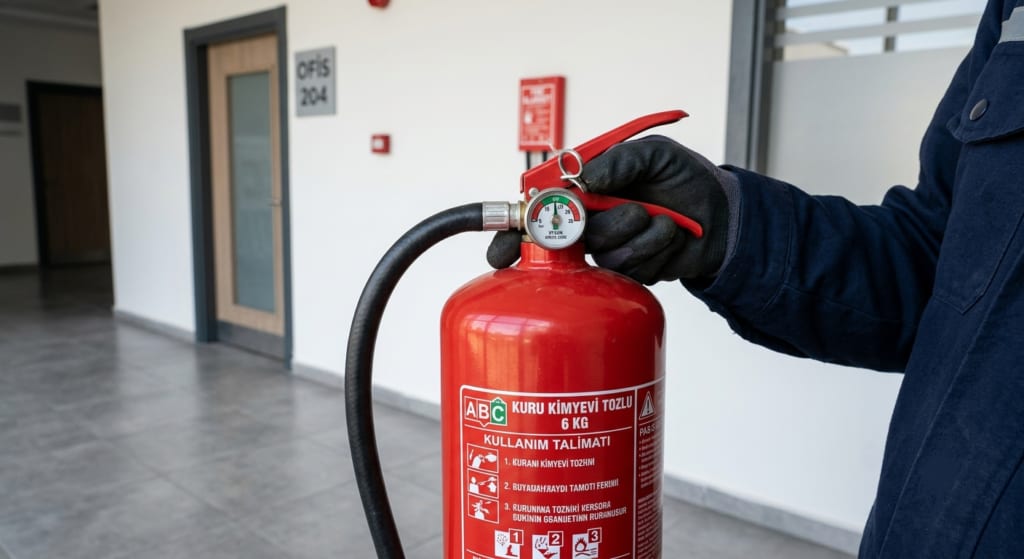
Maintenance and refilling of portable fire extinguishers is a documented activity. BYKHY Article 99 requires that manufacturers or service companies performing maintenance of these devices possess a filling and service competency certificate, "service providing companies must be able to present their certificates to customers upon request" establishes this obligation. This page explains which service intervals are applicable and which certificates you should request from your service company explains it.
Portable fire extinguishers we supply, and we also perform periodic maintenance and refilling as ASPEK. This work is subject to a separate document from system maintenance (explained below); the service is conducted in accordance with TS 11827 documentation and personnel training requirements, and a maintenance/refilling record is delivered for each device. We are based in Ankara; we plan bulk maintenance and refilling across Turkey for sites, factories, and chain facilities.
Fixed gas suppression system cylinders are separate from this and fall directly within our scope — see see the cylinder filling and hydrostatic testA zone monitoring module connects an entire conventional detector line to the addressable loop. Critical areas are renewed with addressable devices while secondary zones continue to operate with their existing wiring. This provides significant cost advantage in capacity upgrade and renovation projects.
Which Devices Are We Talking About?
Suppression devices that can be carried by hand or by vehicle. The three most common types in Turkey:
- ABC dry chemical powder — multipurpose; used in solid, liquid, and gas fires. The most commonly seen type in offices, corridors, production areas, and parking lots.
- CO₂ (carbon dioxide) — leaves no residue, preferred in front of electrical equipment and panels. High-pressure steel cylinder.
- Halocarbon / clean agent — used in areas with sensitive electronic equipment, where secondary damage from dry powder is not desired.
BYKHY Article 99 ties device type to fire class: in areas where Class A fires are likely, multipurpose dry chemical powder or water extinguishers are primarily provided; Class B requires dry chemical powder, carbon dioxide, or foam; Class C requires dry chemical powder or carbon dioxide; Class D requires dry metal powder devices. The regulation also states that water or clean agent devices should be preferred in hospitals, nursing homes, and nurseries .
Legal Periods
BYKHY Article 99requires that periodic inspection and maintenance of portable suppression devices be performed according to TS ISO 11602-2 standard, and defines two separate obligations:
| Period | Work performed |
|---|---|
| Once per year | At the location where the device is kept general inspection — pressure gauge, weight, hose and nozzle, pin and seal, body corrosion, label readability, accessibility |
| At the end of the fourth year | Renewal of internal suppression agent and performance of hydrostatic test being carried out |
Bu iki kalem birbirinin yerine geçmez. Yıllık kontrol yapılmış olması dördüncü yıl yükümlülüğünü ortadan kaldırmaz; tersi de geçerlidir.
Placement and quantity rules
When developing a maintenance plan, it should also be verified whether devices are in correct quantity and correct location . The main criteria sought by Article 99:
- Quantity: 1 unit of suitable type 6 kg dry chemical powder or equivalent gas suppression device must be provided for every 500 m² of building construction area in low hazard class, and for every 250 m² in medium and high hazard class.
- Wheeled device: in parking lots, warehouses, mechanical rooms, and similar locations, a wheeled type suppression device must also be provided.
- Access distance: the distance to reach suppression devices shall be 25 m occurs.
- maximum Installation height: devices heavier than 4 kg and lighter than 12 kg shall be mounted at a height from the floor not exceeding approximately90 cm
- Visibility: Visibility:
- Kalite belgesi: Quality certificate: TS EN 1866, of other portable devices , other portable devices must have TS 862 – EN 3
quality certificate.
Documents to Request from the Service Company
1. TSE Service Competence Certificate — within the scope of TS 11827
TS 11827 "Workplaces — Rules for premises providing maintenance and refilling services for fire extinguishers" TS 11827 "Workplaces – Rules for establishments providing maintenance and refilling services for fire suppression devices" standard establishes the structural characteristics, operational, technical equipment, and personnel conditions for workplaces providing this service, and has been made mandatory through Announcement MSG-MS-2018/7. The company must have a valid TSE Service Competence Certificate obtained under this scope.
When reviewing the certificate, check two things: validity date and scope. Service competence certificates are scope-based; a certificate obtained for another service does not cover portable device maintenance and refilling.
2. Personnel training and examination record
Organizations obtaining a certificate under TS 11827 maintenance and refilling personnelmust, as required by TS ISO 11602-2 referenced in the standard, receive at least 32 hours of training in periodic maintenance, refilling, testing, repair, and inspection, and must successfully pass the examination conducted at the end of training . The person who will physically work on your device must have this record.
Additionally, "Mobile and Portable Fire Extinguisher Inspection, Testing, Refilling, Maintenance, and Installation Operator" is a profession recognized by the Professional Competence Institution; if the personnel have an MYK certificate, this can also be requested.
3. Device quality certificates
If you are purchasing new devices, request TS EN 1866quality certificate for wheeled types, , other portable devices must have quality certificate for hand-portable types. This relates to the device itself and is separate from the service certificate.
4. Maintenance and refilling record
The work performed, date, and next inspection date must be recorded for each device. BYKHY's record retention obligation also applies to these devices; this is the record to be presented during inspection.
An Overlooked Right: Leaving a Temporary Replacement Device
This is one of the most commonly overlooked provisions of the regulation and directly benefits you. BYKHY Article 99 stipulates that when devices are taken for refilling, to avoid leaving the location where suppression devices are kept unprotected,service companies must leave temporary replacement fire suppression devices ready for use, of the same specifications and in the same quantity as those taken in for maintenance stipulates that it is so.
In other words, the situation where "your cylinders are in service for two weeks" leaving the building unprotected is not acceptable. When making a contract, request that this provision be included in writing.
Common Mistakes
- Skipping inspection because the pressure gauge shows green. The gauge shows pressure, not whether the suppression powder has caked. In dry chemical powder devices, the powder compacts over time and the device will not discharge despite being pressurized.
- Placing the device in an invisible location. Behind a door, inside a cabinet, and deep wall recesses are contrary to the regulation. If it must be placed in an invisible location for a compelling reason, its location must be marked with phosphorescent marks.
- Installing the wrong type in the wrong location. Placing a dry chemical powder device in front of a panel can cause complete loss of the panel even if the fire is extinguished; CO₂ or clean agent is preferred in such locations.
- Forgetting the fourth-year obligation. It is common to look at the annual inspection sticker and assume "maintenance has been performed"; the refilling and hydrostatic test at the end of the fourth year is a separate item.
Legal Basis for This Maintenance
Regulation on Fire Protection of Buildings (BYKHY) maintenance of fire safety systems is defined not as an optional improvement, but as an obligation incumbent upon the building owner and administrator defines it as follows:
- Article 84 — Emergency lighting, signage, and fire detection and alarm systems shall be subject to periodic inspection, testing, and maintenance as required by the system specified in the applicable standards, under the responsibility of the building owner and administrator or the building official to whom they have delegated responsibilities in writing.
- Article 100 — Fire suppression systems shall be subject to periodic inspection, testing, and maintenance as required by the system specified in the applicable standards, under the responsibility of the building owner, administrator, or the building official to whom they have delegated responsibilities in writing is a requirementA zone monitoring module connects an entire conventional detector line to the addressable loop. Critical areas are renewed with addressable devices while secondary zones continue to operate with their existing wiring. This provides significant cost advantage in capacity upgrade and renovation projects.
The common aspect of both articles is this: the regulation does not prescribe the period itself, but refers it to the standard the system is subject to. In other words, maintenance frequency is set not by the regulation but by the standard the system was designed to (TS EN 12845 for sprinklers, the TS EN 54 series for detection, TS ISO 14520 for gas systems) and by the manufacturer's own manual. A specification that says "the regulation requires this frequency" is built on the wrong basis.
The Ministry's regulation guide explicitly requires retention of these records: information, documents, and records related to inspections, maintenance, and tests must be kept in a secure place by the building owner, administrator, or responsible party for submission to relevant authorities in any emergency. Maintenance being performed is not enough; it must be documented that it was performed.
Related Pages
- Refilling and hydrostatic test in fixed system cylinders
- Periodic inspection forms and specifications
- Portable fire extinguisher products
To Set Up Your Maintenance Program
One contract, a solution for everything: we provide end-to-end maintenance to fire detection, gas suppression, sprinkler, hydrant, and pump units in their entirety; if you wish, maintenance of camera (CCTV) systems can also be added to the same contract.
If you do not have the brand, age, and last maintenance record of the existing system on hand, that is not a problem; the first step is anyway inventory and current condition assessment. Setting up an annual program without seeing what is there in the field means selling maintenance for a system that does not exist.
You can examine your system brand's product equivalents in our product catalog ; for requirements specific to your facility's use class, you can visit our sectoral solutions pages.
For survey and quotation you can or send your plan through our write or directly You can call call the number. Survey is free within Ankara; for facilities throughout Turkey, the visit plan is established jointly before contract.
Frequently Asked Questions
How often are fire cylinders subject to periodic inspection?
There are two separate periods. In accordance with BYKHY Article 99, devices undergo general inspection once per year at their location; at the end of the fourth year, the extinguishing agents inside are renewed and hydrostatic tests are performed. Periodic inspection and maintenance are conducted according to TS ISO 11602-2 standard.
Do you perform maintenance and refilling?
Yes. We handle both the sale of portable devices and their periodic maintenance and refilling. This service is subject to the conditions of TSE Service Competency Certificate under TS 11827 scope and is carried out in accordance with these conditions; a record is issued for each device. The cylinders of fixed gaseous suppression systems are a separate process — that process is also covered end-to-end by us.
What documents should I request from the service company?
Valid TSE Service Competency Certificate obtained under TS 11827 scope (verify that its scope includes portable device maintenance and refilling), training and examination records of at least 32 hours for maintenance and refilling personnel, quality certificate TS EN 1866 or TS 862–EN 3 if purchasing devices, and device-specific maintenance/refilling records. BYKHY Article 99 requires service-providing companies to present their certificates to customers upon request.
Will my building be left unprotected while my cylinders are in service?
It should not be. BYKHY Article 99 stipulates that when devices are taken for refilling, the service company must temporarily leave replacement devices in working condition, of the same type and quantity as those taken, to prevent the locations from being left unprotected. Request that this provision be included in your contract.
Does a cylinder with a green gauge reading need maintenance?
Yes. The gauge only shows internal pressure. In dry chemical powder devices, the powder can cake over time and the device may not discharge properly despite being pressurized; this can only be detected during periodic maintenance. Additionally, body corrosion, hose aging and seal condition are not reflected in the gauge.
Which type of device should be installed in which location?
BYKHY Article 99 links device type to fire class: Class A requires primarily multipurpose dry chemical powder or water-type, Class B requires dry chemical powder, carbon dioxide or foam-type, Class C requires dry chemical powder or carbon dioxide, Class D requires dry metal powder. In hospitals, nursing homes and kindergartens, water-type or clean gaseous devices should be preferred. Residue-free types are preferred in front of electrical panels.
Who can perform fire cylinder maintenance and refilling?
Maintenance and refilling of portable extinguishers is teamwork requiring knowledge of TS ISO 11602-2 practice; ASPEK provides this service directly for dry chemical powder (KKT), CO2 and foam cylinders. Cylinders are counted by address, gauge and fastening are inspected; those requiring refilling and hydrostatic testing are separated. We provide on-site service in Ankara and throughout Turkey.
Can the maintenance company also perform the periodic inspection?
Periodic maintenance, refilling and remedying of deficiencies for cylinders are handled under one roof by us. If your facility also operates independent inspection, it should be noted: Type A inspection body cannot remedy deficiencies due to impartiality and cannot refill expired cylinders; we perform refilling and replacement after inspection findings.
What document is issued after maintenance and refilling?
Each cylinder receives a label showing the inspection date and the next maintenance date; a report is submitted with a summary cylinder list, refilling records and hydrostatic test records. In fire department and occupational safety inspections, the first thing checked is this label on the cylinders; we maintain the list centrally for your branches and sites throughout Turkey.
What happens if I do not perform maintenance and refilling?
Powder in a dry chemical powder cylinder cakes over time and pressure leaks; the cylinder hangs in place but when triggered either nothing comes out or it empties in a few seconds. Your only weapon in the first minute of a fire is this cylinder. BYKHY places the obligation of keeping extinguishers ready on the operator; in damage files, cylinder maintenance labels are photographed and examined.
Does the insurance company require cylinder maintenance records?
Even in small business fires, it is common practice for the expert to check the cylinder's maintenance label and refilling record; an expired cylinder is noted adversely in the file. Conditions vary depending on the policy and we do not make definitive statements; current labels and reports favor you in every scenario.