

Voice evacuation and announcement system: why is an ordinary audio system not sufficient?
An emergency announcement system (voice evacuation) is a system that verbally instructs people in a building what to do in case of fire or similar emergency. A siren only says "something happened"; voice announcement says "residents on the 3rd floor, evacuate using the west staircase." In crowded and complex buildings, this is the difference that reduces evacuation time. The same system is used in daily operation for music broadcast and general announcements — but emergency priority always overrides others.


.jpg)



















Selection guide and FAQ
The difference between ordinary audio system and voice evacuation system
| Topic | Ordinary audio system | Voice evacuation (EN 54) |
|---|---|---|
| Certificate | None | Control equipment EN 54-16, loudspeakers EN 54-24 certified |
| Fault monitoring | None — if loudspeaker cable breaks, no one would know | Line, amplifier and microphone are continuously monitored; fault is displayed on panel |
| Backup amplifier | None | If amplifier fails, backup amplifier takes over |
| Backup power | None or limited | Battery provides standby time and alarm duration |
| Priority | None | Fire announcement automatically cuts off music and other announcements |
| Wiring | Standard cable | Fire-resistant cable; if the line breaks, the other zone continues to operate |
| Connection to the fire control panel | None | Triggered from the detection panel, makes zone-based announcements |
Speaker types
| Typical use | Where |
|---|---|
| Ceiling (recessed ceiling) | Office, corridor, store, hotel room — homogeneous sound distribution |
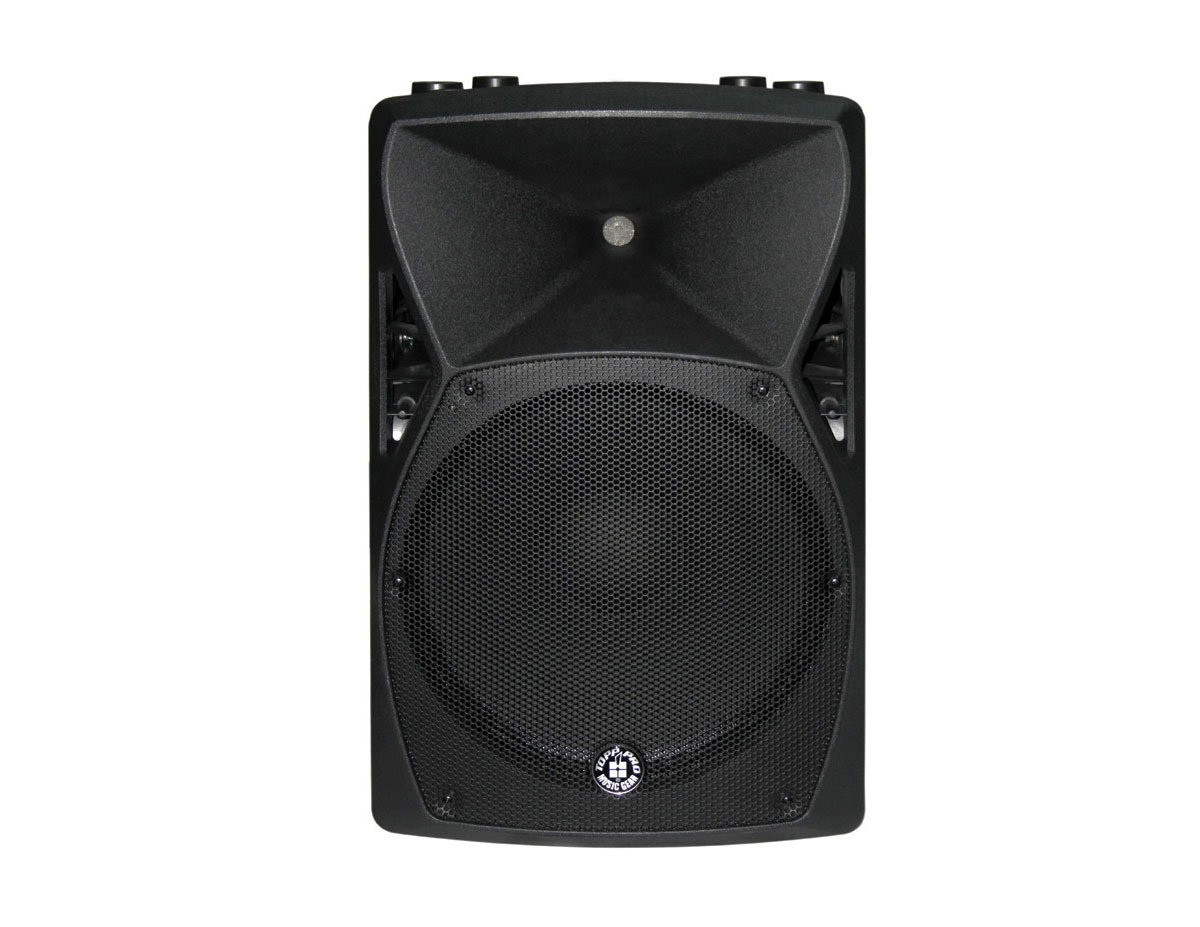
| Wall-mounted type (cabin) | Spaces without suspended ceiling, stairwell, technical area |
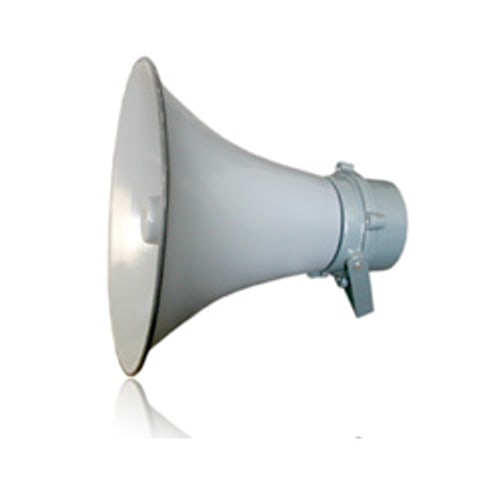
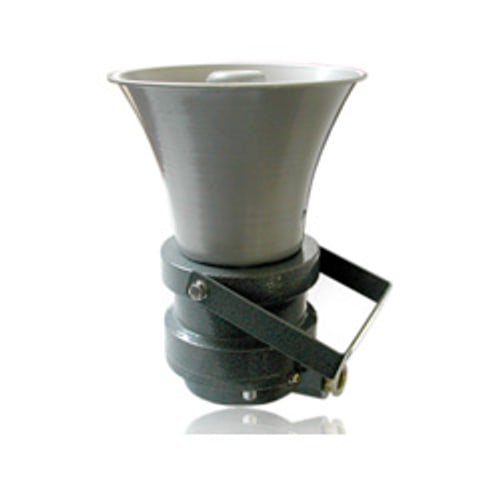
| Horn (ducted) | Parking lot, factory, open area — intelligibility in noisy and reverberant environment |
| Sound column (speaker column) | High-ceiling and reverberant spaces: mosque, sports hall, terminal |
| Outdoor area (IP class) | Facade, garden, field; water and dust-resistant enclosure |
Determining points in the design
- The system is configured using 100-volt line logic: speakers are connected in parallel on a single line and the power drawn by each is regulated via a transformer. This eliminates signal loss over long distances and simplifies speaker addition — this is the fundamental difference from domestic 4–8 ohm systems.
- The primary criterion is not sound level but intelligibility. Raising volume in a reverberant space reduces intelligibility; the correct solution is a greater number of speakers at lower power and positioned closer together. Speech intelligibility is measured and reported during acceptance testing.
- Zoning is the evacuation scenario itself: typically the fire floor, the floor above it, and the floor below are evacuated first; other floors receive a standby announcement. Evacuating the entire building simultaneously can block the stairways.
- Fire announcement is played as a pre-recorded clear message; additionally, a manual speak microphone is provided for fire service and personnel use, and this microphone takes priority over everything.
- Speaker circuits are separated so that if one cable is damaged, other zones remain operational; fire-resistant cable is used.
- The system must be designed in coordination with the fire detection control panel. When a public address system is added later without proper integration with detection, the evacuation scenario cannot be executed.
- In hotels, hospitals, shopping centers, high-rise buildings, and assembly-purpose buildings, voice evacuation is mostly required by regulation; whether it is mandatory for a specific building is evaluated on a project basis using the Regulation on Fire Protection of Buildings.
A common situation we encounter in shops and workplaces is as follows: there is an amplifier and speaker system set up for music, and it is assumed that announcements will be made through it in case of fire. However, in this system, no one notices if the speaker line is cut, if the amplifier fails there is no backup, when the power is cut the system goes completely silent, and it has no connection whatsoever to the fire control panel. In a building where voice evacuation is mandatory, this installation is not accepted during inspection either. The existing sound system can usually be preserved and continue to operate for daily use; the emergency function is instead installed separately with a certified system.
Frequently asked questions
Is a voice evacuation system mandatory in my building?
This varies depending on the building's occupancy classification, height, and personnel capacity; it is evaluated through the Regulation on Fire Protection of Buildings. It is generally required in hotels, hospitals, shopping centers, high-rise buildings, and large assembly areas. We can review your project and clearly state whether it is mandatory and the scope in which it is required.
Can I use my existing music system for evacuation?
No, if it is not certified and not connected to the fire control panel. However, the existing system does not need to be discarded: it can continue to be used for daily music and announcements, the emergency side is installed with certified equipment and takes priority. In some projects, the existing speaker cabling can also be re-evaluated.
How many speakers are required?
It is calculated not based on the area's square meters, but on ceiling height, ambient noise, and reverberation. As a rule, speaker quantity increases in high-ceilinged and noisy spaces, with lower power ratings. During site survey we measure the ambient noise level and determine the layout accordingly.
Can announcements be made if the power is cut?
Yes. The system is designed with battery backup; after power loss it remains in standby mode for a certain period and carries sufficient energy to make announcements in an alarm situation. Battery capacity is calculated within the project scope and measured during periodic maintenance.
Can we determine the announcement text ourselves?
Yes, pre-recorded messages are written according to your building (floor, exit direction, repeated in a second language if necessary). It is important for intelligibility that the text be short, clear, and read slowly; expressions that create panic are avoided.