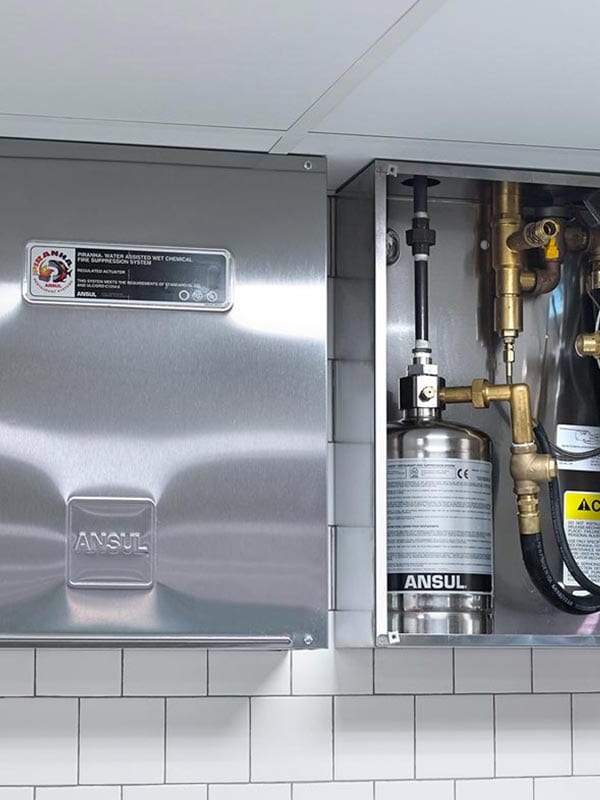
In commercial kitchens, fire starts with the ignition of oil in the cooking pan and spreads to the hood duct within seconds. Attempting to extinguish this fire with water enlarges the fire. For this reason, hood automatic extinguishing systems operate with an extinguishing agent that forms a blanket by saponifying over the hot oil and stops the fire before it reaches the duct. work with wet chemical extinguishing agent
We provide periodic maintenance, functional testing, nozzle and tube servicing, and post-discharge activation services for automatic hood suppression systems in hotel, hospital, shopping mall, cafeteria, and restaurant kitchens.
Why a Separate System is Required?
Cooking oil fire does not behave like an ordinary solid material fire. The ignition temperature of oil is very high, and after the fire is extinguished, the oil remains at a temperature where it will spontaneously reignite. When water is applied, it instantly vaporizes and scatters the hot oil everywhere. Wet chemical extinguishing agent solves both problems simultaneously: it creates a coating on the oil surface that cuts off oxygen through saponification and simultaneously cools the oil.
BYKHY regulates the application of automatic hood suppression systems in cooking areas of commercial kitchens and requires that kitchen exhaust systems be separately addressed from a fire safety perspective.
What Is Included in Maintenance?
Extinguishing agent and activation
- Pressure and weight control of wet chemical cartridge, date of last test
- Freedom of activation mechanism (mechanical or electrical) and condition of safety pin
- Fusible link elements replacement — these elements, contaminated by oil and vapor, are periodically renewed
- Accessibility and functionality of manual discharge station
Nozzles and distribution
- Protective cap of each nozzle in place and its opening not clogged condition
- Alignment of nozzles with the equipment they protect has been maintained
- Nozzle type compatibility with the protected equipment (different types are used for fryer, grill, range, and duct)
- Distribution pipe connections and fasteners
Nozzle caps sticking due to oil layer is by far the most frequently encountered deficiency in these systems. If the cap does not open, the extinguishing agent cannot reach the area; the system discharges and serves no purpose.
Cutoff and integration
- Automatic gas shutoff valve actually tested to confirm closure when system is activated
- Electrical equipment power supply cutoff
- Planned behavior of hood fan and exhaust system
- Signal transmission to fire alarm panel
Kitchen layout and duct
- Whether cooking equipment is in their installed positions — the most frequently overlooked deficiency
- Hood filters installed and clean
- Oil accumulation in exhaust duct and cleaning record
- Availability of portable extinguishing equipment of appropriate class on site
Equipment arrangement in kitchens frequently changes according to operational needs. When a fryer is relocated or a new grill is added, nozzle positioning becomes invalid. During maintenance, layout is compared with the installation project; if changes exist, the system is reconfigured.
How the system works and why wet chemical is mandatory in our hood suppression guide we explained it.
Why Should You Procure This Service from a Single Firm?
Fire safety is not a single system, but two interdependent engineering disciplines: mechanical side (pump unit, sprinkler, hydrant, fire cabinet, piping) and electronic side (detection, alarm, announcement, suppression triggering, control panels). Few firms in the market perform both sides together; most facilities obtain mechanical maintenance from one firm and electronic maintenance from another.
The problem starts here. What activates the system during a fire is not individual devices, but the connections between them: the flow switch will alert the panel, the panel will trigger the pump and damper, the announcement will sound before the gas system discharges, the elevator will descend to the evacuation floor. If there is a gap in responsibility between two firms in the middle of this chain, both firms may hand over their equipment as "working" while the system as a whole does not function. The most frequent fault we observe in the field is not a defective device, but an interface that no one ownsA zone monitoring module connects an entire conventional detector line to the addressable loop. Critical areas are renewed with addressable devices while secondary zones continue to operate with their existing wiring. This provides significant cost advantage in capacity upgrade and renovation projects.
As ASPEK Mühendislik, we are headquartered in Ankara and serve throughout Turkey. We conduct mechanical and electronic maintenance within the same team schedule; the installation, filling, and maintenance of sprinkler, hydrant, and fire pump units and FM-200 and Novec 1230 gas suppression systems fall within this scope — areas where finding a qualified technician is most difficult.
We structure our scope accordingly: from detection to gas suppression, from sprinkler and hydrant lines to fire pump units we provide end-to-end end to end in a building — single contract, single point of contact, single reporting format. For facilities that request it, we also add the periodic maintenance of camera (CCTV) systems to the same contract; when fire and security infrastructure is consolidated under one roof, there is no such thing as a "fault falling between two firms."
Legal Basis for This Maintenance
Regulation on Fire Protection of Buildings (BYKHY) maintenance of fire safety systems is defined not as an optional improvement, but as an obligation incumbent upon the building owner and administrator defines it as follows:
- Article 84 — Emergency lighting, signage, and fire detection and alarm systems shall be subject to periodic inspection, testing, and maintenance as required by the system specified in the applicable standards, under the responsibility of the building owner and administrator or the building official to whom they have delegated responsibilities in writing.
- Article 100 — Fire suppression systems shall be subject to periodic inspection, testing, and maintenance as required by the system specified in the applicable standards, under the responsibility of the building owner, administrator, or the building official to whom they have delegated responsibilities in writing is a requirementA zone monitoring module connects an entire conventional detector line to the addressable loop. Critical areas are renewed with addressable devices while secondary zones continue to operate with their existing wiring. This provides significant cost advantage in capacity upgrade and renovation projects.
The common aspect of both articles is this: the regulation does not prescribe the period itself, but refers it to the standard the system is subject to. In other words, maintenance frequency is set not by the regulation but by the standard the system was designed to (TS EN 12845 for sprinklers, the TS EN 54 series for detection, TS ISO 14520 for gas systems) and by the manufacturer's own manual. A specification that says "the regulation requires this frequency" is built on the wrong basis.
The Ministry's regulation guide explicitly requires retention of these records: information, documents, and records related to inspections, maintenance, and tests must be kept in a secure place by the building owner, administrator, or responsible party for submission to relevant authorities in any emergency. Maintenance being performed is not enough; it must be documented that it was performed.
Related Pages
To Set Up Your Maintenance Program
One contract, a solution for everything: we provide end-to-end maintenance to fire detection, gas suppression, sprinkler, hydrant, and pump units in their entirety; if you wish, maintenance of camera (CCTV) systems can also be added to the same contract.
If you do not have the brand, age, and last maintenance record of the existing system on hand, that is not a problem; the first step is anyway inventory and current condition assessment. Setting up an annual program without seeing what is there in the field means selling maintenance for a system that does not exist.
You can examine your system brand's product equivalents in our product catalog ; for requirements specific to your facility's use class, you can visit our sectoral solutions pages.
For survey and quotation you can or send your plan through our write or directly You can call call the number. Survey is free within Ankara; for facilities throughout Turkey, the visit plan is established jointly before contract.
Frequently Asked Questions
Why is water not used to combat kitchen fires?
Water in contact with hot oil instantly vaporizes and scatters the oil, enlarging the fire. Additionally, oil remains at a temperature where it can still ignite spontaneously even after being extinguished. Wet chemical suppressant saponifies the oil surface, cutting off oxygen while simultaneously cooling it.
How frequently does a range hood suppression system require maintenance?
Frequency is determined according to the manufacturer's instructions and the standard to which the system is subject; BYKHY establishes the requirement, leaving the period to the relevant standard. Due to the high oil and vapor load in the kitchen environment, maintenance intervals for these systems are generally more frequent than for other suppression systems.
We relocated equipment in the kitchen, does this affect the system?
Yes, it directly affects it. Nozzles are positioned and aimed at specific points on specific appliances. When a fryer, griddle or range is relocated, the nozzle no longer sprays at its target but into empty space. In this case, the system must be reconfigured.
What must be done after the system is discharged?
The kitchen is cleaned and suppressant residue is removed, the cartridge is taken for refilling, the actuation mechanism and fusible link elements are renewed, nozzle caps are replaced. The kitchen must not be operated until the system is returned to automatic mode through testing.
Who can perform range hood suppression system maintenance?
A team knowledgeable in wet chemical system nozzle placement, fusible links and gas shut-off valve is required; ordinary kitchen service providers are unfamiliar with this system. ASPEK performs maintenance according to NFPA 96 and NFPA 17A practice with its own staff. We service restaurant kitchens in Ankara and hotel and shopping mall kitchens throughout Turkey.
Can the maintenance company also perform the periodic inspection?
Control of nozzle caps, actuation line and manual pull station, and remedying of identified deficiencies are handled in-house. In facilities requiring independent inspection, a Type A inspection body cannot remedy deficiencies due to impartiality; we perform fusible link replacement and tank/cartridge renewal.
What document is provided upon completion of maintenance, is it useful in inspections?
A nozzle and fusible link control list, tank/cartridge pressure values, gas shut-off test and maintenance report with replaced parts are prepared; a maintenance label is affixed to the system. This record is requested during fire department and food establishment inspections; we provide reporting in a single format for chain kitchens throughout Turkey.
What happens if I do not perform maintenance?
The enemy in the range hood is oil: nozzle outlets become clogged with grease, the oil crust on the fusible link causes delayed opening. Wet chemical agent saponifies hot oil on its surface to extinguish it; with clogged nozzles and insufficient agent this layer does not form, the kitchen fire travels from the duct throughout the entire building. BYKHY places the responsibility for system readiness on the operator; insurance also first asks for maintenance records in case of loss.
Does the insurance company request range hood system maintenance records?
In restaurant and hotel kitchen fires, it is common practice for the expert to request duct and range hood cleaning records along with the suppression system maintenance record. Policies differ and we do not make definitive judgments; however, we observe in the field that compensation discussions become difficult in unmaintained kitchens.