
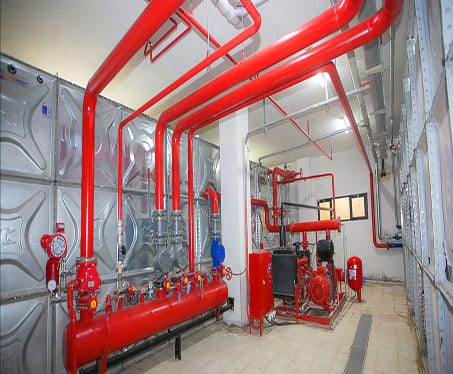
Periodic inspection takes a photograph of the system; maintenance closes the deficiencies in that photograph — the two cannot replace each other. This page consolidates in one place the legal basis for periodic fire protection system inspection, who signs the report, the systems covered, the documents to be issued at the end of inspection, and the procedure to follow if the report comes out incomplete.
When a facility is said to have "periodic inspection of fire systems," two separate jobs are often considered as a single line item: the inspection that determines the system's condition on that day, and the maintenancethat keeps the system operational. These two are not the same thing, and both are mandatory obligations. This page is an umbrella page: it consolidates in one place the difference, which regulation the obligation comes from, who signs the report, which systems are covered, what documents are issued at the end of inspection, and what to do if the report comes back incomplete. ASPEK Mühendislik is headquartered in Ankara; we provide periodic inspection, testing, maintenance, and deficiency rectification services nationwide, with both mechanical and electronic aspects handled in-house.
Periodic Inspection and Maintenance Are Not the Same Thing
Periodic inspection is a determination process: the system is tested, values are measured, non-conformities are recorded, and a dated and signed report is produced. Maintenance, on the other hand, is an intervention process: cleaning, adjustment, calibration, component replacement, filling. Inspection takes a photograph of the system; maintenance closes the gaps shown in that photograph.
| Question | Periodic Inspection | Maintenance |
|---|---|---|
| What is the purpose? | To determine, measure, and report the condition | To keep the system operational |
| What is the output? | Dated, signed inspection report and list of non-conformities | Rectified deficiencies, replaced components, updated maintenance record |
| If deficiencies are found? | Written in the report; inspection does not rectify the deficiency | Deficiency is rectified and entered in the closure record |
| Who performs it? | Engineer or technician from the relevant discipline | Competent service team familiar with the system |
The most common misunderstanding we see in the field is facilities with an annual inspection report believing themselves to be maintained. A report is a condition determination; unless the deficiencies written in the report are rectified, the system remains deficient, and in the next inspection the same item will reappear — this time as a known and unresolved deficiency .
Which Regulation Does the Obligation Come From?
The periodic inspection of fire systems stands at the intersection of two separate regulations, and these two are not alternatives to each other.
BYKHY Article 84 and Article 100
Regulation on Fire Protection of Buildingsmandates that fire detection and alarm systems as well as extinguishing systems shall be subject to periodic inspection, testing, and maintenance under the responsibility of the building owner and manager. The point to note is this: the regulation does not prescribe the period itselfdoes not prescribe frequency; it defers frequency to the standard to which the system is subject (TS EN 12845 for sprinklers, TS EN 54 series for detection, TS ISO 14520 for gas systems) and the manufacturer's manual. Any specification claiming "the regulation requires this frequency" has laid its foundation incorrectly.
Occupational Health and Safety Conditions in the Use of Work Equipment Regulation (ANNEX III)
On the occupational health side, the same piping system now appears as work equipment : ANNEX III lists fire piping and extinguishing devices among equipment subject to periodic inspection and requires that inspection be conducted by authorized persons from the relevant discipline. The period here too is deferred to the relevant standards and manufacturer's instructions; the frequency of inspection is determined according to the standard to which the system is subject and the manufacturer's maintenance manual. The document requested by the labor inspector during inspection is the report of this inspection.
Practical consequence: building management is responsible under BYKHY, and the employer under the Work Equipment Regulation; the same pipes and panels are viewed with two separate eyes. Combining the two obligations in a single inspection-maintenance program simplifies both the schedule and the cost — when conducted separately, the same pump is tested by two different firms twice a year, and when two reports do not align with each other, you become the arbitrator.
Who Signs the Periodic Inspection Report?
The report is signed by the person who actually performed the inspection, and this person must be an engineer or technician from the relevant discipline of the equipment. In fire infrastructure, this distinction is important because the piping extends across two disciplines: pump group, sprinklers, hydrants, and piping are the mechanical side; detection, alarm, announcement, and extinguishing triggering are the electronic side. When requesting a quote, ask who will perform the inspection and their title; the report must contain the inspection date, the name, title, and signature of the person who performed the inspection, the identity of the tested equipment, and the measured values. Approach with caution any report signed with two disciplines covered at once without ever seeing the site.
Which Systems Are Covered?
Although the umbrella title is "fire systems," inspection is performed system by system. The scope of inspection for each is written item by item on its respective page:
- Fire pump group — automatic activation test, activation pressures, performance measurement
- Sprinkler (spray) — alarm valve, flow switch, test-drain line, head inspection
- Fire cabinet and hydrant — hose inspection, pressure and flow measurement at the most unfavorable point
- Fire detection and alarm — detector activation, battery life test, siren and integration chain; for equipment equivalents see detection catalog
- Gas extinguishing (FM-200, Novec 1230, CO₂, inert) — cylinder weight and pressure check, activation test, compartment integrity
- Gas system cylinder filling and hydrostatic test — filling process for cylinders below threshold
- Hood suppression system — wet chemical cylinder, nozzles, automatic gas shut-off valve
- Emergency lighting and signage — function and duration test, escape route coverage
- Portable fire extinguishers — on-site inspection, maintenance, and filling
How Frequently Is Each System Inspected?
The table below distinguishes two things: the source determining frequency (standard + manufacturer's manual) and how contracts are structured in practice. The second column is field reality, not regulatory provision: in intensive and critical facilities such as hospitals, data centers, and shopping malls, contracts are structured on a monthly, quarterly, or 4-monthly basis; in many facilities, 6-month visits and annual comprehensive testing are sufficient. For a critical facility example, see hospital solutions page.
| System | Source determining frequency | Contract frequency in practice |
|---|---|---|
| Fire detection and alarm | TS EN 54 / TS CEN/TS 54-14 + manufacturer's manual | Monthly–quarterly in critical facilities; 6-monthly + annual comprehensive test in many facilities |
| Fire pump group | TS EN 12845 + motor manufacturer | Routine operation by facility personnel; service visit 3–6 monthly is common |
| Sprinkler | TS EN 12845; NFPA 25 series also referenced in many specifications | 6-monthly–annually; 3-monthly in intensive facilities |
| Fire cabinet and hydrant | TS EN 671 / TS EN 14384 | Annually; 6-monthly in large areas |
| Gas extinguishing | TS ISO 14520 + manufacturer's manual | 6-monthly; 3–4 monthly in critical rooms |
| Hood suppression | NFPA 96 / NFPA 17A + manufacturer's manual | Predominantly 6-monthly; more frequent in intensive kitchens |
| Emergency lighting and signage | Applicable standard + manufacturer manual | Brief function check by facility staff; duration test during service visit |
| Portable extinguishers | Relevant TS standard + manufacturer's manual | Annual on-site inspection is established practice |
What Documents Are Issued at the End of Inspection?
- Equipment-based periodic inspection report — date; name, title, and signature of person conducting inspection; equipment identity; test performed; value measured
- Non-conformity list — with photographs, location information, and priority ranking; the phrase "general maintenance performed" carries no information
- Test and measurement records — battery life test, pressure-flow values, cylinder weight results, activation pressures
- Date of next inspection — linked to calendar
- Closure record if deficiencies were rectified — when and how each item was closed
For item-by-item content of the form, see periodic inspection forms and specification page. These documents must be kept in your archive: inspection and maintenance records must be retained for submission to the relevant authorities in an emergency. Mere completion of maintenance is not enough; it must be documented that it was performed.
What If the Report Comes Back Incomplete?
A report from a properly conducted inspection often comes back incomplete; this shows that the process is working. The real question is: who will rectify the deficiency?
Here it is necessary to understand the market structure. A Type inspection body, by virtue of impartiality, cannot itself rectify the deficiencies it finds — it cannot perform the work it inspected, and this rule is correct. But the consequence is this: when the report reaches you, the work is incomplete, it is split in two; you search for a second contractor to rectify the deficiencies, and you yourself manage the "was it rectified, was it rectified correctly" traffic between the two firms. ASPEK is on the other side of the chain: we are not an inspection body; we are the side that performs the inspection, testing, and maintenance, and also rectifies the deficiencies that appear in the report and prepares the closure record. Even if you have received a report from an inspection body, bring that report to us — the list of deficiencies is our work list.
A concrete example: if the report states that the weight of a gas extinguishing cylinder has fallen below threshold, filling is required. No maintenance firm fills a gas system cylinder in its own facility; filling is done at a certified filling facility for this work, and that is the correct way to do it. On our side, the process is handled in-house: we remove the cylinders, arrange shipment, install them upon filling return, reactivate the system, and deliver the documents. For details, see see the cylinder filling and hydrostatic test page.
Build Your Inspection Program Under One Roof
In facilities where the mechanical side is distributed to one firm, the electronic side to another, and inspection to a third, the most common result we see is interfaces that no one owns. As ASPEK Mühendislik, we conduct periodic inspection, testing, maintenance, and deficiency rectification in a single program; our headquarters is in Ankara, and our field organization covers all of Turkey . You can see how we structure contract scope on maintenance contract the page, and you can contact us.
Why Should You Procure This Service from a Single Firm?
Fire safety is not a single system, but two interdependent engineering disciplines: mechanical side (pump unit, sprinkler, hydrant, fire cabinet, piping) and electronic side (detection, alarm, announcement, suppression triggering, control panels). Few firms in the market perform both sides together; most facilities obtain mechanical maintenance from one firm and electronic maintenance from another.
The problem starts here. What activates the system during a fire is not individual devices, but the connections between them: the flow switch will alert the panel, the panel will trigger the pump and damper, the announcement will sound before the gas system discharges, the elevator will descend to the evacuation floor. If there is a gap in responsibility between two firms in the middle of this chain, both firms may hand over their equipment as "working" while the system as a whole does not function. The most frequent fault we observe in the field is not a defective device, but an interface that no one owns.
As ASPEK Mühendislik, we are headquartered in Ankara and serve throughout Turkey. We conduct mechanical and electronic maintenance within the same team schedule; the installation, filling, and maintenance of sprinkler, hydrant, and fire pump units and FM-200 and Novec 1230 gas suppression systems fall within this scope — areas where finding a qualified technician is most difficult.
We structure our scope accordingly: from detection to gas suppression, from sprinkler and hydrant lines to fire pump units, we maintain every fire safety system in a building end to end — single contract, single point of contact, single reporting format. For facilities that request it, we also add the periodic maintenance of camera (CCTV) systems to the same contract; when fire and security infrastructure is consolidated under one roof, there is no such thing as a "fault falling between two firms."
Legal Basis for This Maintenance
Regulation on Fire Protection of Buildings (BYKHY) maintenance of fire safety systems is defined not as an optional improvement, but as an obligation incumbent upon the building owner and administrator defines it as follows:
- Article 84 — Emergency lighting, signage, and fire detection and alarm systems shall be subject to periodic inspection, testing, and maintenance as required by the system specified in the applicable standards, under the responsibility of the building owner and administrator or the building official to whom they have delegated responsibilities in writing.
- Article 100 — Fire suppression systems shall be subject to periodic inspection, testing, and maintenance as required by the system specified in the applicable standards, under the responsibility of the building owner, administrator, or the building official to whom they have delegated responsibilities in writing is a requirement.
The common aspect of both articles is this: the regulation does not prescribe the period itself, but refers it to the standard the system is subject to. In other words, maintenance frequency is set not by the regulation but by the standard the system was designed to (TS EN 12845 for sprinklers, the TS EN 54 series for detection, TS ISO 14520 for gas systems) and by the manufacturer's own manual. A specification that says "the regulation requires this frequency" is built on the wrong basis.
The Ministry's regulation guide explicitly requires retention of these records: information, documents, and records related to inspections, maintenance, and tests must be kept in a secure place by the building owner, administrator, or responsible party for submission to relevant authorities in any emergency. Maintenance being performed is not enough; it must be documented that it was performed.
Frequently Asked Questions
What is the difference between periodic inspection and maintenance, should I have them performed by separate companies?
Inspection is a detection operation: it tests, measures, and produces a report. Maintenance is an intervention operation: it remedies deficiencies, replaces parts, and keeps the system operational. You are not obligated to split them between separate companies; ASPEK conducts both in a single program. Even if you have the inspection performed by a Type A notified body, a separate contractor is still required for deficiency remediation, because the notified body cannot remedy the deficiencies it finds due to impartiality requirements.
Who signs the fire system periodic inspection report?
The engineer or technician from the relevant discipline who actually performed the inspection signs it. The Health and Safety Regulations in the Use of Work Equipment classifies fire systems among work equipment subject to periodic inspection and requires inspection to be performed by authorized persons. The report must contain the name, title, signature, date, equipment identifier, and measured values; ask the proposing company for the discipline and title of the person who will perform the inspection during the quotation phase.
Is fire system periodic inspection legally mandatory?
Yes, from two separate regulations: BYKHY Articles 84 and 100 impose on building owners and administrators the obligation to subject systems to periodic inspection, testing, and maintenance; the Work Equipment Regulations Annex-III ties the same installations to periodic inspection as an employer obligation. The frequency is determined not by the regulations but by the standard to which the system is subject and the manufacturer's manual. Records are requested during fire authority inspections and labor inspector inspections.
How long does the inspection take, is it necessary to shut down the facility?
At a medium-sized facility it typically takes one day, and at large or widespread facilities two to three days. Most tests are performed without shutting down operations; announcements, evacuation scenarios, and integration tests, if required, are scheduled outside working hours. In gaseous suppression tests, the gas is not discharged; triggering and solenoid circuits are tested with the circuit isolated.
What documents will I receive at the end of the inspection?
A dated and signed periodic inspection report on a device basis; measurement and test records; a photographed and priority-ranked non-conformance list; the date of the next inspection; and a closure record if deficiencies have been remedied. These documents must be retained for presentation to relevant authorities in case of emergency — the performance of maintenance is not sufficient; it must be documented.
Does the fire authority or insurance company require this report?
Control and maintenance records are requested during fire authority inspections and labor inspector inspections. On the insurance side, the main question comes after damage occurs: the expert assessment requires documentation that the system was operational and maintained at the time of the incident. A facility without records cannot prove this even if maintenance was actually performed; this is why filing the report is as important as the work itself.
The report shows deficiencies; why doesn't the organization that performed the inspection remedy them?
A Type A notified body cannot remedy the deficiencies it finds due to impartiality requirements — it cannot perform the work it inspected, that is the rule and it is correct. However, this places the burden on you to find a second contractor. ASPEK is the maintenance and deficiency remediation side: contact us with your report; we will remedy the deficiencies, prepare a closure record, and prepare the facility for the next inspection. We are based in Ankara and operate nationwide throughout Turkey.