
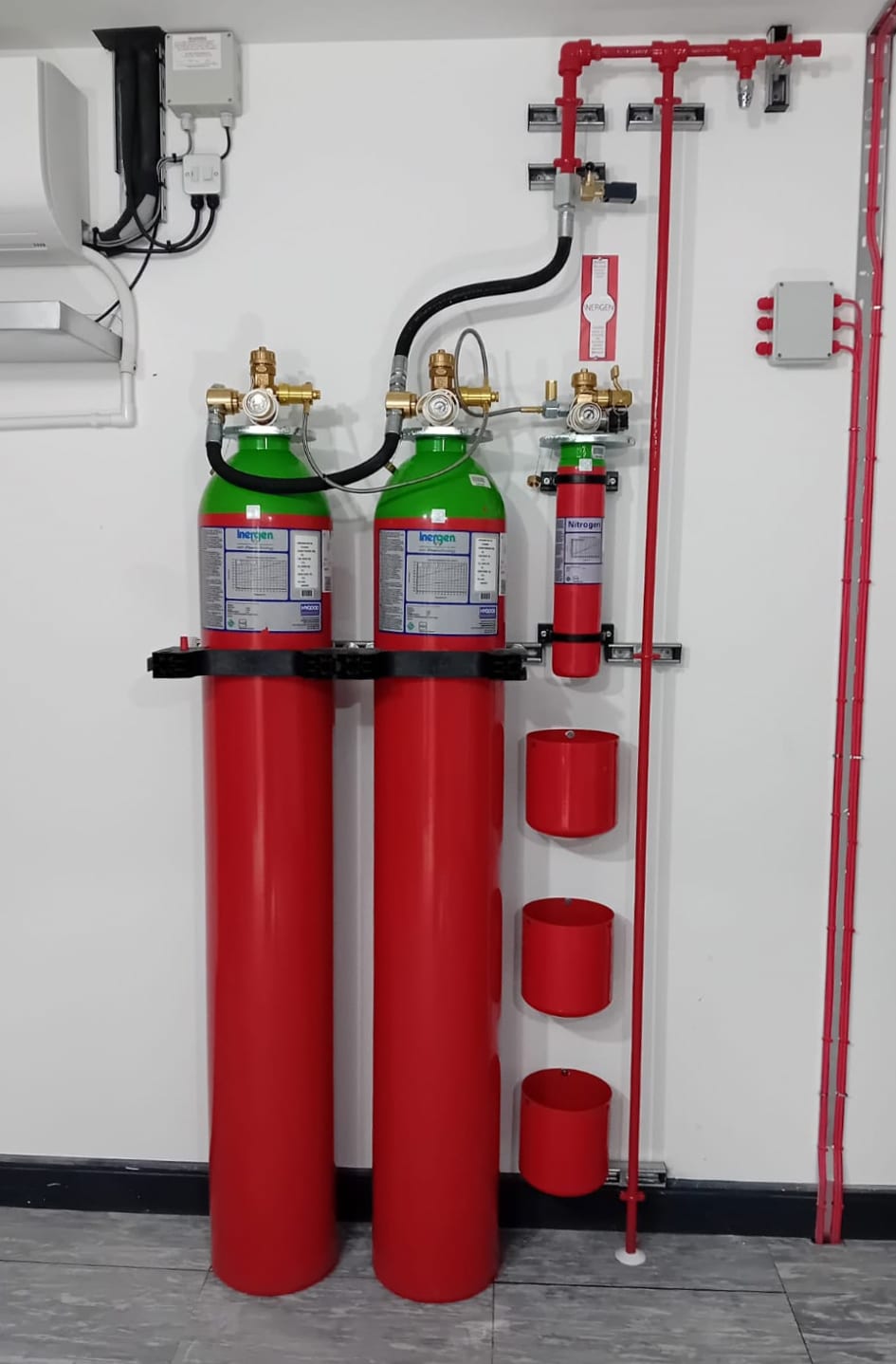
CO₂ and inert gas systems, differentiated from FM-200 and Novec in terms of design logic:they extinguish not chemically, but by diluting the oxygen in the environment. This produces two consequences — a much larger volume of gas is discharged on-site, and CO₂ at design concentration is lethal to humans. In the maintenance of these systems, personnel safety provisions are as critical as the gas itself.
We provide periodic maintenance, functional testing, cylinder refilling, and troubleshooting services for fixed suppression systems operating with carbon dioxide (CO₂) and argon-based inert gas mixtures (IG-01, IG-55, IG-541, IG-100).
Why Are These Systems Treated Separately?
Clean gases such as FM-200 and Novec 1230 operate at concentrations designed for occupied spaces. CO₂ and inert gases, however, extinguish by oxygen displacement principle, and two distinctions arise from this principle:
- The discharged volume is considerably larger. A sudden and marked pressure rise occurs within the enclosure; this pressure must be vented in a controlled manner.
- CO₂ at design concentration is not suitable for human life. While inert mixtures can be designed to target oxygen levels at which a person may remain for a short time, CO₂ is asphyxiant and evacuation of the enclosure is mandatory.
For this reason, in CO₂ systems, delay time, alarms, lockout devices, and discharge arrangement are integral to the system—not an "optional safety add-on."
Standard difference
TS ISO 14520 covers halogenated hydrocarbon extinguishants (HFC-227ea, FK-5-1-12, etc.) and inert gases (IG-01 argon, IG-100 nitrogen, IG-55, IG-541); the series parts list enumerates these gases separately. CO₂ systems fall outside this series and are designed according to their own standard (in international practice NFPA 12 / EN ISO 6183). When scoping maintenance work, it is established from the outset which standard is being applied; the system's design and acceptance documentation shows this.
What Is Included in Maintenance?
Life safety devices — these come first
- Testing of lockout device — a mechanism that physically cuts off the discharge path when maintenance or work is to be performed in the enclosure; TS ISO 14520 defines this device as a separate term
- Measuring delay time and evaluating whether it is sufficient for enclosure evacuation
- Testing audible and visual alarms prior to discharge; for CO₂ systems, if a pneumatic siren is present, testing it separately
- Functionality and accessibility of abort and manual discharge stations
- Presence and legibility of warning signs inside the enclosure and at all entrances
- Doors opening in the direction of escape and self-closing
- Personnel being informed about the system — TS ISO 14520 Section 9.4 requires that personnel working in the protected enclosure receive training on system operation and particularly on safety matters
Pressure relief vent
The pressure generated in the enclosure during inert gas and CO₂ discharge can rise to a level causing structural damage. During maintenance, the vent is verified to be present, correctly sized, unobstructed, and functional ; vents sealed or blocked with stored materials during later modifications are among the most common deficiencies we encounter.
Cylinders and discharge path
- For CO₂ cylinders, weighing; for inert gas cylinders, temperature-corrected pressure reading (see refill thresholds)
- Identification of cylinders due for hydrostatic body test — since these cylinders are stored at 200 bar and above, gas cannot be recovered; they are vented in a controlled manner and refilled with fresh gas after testing
- Comparison of pressure and weight gauges at least annually with calibrated instruments
- Cylinder marking, date of last hydrostatic test, corrosion, and securing clamps
- Manifold, flexible hoses, check valves, and pilot line; hoses to be inspected annually for damage (TS ISO 14520 Section 9.2.3)
- Nozzles for blockage, direction, and type verification; in selective valve systems, testing valve logic
Detection, control, and enclosure
- Fire suppression control panel alarm and out-of-service logs
- Testing of cross-zone detection logic
- Solenoid circuit isolated trigger test
- Dampers and ventilation shutting down/stopping upon gas discharge signal
- Enclosure integrity — TS ISO 14520 Section 9.2.4.1 requires at least every 12 months detection of leakage quantities and infiltrations or changes affecting suppression performance; if not visually apparent, repetition of the enclosure integrity test (door fan test) is required
Additionally, Section 9.2.4.3 of the standard states: if there is any change in the hazard type or within the enclosure, the system must be redesignedto maintain the original protection level. This is not a matter to be "corrected through maintenance."
Where Are They Used?
CO₂ systems are generally preferred in volumes with no continuous human occupancy and high fire load: generator and turbine rooms, spray booths, cable galleries, printing machinery, fuel and oil units. Inert gas systems are used in spaces with dense electronic equipment and where residue is undesirable: data centers, server rooms, archives, energy and transformer installationsA zone monitoring module connects an entire conventional detector line to the addressable loop. Critical areas are renewed with addressable devices while secondary zones continue to operate with their existing wiring. This provides significant cost advantage in capacity upgrade and renovation projects.
In small volumes (panels, cabins, machinery), the same function is served by in-cabinet micro suppression systems; we explain their maintenance on a separate page we explained it.
Legal Basis for This Maintenance
Regulation on Fire Protection of Buildings (BYKHY) maintenance of fire safety systems is defined not as an optional improvement, but as an obligation incumbent upon the building owner and administrator defines it as follows:
- Article 84 — Emergency lighting, signage, and fire detection and alarm systems shall be subject to periodic inspection, testing, and maintenance as required by the system specified in the applicable standards, under the responsibility of the building owner and administrator or the building official to whom they have delegated responsibilities in writing.
- Article 100 — Fire suppression systems shall be subject to periodic inspection, testing, and maintenance as required by the system specified in the applicable standards, under the responsibility of the building owner, administrator, or the building official to whom they have delegated responsibilities in writing is a requirementA zone monitoring module connects an entire conventional detector line to the addressable loop. Critical areas are renewed with addressable devices while secondary zones continue to operate with their existing wiring. This provides significant cost advantage in capacity upgrade and renovation projects.
The common aspect of both articles is this: the regulation does not prescribe the period itself, but refers it to the standard the system is subject to. In other words, maintenance frequency is set not by the regulation but by the standard the system was designed to (TS EN 12845 for sprinklers, the TS EN 54 series for detection, TS ISO 14520 for gas systems) and by the manufacturer's own manual. A specification that says "the regulation requires this frequency" is built on the wrong basis.
The Ministry's regulation guide explicitly requires retention of these records: information, documents, and records related to inspections, maintenance, and tests must be kept in a secure place by the building owner, administrator, or responsible party for submission to relevant authorities in any emergency. Maintenance being performed is not enough; it must be documented that it was performed.
Related Pages
- Cylinder refilling and hydrostatic test
- FM-200 and Novec 1230 system maintenance
- Gaseous suppression products
To Set Up Your Maintenance Program
One contract, a solution for everything: we provide end-to-end maintenance to fire detection, gas suppression, sprinkler, hydrant, and pump units in their entirety; if you wish, maintenance of camera (CCTV) systems can also be added to the same contract.
If you do not have the brand, age, and last maintenance record of the existing system on hand, that is not a problem; the first step is anyway inventory and current condition assessment. Setting up an annual program without seeing what is there in the field means selling maintenance for a system that does not exist.
You can examine your system brand's product equivalents in our product catalog ; for requirements specific to your facility's use class, you can visit our sectoral solutions pages.
For survey and quotation you can or send your plan through our write or directly You can call call the number. Survey is free within Ankara; for facilities throughout Turkey, the visit plan is established jointly before contract.
Frequently Asked Questions
Can CO₂ extinguishing system be used in occupied areas?
CO₂ at design concentration is asphyxiant and unsuitable for life; therefore systems are designed on the basis of area evacuation. Delay time, audible and visual alarms, locking devices, doors opening in escape direction and warning signs are integral parts of the system — during maintenance these are checked before the gas.
What is the difference between inert gas systems and FM-200?
FM-200 and halogenated hydrocarbons such as Novec are stored in liquid phase and require smaller volume containers; inert gases (argon IG-01, IG-55, IG-541, nitrogen IG-100) are stored in gas phase at high pressure, require more cylinders and create a noticeable pressure rise in the area during discharge. Quantity control also differs: for halogenated hydrocarbons weight is the basis, for inert gases pressure is the basis.
Why is the pressure relief vent so important?
Discharge of inert gas and CO₂ means a large volume of gas entering the area in a short time. If this pressure is not controlled during relief, structural damage can occur to walls, suspended ceilings, doors or glass surfaces and loss of area integrity prevents gas containment. We frequently encounter in the field cases where the vent has been subsequently closed or its opening blocked.
According to which standard is CO₂ system maintained?
TS ISO 14520 series covers halogenated hydrocarbons and inert gases; CO₂ systems fall outside this series and are designed and maintained according to their own standard (in international practice NFPA 12 / EN ISO 6183). When establishing the maintenance scope, the system design and acceptance documentation are reviewed to determine which standard was the basis.
We performed alterations in the area, will the system be affected?
Yes. TS ISO 14520 Article 9.2.4.3 requires that the system be redesigned to maintain the original protection level if there is any change in the type of hazard in or to the enclosure. Furthermore, in accordance with Article 9.2.4.1, at least every 12 months changes affecting the leakage rate shall be investigated, and if not visually detectable, the enclosure integrity test shall be repeated.