
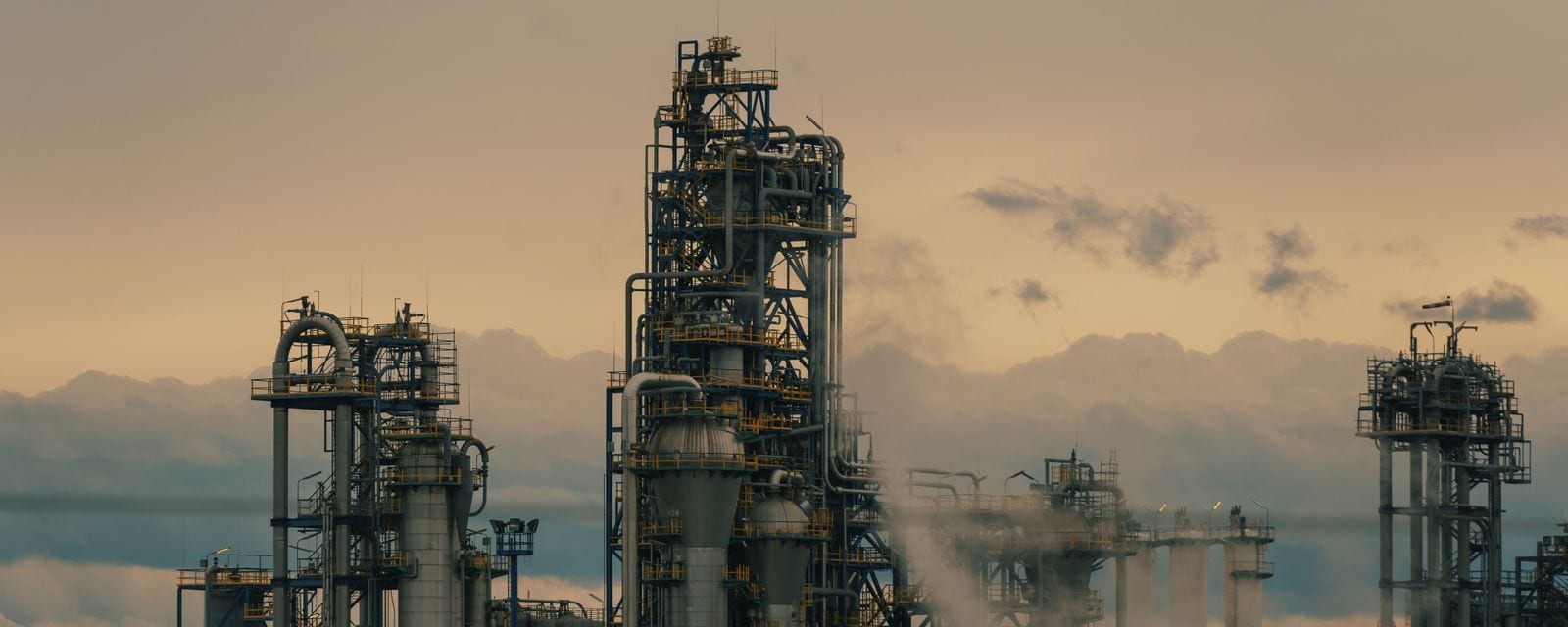
In petrochemicals, fire typically begins with gas leakage. Therefore, detection is dual-layer: gas detection that captures the leak before flame develops, and Ex-proof flame detectors that see the flame within seconds. All equipment must be certified for explosive atmospheres.
Fire risks in this environment
- Flammable gas leakage and explosion risk
- Combustible liquid pool fire
- Hydrogen flame invisibility (UV/Multi-IR required)
- Harsh field conditions (salt, humidity, vibration)
- Toxic gas exposure
Regulations and standards
Explosive atmosphere classification (Zone) and ATEX/IECEx certification are mandatory. Flame detectors are subject to EN 54-10; gas detection is subject to relevant EN standards; SIL SIL level is required in critical applications.
Recommended technologies
Refinery & Petrochemical Fire Safety — the right solution combination and the reasons behind it.
Ex-Proof Flame Detector (IR3 / UV-IR)
Detects flame within seconds in explosive atmosphere; certified ATEX/IECEx.
Related products →Fixed Gas Detectors
Detects flammable and toxic gas leakage before flame develops.
Related products →Hydrogen Flame Detection
Hydrogen flame is invisible; UV or Multi-IR (IR3-H2) is required.
Related products →Typical system architecture
The field is scanned with fixed gas detectors according to gas leak points; process units and tank areas are protected with Ex-proof flame detectors with field-of-view/range calculations. Alarm and fault signals are transmitted to the gas/fire panel and DCS/SCADA; foam suppression is linked to the scenario.
Common field mistakes
- Using standard (non-Ex) equipment in Ex zones
- Using only IR detector in hydrogen atmosphere
- Determining flame detector placement without FoV calculation
- Installing gas and fire detection separately, without integration
- Not specifying SIL requirement in specification
Frequently Asked Questions
Which flame detector for refineries?
Triple IR (IR3) or UV/IR detectors certified ATEX/IECEx are used. If hydrogen risk exists, UV or Multi-IR (IR3-H2) is required; IR alone cannot detect hydrogen flame.
Gas detection or flame detection?
Both together. Gas detection captures the leak before flame develops; flame detector provides intervention within seconds at ignition.
Refinery & Petrochemical Fire Safety — request a quote for your project
Engineering, installation, commissioning and maintenance — from a single source. Free site survey within Ankara.