
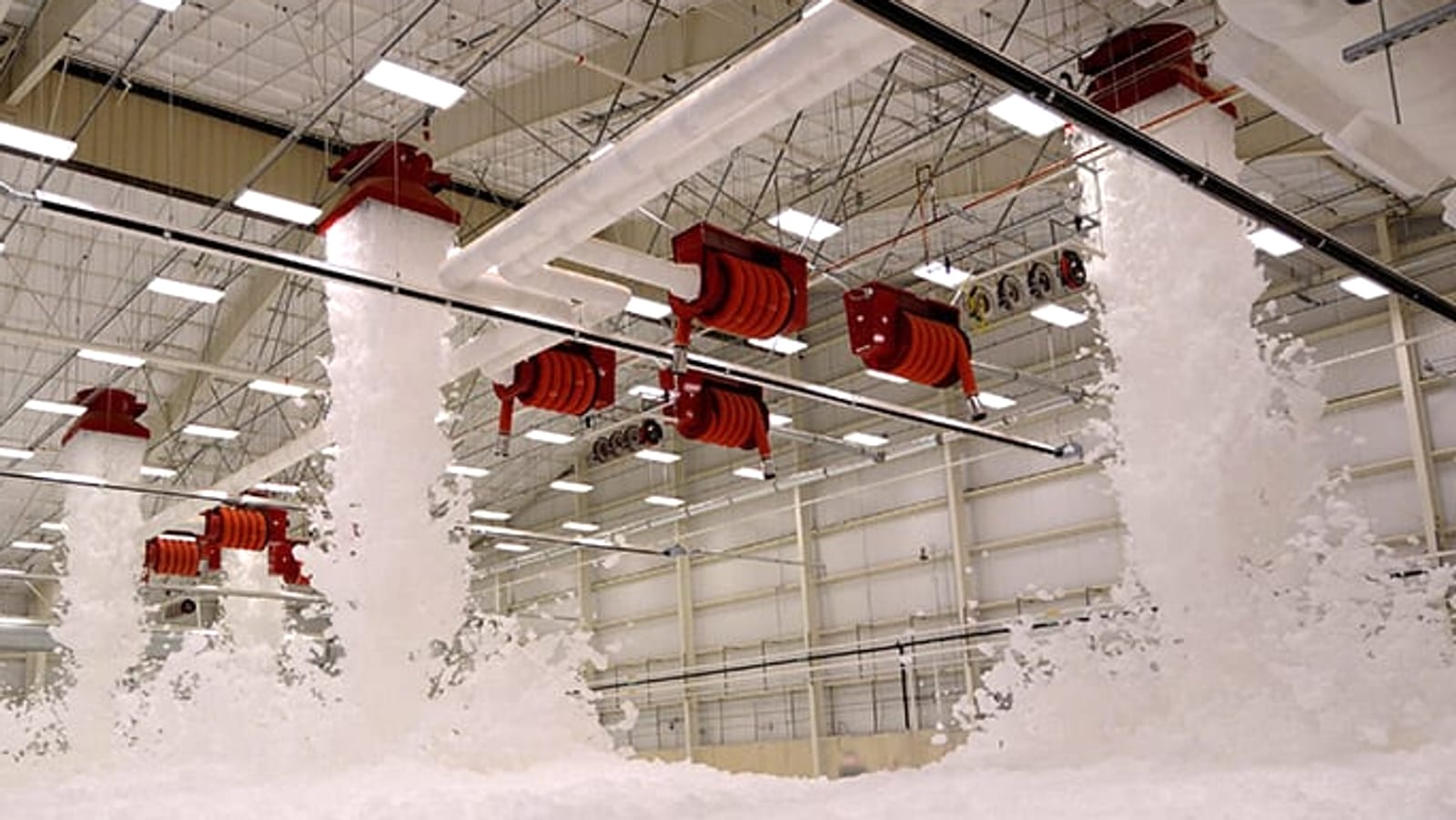
Foam does one thing in flammable liquid fires that water cannot do: it stops evaporation by covering the fuel surface. What extinguishes the fire is not water poured over the flames, but the thin film that enters between the fuel and air. For this reason, in foam systems the actual engineering is not on the water side, but on the correct concentrate mixed in the correct ratio and continuouslyafter suppression.
Where foam is required
Foam systems are considered wherever liquid fires that cannot be extinguished with water or where water extinguishment is dangerous exist:
- Fuel tank farm and in-tank protection. Different application methods are used in fixed-roof, floating-roof, and internal floating-roof tanks.
- Loading and unloading islands, tanker platforms. Areas where spilled fuel can pool and ignite rapidly.
- Aircraft hangar and helicopter landing pad. In hangars, volume-filling with high-expansion foam is generally preferred, while on landing pads, monitor and nozzle application is preferred.
- Solvent, paint, and chemical storage. For polar solvents, alcohol-resistant concentrate is mandatory.
- Transformer and turbine areas. Foam-water spray combination in oil fire.
- Waste and recycling facilities. Foam with wetting capability in cases where water does not penetrate deep pile fires.
- Overflow pools and fuel separators. Coverage of pool surface to prevent fire spread.
Concentrate selection: the first and most critical decision
| Concentrate | Suitable fuels | Note |
|---|---|---|
| AFFF (aqueous film-forming) | Hydrocarbons such as petrol, diesel, jet fuel | Forms a thin water film on the fuel surface; provides rapid extinguishment |
| AR-AFFF (alcohol-resistant) | Hydrocarbons + alcohol, ethanol-blended fuel, acetone, polar solvents | Forms a gel-like barrier in contact with polar liquid; standard AFFF dissolves in these fuels |
| Protein / FP / FFFP | Hydrocarbon, especially tank fires | Resistant to heat and re-ignition, lower fluidity |
| Synthetic / multipurpose | Medium and high-expansion applications | Used in volume-filling based systems |
| Fluorine-free (F3) | According to manufacturer's approval list | Contains no fluorine; performance should be evaluated together with approved fuel list and test protocol |
The most expensive mistake we have seen in the field is a facility with alcohol-containing fuel yet designed with standard AFFF system. The system is complete on paper, but in a real fire the foam blanket collapses within minutes.
Transition to fluorine-free foam
Restrictions on foam concentrates containing fluorinated compounds are progressively expanding in international regulations. This creates two separate questions for operators: which concentrate to select in newly installed systems and how to convert existing systems.
It must be understood from the outset that conversion is not merely changing the liquid in the tank. Fluorine-free concentrates have different flow and foaming behavior; pipeline and tank flushing, re-verification of mixing ratio, and in some cases nozzle or generator replacement are required. The conversion decision cannot be made without reviewing the facility's fuel inventory and the approval scope of the existing system.
Expansion ratio: how much the foam inflates
| Class | Characteristic | 1–2 zones |
|---|---|---|
| Low expansion | Heavy and fluid; spreads over fuel surface, resistant to wind | Tank, loading island, pool fire, monitor application |
| Medium expansion | Lighter; fills limited volumes in a short time | Pooling areas, enclosed process zones |
| High expansion | Very light; fills volume from bottom to top, suppresses heat and smoke | Aircraft hangar, cable gallery, deep storage, waste bunker |
In high-expansion foam system, the air supplied by the foam generator is important: generators supplied with external air do not carry smoke produced by the fire into the foam and produce more stable filling.
Mixing (proportioning) methods
The correct ratio mixing of foam concentrate with water determines the actual performance of the system. Common methods:
- Bladder tank. Pressurized water compresses the flexible bladder inside the tank, pushing the concentrate to the line. Requires no electricity or moving parts; the most common solution for fixed systems.
- Line proportioner. Simple and economical; high pressure loss, provides correct ratio only in a narrow flow range.
- Pump injection. A separate concentrate pump is used; maintains ratio over a wide flow range, requires electricity and control.
- Balanced pressure system. Concentrate and water pressure are equalized by a diaphragm valve; preferred in large multi-zone facilities.
Whichever method is selected, the mixing ratio must be verified by measurement during commissioning. The field-measured value obtained by conductivity or refractive index measurement is valid, not the catalog value. An unmeasured ratio is the most frequently overlooked deficiency in systems.
Application methods
- Foam sprinkler / foam-water spray. Application to the entire area via fixed pipe network; generally with a deluge valve.
- Monitor (top). Remote-controlled high-flow application; tank areas and loading islands.
- Top-of-tank application. Foam chamber or in-tank injection; selected according to tank type.
- High-expansion volume filling. Filling the volume to a certain height with generators.
- Foam fire cart and portable equipment. Solution complementary to fixed system for personnel intervention.
Three numbers in design
- Application flow rate. The amount of foam solution applied per minute per unit area of surface to be protected; determined according to fuel type and application method.
- Application duration. The period during which the system must operate continuously. In tank fires, this period is significantly longer than in area protection applications.
- Concentrate stock. Found by flow × duration × mixing ratio; a re-intervention margin is added. In a facility where stock calculation has not been done, the system operates, but the concentrate runs out before the fire is extinguished.
What should really be measured in maintenance
- Concentrate sample analysis. Concentrate settles, degrades, and is affected by freeze-thaw cycles over time. Taking samples at regular intervals and sending them to laboratory analysis is the only method that shows the true condition of the system.
- Mixing ratio verification. Ratio is measured in the solution taken from the test connection.
- Bladder tank inspection. Tank pressure, discharge valve and bladder integrity; corrosion and sediment inspection.
- Deluge valve and line test. Opening the valve, cleaning the line, and confirming nozzles are not clogged.
- Concentrate expiry date and stock level. Resupply period after discharge must be defined in the facility's operation plan.
We conduct periodic maintenance of foam systems foam suppression maintenance within the scope of. For brand-independent technical specification example foam extinguishing specification page; for introductory explanation of the subject, see foam systems article bakabilirsiniz.
Project and product
For foam concentrates, bladder tanks, proportioners, monitors and foam cart equipment foam extinguishing product group you can review, for concentrate selection, flow and stock calculation for your facility contact us.
Frequently Asked Questions
Where is foam suppression system used?
It is used in locations containing flammable and combustible liquids: fuel tank farms, loading and unloading islands, aircraft hangars and helicopter pads, solvent and paint storage tanks, transformer yards, overflow basins and waste facilities carrying deep-pile fire risk.
What is the difference between AFFF and alcohol-resistant (AR-AFFF) foam?
Standard AFFF creates a thin water film on the surface of hydrocarbon fuels such as gasoline and diesel. In polar liquids such as alcohol, ethanol-blended fuel and acetone, this film dissolves; AR-type concentrate forms a gel-like barrier when in contact with these liquids, keeping the foam blanket intact. If polar liquid is present in the facility, AR-type is mandatory.
How is the transition to fluorine-free foam carried out?
The transition is not merely changing the liquid in the tank. The piping and tank must be flushed of residue, the mixing ratio of the new concentrate must be re-verified in the field, and in some cases the nozzle or foam generator must be replaced. The decision is made after examining the facility's fuel inventory and the approval scope of the existing system.
What is the service life of foam concentrate?
It varies depending on storage conditions and concentrate type; rather than giving a specific year, the correct method is to sample and have it analysed at regular intervals. Concentrate may settle, degrade and be affected by freeze-thaw cycles over time. An unmaintained system will appear full and intact until the moment of discharge.
How is the foam mixing ratio verified?
It is verified by measuring conductivity or refractive index in the solution taken from the system's test connection. Catalog value or nameplate alone is not sufficient; an unverified ratio at commissioning is the most frequently overlooked deficiency in foam systems.