In a commercial kitchen, fire starts in the deep fryer and is carried by the hood exhaust to the plenum and duct. This fire is Class F: water causes hot oil to explode and spread, ABC powder cuts the flame but prevents re-ignition. Hood suppression systems therefore work with wet chemical agent and protect the plenum and duct opening as well as the cooking appliance. This page explains agent selection, system components, NFPA 96 and NFPA 17A framework, acceptance and maintenance schedule.
What's Actually Happening at the Deep Fryer?
In a commercial kitchen, fryer oil is maintained at 170–190 °C throughout the day. When the thermostat fails, temperature rises rapidly; vegetable oils ignite at approximately 350 °C without requiring a spark. The oil surface begins to burn, and the hood exhaust draws the flame upward — into the plenum and ductwork opening.
The real danger is there. An oil film condensing on the duct wall for months is the most calorific fuel in the kitchen and passes through the building interior. Even if the flame at the cooktop is suppressed, if oil adhering to the duct continues to burn, the problem is not the kitchen's but the roof's. This is why the system protects not only the appliance, but also the plenum and duct opening in the same discharge.
Water, ABC Powder, and Wet Chemical: Which One and Why?
Cooking oil fire is a separate class (F in Europe, K in North America). The reason is not the difficulty of suppressing the flame, but its reignitionafter suppression.
| Suppressant | On the oil surface | Reignition | Decision |
|---|---|---|---|
| Water / water mist | Penetrates beneath the oil and vaporizes instantly, spraying hot oil upward | Cannot extinguish | Not used — enlarges the fire |
| ABC dry chemical powder | Interrupts the flame briefly, leaves no lasting coating | High — fire reignites when powder disperses | Not suitable as fixed system |
| Wet chemical | Reacts with oil and leaves a foamy soap layer, which cools by vaporization while drawing heat | Low — the coating persists until oil cools | This is the hood's agent |
Clear statement for the operator: If a fixed system is installed beneath the hood, the agent is wet chemical; water, ABC powder, and CO₂ are not alternatives to this function. A Class F portable device is installed alongside, not in place of,
the fixed system.
System Components
The wet chemical agent waits in a wall-mounted tank outside the cooking line; depending on the system, the tank is either kept under constant pressure (the Buckeye tanks in our catalog come pressurized with nitrogen) or is pressurized by a propellant cartridge when the system is triggered. Nozzles are not distributed on a "a few under the hood" basis; each type aims at a specific surface from a specific height:
- Wet chemical rests in an unpressurized tank mounted to the wall outside the cooking line; upon activation, a propellant cartridge pressurizes the tank. Nozzles are not distributed under the logic of "a few under the hood"; each type is aimed at a specific surface from a specific height: Deep fryer
- — one or more nozzles according to the oil surface area Grill, griddle, wok, salamander
- — separate nozzle and geometry for each appliance Plenum and filter band
- Duct inlet Duct opening
— protects from the inlet according to cross-section, not along the duct flow point compiled by flow points
Detection line and fusible link
Detection line and fusible link
Shut-off components and discharge chain
- Shutoff elements and discharge chain Manual station — located in the discharge path, away from the cooking line [48] Gas shutoff valve
- Gas shutoff valve — mechanically triggered, manually reset; does not open spontaneously
- Electrical shutoff — fryer, salamander, induction supply contactor de-energizes
- Panel contact — discharge signal goes to the fire panel via dry contact
Chain: link breaks or station is pulled → propellant cartridge pressurizes tank → nozzles discharge → gas and electricity shut off → signal sent to panel.
Within NFPA 96 framework, upon activation fuel and electrical supply are shut off; however, stopping the exhaust fan is not necessarily mandatory — the decision must be documented in the design.
Which Standard Covers What?
| Standard | Coverage |
|---|---|
| BYKHY (art. 57) | Mandates automatic suppression with gas detection, shutoff, and alarm in certain commercial kitchens; leaves interval to standard |
| NFPA 96 | Hood, plenum, duct, cleaning, and suppression integration |
| NFPA 17A | Wet chemical system design, installation, inspection, and maintenance |
| UL 300 | Fire test and approval criteria for kitchen wet chemical systems |
| TS EN 17446 | Fixed suppression system requirements for commercial cooking equipment in Europe |
If you write the specification using a neutral title such as hood suppression system technical specification rather than a brand name, you can request proposals from multiple manufacturers.
Duct and Filter Cleaning Are Not the System's Function
The suppression system stops the fire; it does not reduce oil in the duct. Greasy duct cleaning is a separate operational routine; frequency stems from usage intensity — intense charcoal/wood-fired frying kitchens require most frequent cleaning, café kitchens the least. Filter washing is a weekly task. In a kitchen where the duct has not been cleaned in two years, the system still operates, but the nozzle at the duct opening cannot reach burning oil meters away: the system is defined by the first seconds, not by what comes after cleaning.
Acceptance and Maintenance
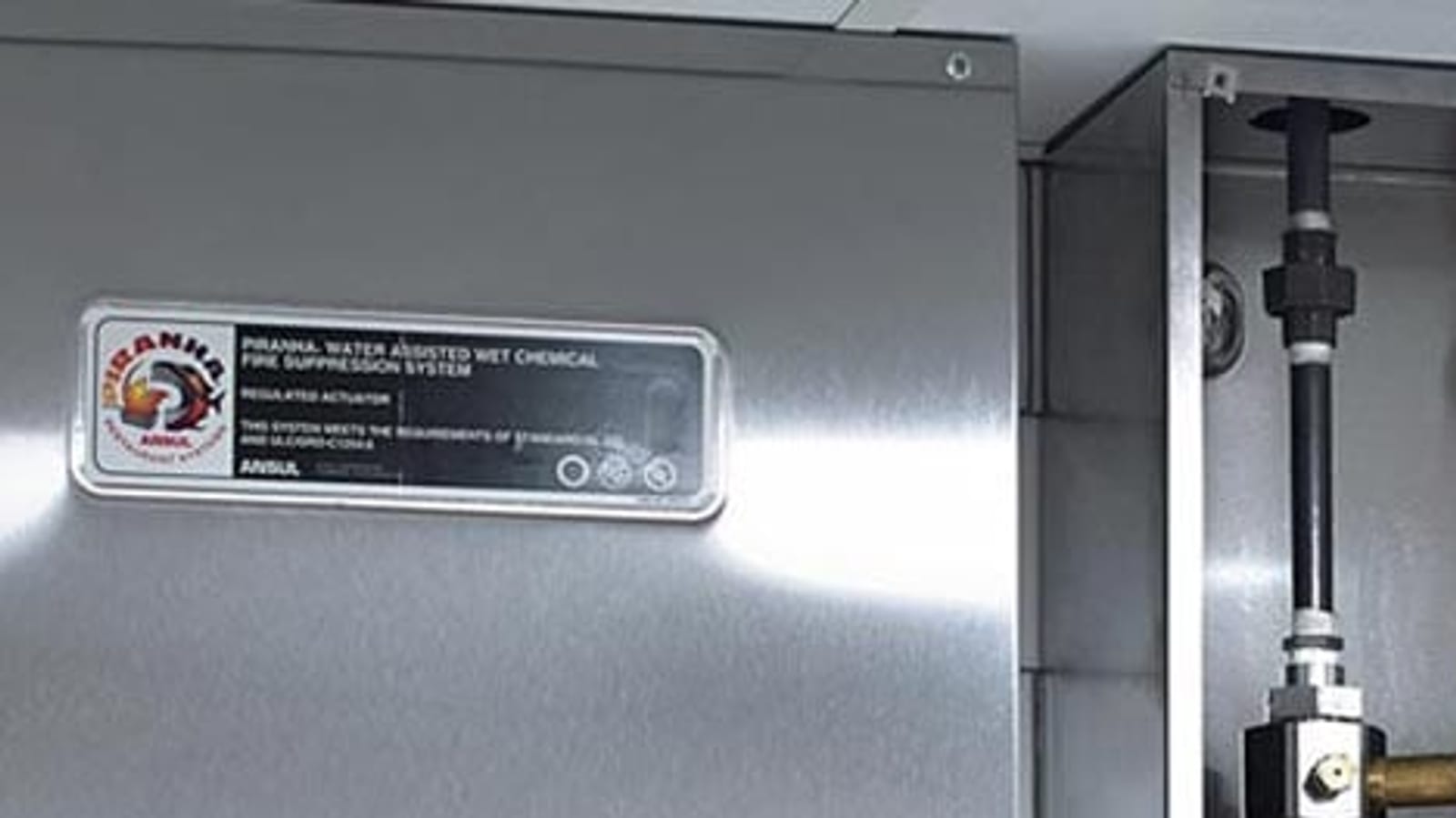
At acceptance, do not rely on declaration alone; request testing: nozzle type and count matching the design and appliance layout, manual station access being unobstructed, the gas valve actually closing, electrical supply dropping, contact reaching the panel. Documentation must include system label, listing certificate, and commissioning report.
The "six months or annually" confusion in maintenance stems from mixing two separate calendars:
- System's own inspection — BYKHY imposes the obligation, defers interval to standard; wet chemical kitchen systems rely on six-month inspection intervals per NFPA 96 and NFPA 17A. Fusible link, nozzle cap, and triggering are in this category.
- Periodic inspection under work equipment scope — a separate obligation; if no specific interval in standard, it runs annually, and its output is the report required in audit.
- Weekly operational check — your team's responsibility: pressure gauge, nozzle caps, station access, filters.
Scope and checklist hood suppression system maintenance page.
Cost and Next Steps
There is no single figure; the kitchen determines it. Line items forming the quote: appliance count and type, total flow points, nozzle count, tank capacity, gas valve diameter, and installation access. Equipment cost and installed and commissioned system cost are not the same; a marketplace listing does not include piping, valve, and commissioning. We have detailed the line items on the items determining price page.
Correct sequence: hood and duct design → appliance placement finalized → suppression design → installation → acceptance. If nozzle location is set before layout is confirmed, the system becomes invalid within months. Field steps are outlined in suppression system installation; for the full restaurant scope, see fire suppression for restaurants page. We conduct remote preliminary diagnosis from kitchen photos and appliance lists and conduct planned regional field work across Turkey; on-site survey is complimentary within Ankara.
Frequently Asked Questions
In which kitchens is a hood suppression system mandatory?
The article on kitchens in the Regulation on Fire Protection of Buildings (art. 57) covers shopping mall and high-rise building kitchens, food factories, and kitchens serving more than 100 people at once; these hoods require automatic suppression with gas detection, shutoff and alarm systems. For operations below this threshold, fire coverage conditions in insurance policies, shopping mall and franchise agreement annexes, and the location of the kitchen within the building lead to the same outcome.
There is a Class F portable cylinder in the kitchen; is a fixed system still necessary?
A portable device requires human intervention; it does not work when personnel are absent or after the flame has climbed into the hood. A fixed system protects the appliance surface, plenum, and duct opening simultaneously, cuts gas and electricity, and sends a signal to the alarm panel. The two are not alternatives to each other: the portable device is in addition to, not in place of, the fixed system.
Does the exhaust fan stop when the system operates?
Most Turkish sources state "the fan stops" without citing a source. Within the framework of NFPA 96 regulating commercial cooking ventilation, shutdown of fuel and electrical supply to cooking appliances is expected upon actuation; stopping the exhaust fan is not mandated in all cases. In some designs, fan operation is preferred because continued rotation carries the agent toward the duct opening; some authorities require stopping as a local additional condition. The decision must be documented in the design and tested at acceptance according to that decision.
How many nozzles and how much agent are required?
In pre-engineered systems, each cooking appliance and each protection point carries a flow point load; the sum of points determines the number of nozzles and tank capacity. As the oil surface area of the fryer, grill or wok type, hood plenum length, and duct opening cross-section change, the result changes. For this reason, the question "how many liters should I get" cannot be answered without a device list and hood dimensions; if the manufacturer's listed upper limit is exceeded, a second tank is added.
Is maintenance performed every six months or annually?
These are two separate obligations, which is why sources appear contradictory. BYKHY imposes the requirement and refers the frequency to the applicable standard; in wet chemical kitchen systems, NFPA 96 and NFPA 17A are based on six-month inspection intervals. Periodic inspection within the scope of work equipment is a separate calendar and runs on an annual basis unless the standard specifies a particular interval. Monthly visual inspection is the responsibility of the facility itself; manufacturers' manuals require this inspection on the basis of NFPA 17A and require a record of it to be kept.
The system has discharged; can I open the kitchen the same day?
First, the gas valve and electrical supply remain shut; no one resets them. Ready-to-eat food touched by agent is discarded; surfaces and appliances are cleaned using the method prescribed by the manufacturer. The tank is taken for refilling; the actuation cartridge, fusible links, and nozzle caps are replaced. Then a function test is performed, the system is set to automatic mode, and a report is signed. The only factor determining the time is spare part availability; the kitchen must not be operated at full capacity until the system is set to automatic mode.
I do not have the duct cleaned regularly; will the system still work?
The system actuates and stops the fire on the appliance, but grease accumulated in the duct is a separate fuel. The nozzle at the duct opening protects only the entrance; it cannot reach ignited grease layers meters away. Greasy duct and filter cleaning is an operation routine separate from the suppression system; frequency is determined by the kitchen's usage intensity and the duct and filter condition must be documented in the maintenance report.