
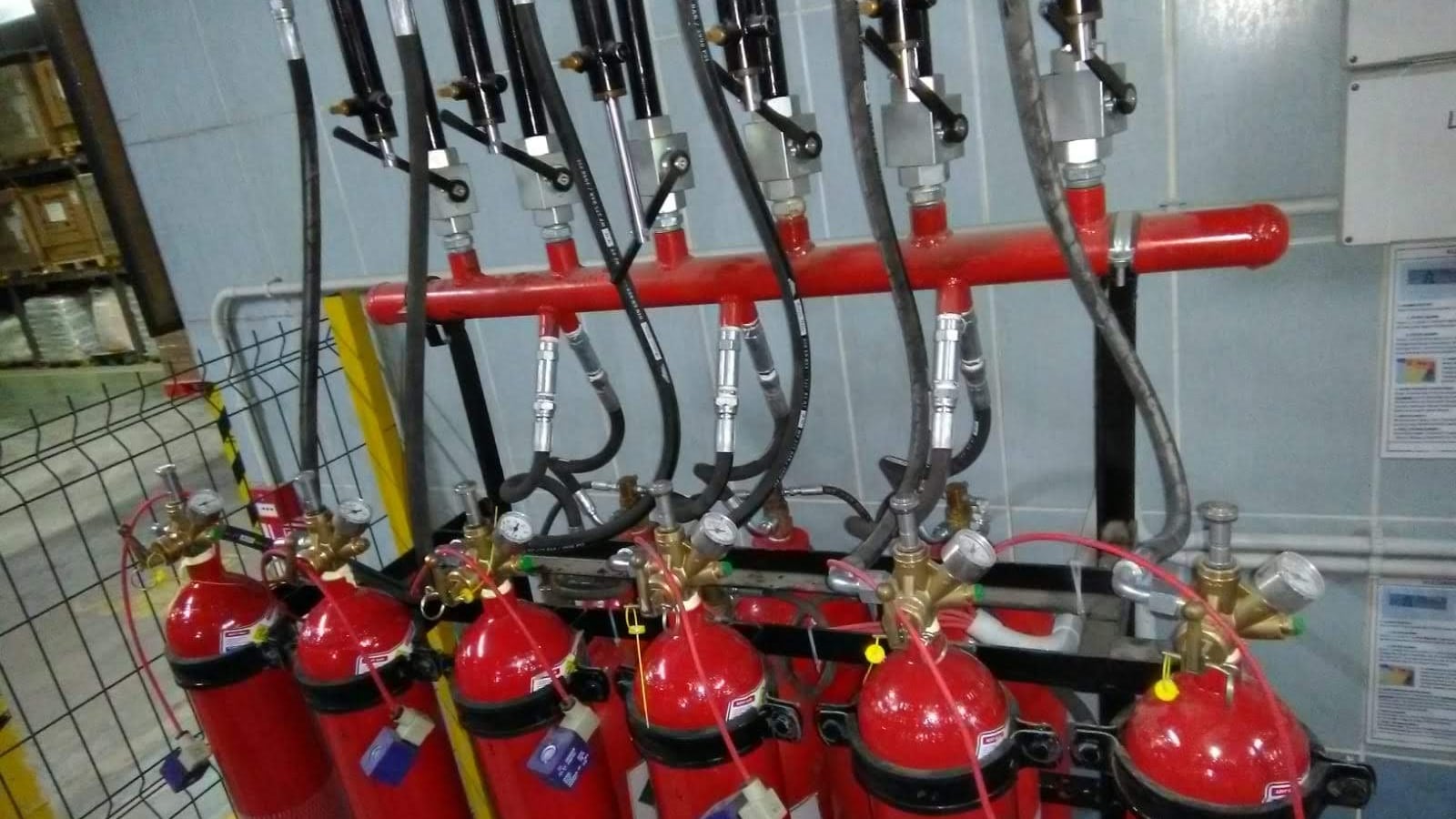
Gaseous fire suppression is for locations where water cannot be used: data centers, server rooms, archives, museums, transformer rooms and control rooms. The gas extinguishes by covering the entire volume of the space, leaving no residue and causing no damage to equipment. In return, it imposes two conditions: the space must be its entire volume verified by calculation. airtight enclosed calculation verified
How Does Gas Suppression Extinguish Fires?
Combustion persists through the combination of four elements: fuel, oxygen, heat, and chemical chain reaction. Gas systems extinguish by interrupting one of these — which one depends on the gas family:
- Clean gases (FM-200, NOVEC 1230) — Primarily absorb heat and interrupt the chain reaction. Because they do not significantly reduce oxygen, they are approved for occupied spaces.
- Inert gases (IG-55, IG-541, argon, nitrogen) — Dilute the oxygen in the space; oxygen falls to a level where combustion cannot continue (typically 12–14%) but remains within a range that humans can tolerate briefly.
- CO₂ — Reduces oxygen to a level where combustion is impossible. This level is lethal to humans.
Gas Families: Which for Where?
| FM-200 (HFC-227ea) | NOVEC 1230 | Inert (IG-541 etc.) | CO₂ | |
|---|---|---|---|---|
| Suppression mechanism | Heat absorption + chain interruption | Heat absorption | Oxygen dilution | Oxygen dilution |
| Occupied space | Suitable (at design concentration) | Suitable | Suitable | NOT SUITABLE — lethal |
| Discharge time | ~10 sec | ~10 sec | ~60 sec | Variable |
| Cylinder volume | Low | Low | High — separate cylinder room may be required | Medium |
| Environment (GWP) | High — subject to the HFC phase-down schedule | Very low | Zero (natural gases) | Low |
| Typical location | Current applications | Data center, archive, museum | Large volume, environmentally conscious project | Unmanned control panel / machine space |
Selection note: In new projects, NOVEC 1230 and inert gases are taking the lead; FM-200 has a high global warming potential (GWP) and is subject to the HFC phase-down schedule; its use is not banned, but supply may become harder as import quotas shrink. Inert gas is the most environmentally clean option but requires significantly more cylinders — if space is not allocated at project start, it becomes a difficult problem to solve later.
Cross-Zone Approval and Discharge Scenario
A gas system does not discharge on alarm from a single detector. The space is protected by two independent detection zones (A and B); detectors are installed alternately toward the ceiling with cross-wired lines, so the same point is seen by two different zones.
The typical scenario operates in this sequence:
- A detector in zone A detects → siren sounds intermittently. Gas does not discharge. This is a "go check" alert.
- A detector in zone B also detects → cross approval is completed. Siren goes continuous, bell activates.
- Delay timer runs (typically 30 sec) — personnel evacuate; air conditioning stops, dampers close.
- Time expires → command line from the panel opens the cylinder's solenoid valve, gas travels through pipe to nozzle and fills the space.
Why so much complexity? Because false alarm discharge from a single detector is both dangerous and very expensive: cylinder refills, lost work days, and space evacuation. Cross approval reduces this risk to nearly zero.
Panel and cylinder bank are located outside the space, next to the entry door — so manual activation or cancellation can be performed without entering a gas-filled room. Inside the space, a siren is installed so personnel working there hear the initial alarm and can exit before time expires.
For an animated explanation of the scenario, see the "How Systems Work" section on the home page → Suppression → Gas Suppression diagram.
Space Airtightness: The System's Most Critical Condition
Gas extinguishes by filling the space its entire volume at a specific concentration, and this concentration must be maintained for a set duration (hold time, typically 10 minutes) to prevent fire reignition.
If the space leaks, gas escapes, concentration drops, and fire returns. Leak paths are nearly always the same:
- Cable and pipe penetrations (not sealed with fire-stopping)
- Gaps under doors and around door frames
- Unclose-able ventilation dampers
- Leak paths under raised floors and above suspended ceilings
For this reason, an airtightness test (door fan test) is performed at acceptance. A fan is mounted on the door, the space is pressurized, and leak flow is measured to calculate hold time. A gas system without a test report exists on paper but has no guarantee it will actually work.
Specification note: If the specification does not include "airtightness test shall be performed and hold time shall be reported," this work is usually not done.
Discharge Calculation and Pressure Relief Damper
Gas quantity is not determined by guesswork; it is calculated. The calculation depends on the space's net volume, design concentration, minimum and maximum ambient temperature, and altitude above sea level. Pipe diameters and nozzle holes are also determined by separate flow calculation — gas exiting the nozzle must distribute homogeneously in the space.
The most frequently omitted item is the pressure relief damper. As gas discharges in seconds, a sudden pressure rise (or in inert gases first rise, then drop) occurs in the space. If this pressure is not relieved:
- Drywall walls and suspended ceilings can be damaged
- Doors can open — gas escapes, suppression fails
- The space can sustain structural damage
The damper's cross-section is also calculated; "just install one" is not sufficient.
Where Is It Used?
- Data center and system room — water destroys equipment; downtime cost exceeds hardware value
- Museum, archive, library — artifacts and documents suffer irreversible damage from water
- Transformer, panel, and control rooms — energized equipment
- Hospital imaging and system rooms — MR/CT equipment
- Generator room, engine room, CNC and paint spray booths
For small volumes (single panel, transformer cell), a gas system is often replaced by aerosol on economic grounds: it requires no pressurized cylinder or piping installation.
Common Field Mistakes
- Omitting airtightness testing — this is the only proof the system will work
- Omitting the pressure relief damper or failing to calculate its cross-section
- Discharge on single detector alarm — cross approval not installed
- Failing to program air conditioning and damper shutdown before discharge — gas escapes through ventilation
- Using CO₂ in occupied spaces
- Not sealing cable penetrations with fire-stopping — most common leak path
- Selecting inert gas without allocating cylinder room space — unsolvable problem mid-project
- Not periodically weighing cylinders — a silently discharged cylinder is a non-existent system
For small volumes such as electrical panels, UPS cabinets, and machine spaces, the same clean gases are used as micro systems ; see its comparison with aerosol and detection-hose solutions on our panel suppression page.
Maintenance
A gas system is not "installed and forgotten." Cylinder weight and pressure checks, solenoid valve and command line testing, detector function testing, and scenario (cause & effect) validation must be performed and documented periodically. Modifications to the space (new cable penetration, partition wall) compromise airtightness — testing must be repeated after modification.
For the only measurement proving the space actually holds gas, see our room leakage test (door fan) page; for options that extinguish by diluting oxygen, consult our CO₂ and inert gas suppression guide.
Mevcut Bir Gazlı Sistemi Devralmak
Kurulu bir sistemin bakımını devralmak, sıfırdan kurmaktan farklı bir iş. Devraldığımız sistemlerde ilk ziyaret bir kontrol ziyareti değil, envanter ziyareti oluyor: hangi gaz, kaç tüp, hangi hacim, hangi panel.
Devirde istediğimiz belgeler şunlar: hesap dosyası (hacim, derişim, madde miktarı), tüplerin son basınçlı kap muayene kayıtları, en son yapılan oda sızdırmazlık ölçümü ve varsa boşalma olay kayıtları. Bu dört belge bulunduğunda sistemin geçmişi görülüyor; bulunmadığında ilk yıl bu geçmişi yeniden kurmakla geçiyor.
Envanterde ayrıca hacmin bugünkü hâli ölçülüyor ve hesap dosyasındaki değerle karşılaştırılıyor. Yıllar içinde eklenen bir kabin, kaldırılan bir asma tavan ya da değiştirilen bir havalandırma, hesabı sessizce geçersiz kılmış olabiliyor. Fark bulunduğunda bunu ölçülmüş değerlerle yazılı bildiriyoruz.
Devir sonunda tesise bıraktığımız şey bir rapordan fazlası: numaralanmış tüp listesi, güncel hacim ölçüsü, açık kalan eksikler ve bunların öncelik sırası. Sonraki yıllar bu tablonun üzerine yürüyor.
Explore gas suppression products → · Suppression control panels →
Frequently Asked Questions
Başka bir firmanın kurduğu gazlı sistemin bakımını devralıyor musunuz?
Devralıyoruz. İlk ziyaret bir envanter çalışması oluyor: hangi gaz, kaç tüp, hangi hacim, hangi panel. Hesap dosyası, basınçlı kap muayene kayıtları, son sızdırmazlık ölçümü ve olay kayıtları isteniyor.
Belgeler bulunamazsa ne oluyor?
Sistemin geçmişi hakkında bir boşluk kalıyor ve ilk yıl bu geçmişi yeniden kurmakla geçiyor: hacim yeniden ölçülüyor, tüpler numaralanıyor, mevcut durum sıfır noktası olarak kaydediliyor.
FM-200 or NOVEC 1230?
Both are clean gases and can be used in occupied spaces. The difference is environmental: FM-200 has a high Global Warming Potential (GWP) and is subject to the HFC phase-down schedule (its use is not banned); NOVEC 1230 has a very low GWP. In new projects, NOVEC or inert gas is preferred; FM-200 is more relevant for the continuation of existing systems.
Is room tightness test (door fan test) mandatory?
Yes. Gas extinguishes by filling the volume and must maintain concentration for a certain period (typically 10 minutes). If the room leaks, gas escapes and fire returns. In the test, a fan is attached to the door, leakage flow is measured and holding time is calculated. A system without the report has no guarantee of functioning.
Does the room sustain damage when gaseous suppression is discharged?
No, if the pressure relief damper is correctly sized. If the damper is absent or undersized, the sudden pressure rise during discharge can damage drywall partitions, suspended ceilings and doors; if the door opens, gas escapes and suppression also fails.
Why are two detectors required; is one detector not sufficient?
A single detector's false alarm would cause gas discharge—dangerous for occupants and very costly (cylinder refill, downtime). For this reason, the space is protected by two independent zones and gas discharges only when both zones confirm, after the delay period.
Why are cylinders located outside the room?
In case of gas discharge, one must be able to manually activate or cancel the system without entering the affected space. For this reason, the panel and cylinder assembly are positioned outside the space, near the entrance door. Only a siren is placed inside, so occupants can hear the initial alarm and evacuate.
Can I use aerosol instead of a gaseous system?
Yes, for small enclosed volumes (panel, transformer cell, small technical room)—an aerosol generator does not require pressurized cylinders and piping, making it much more economical. For large spaces and occupied areas, gaseous systems are preferred.