
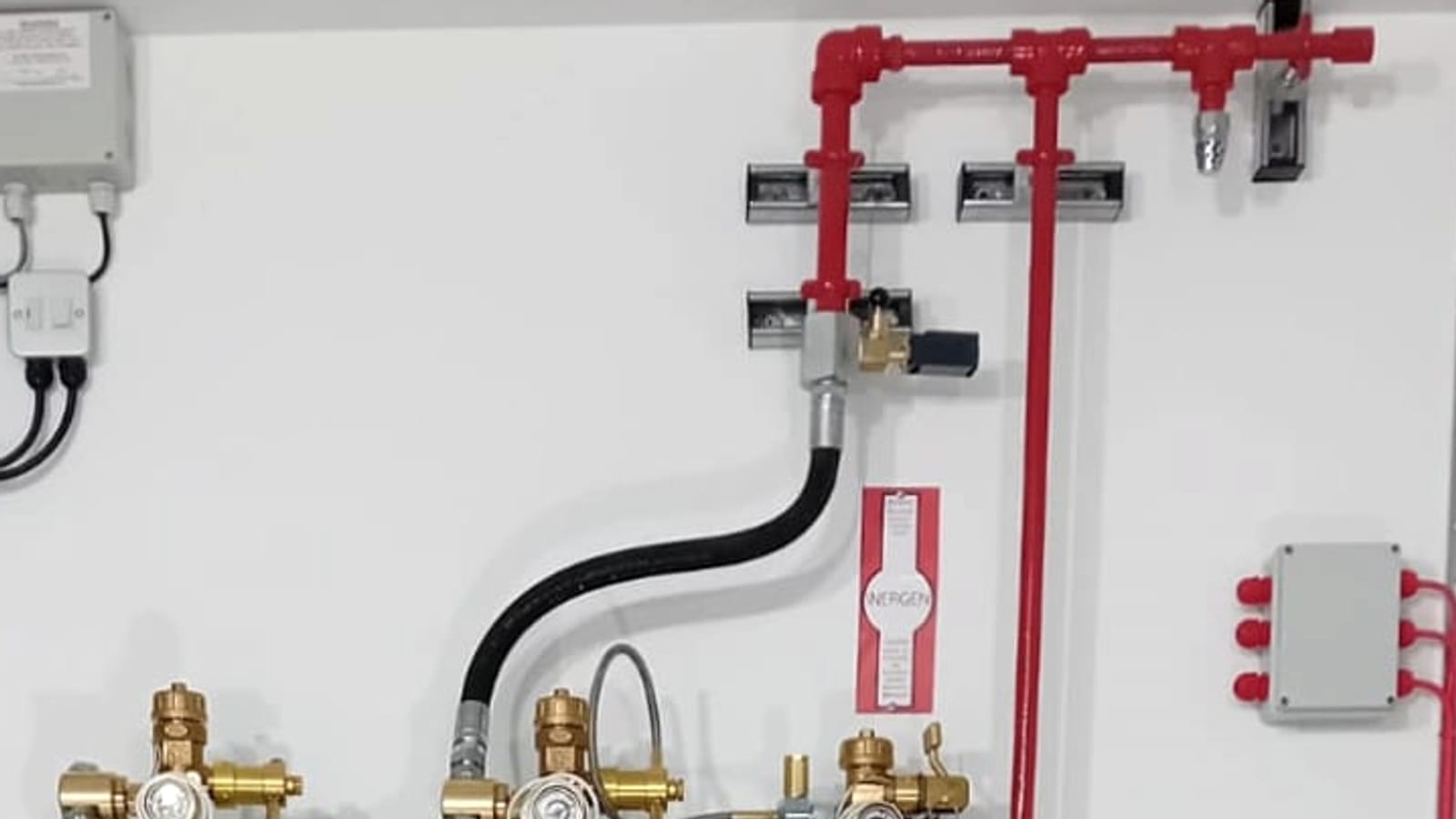
In-panel suppression, extinguishing fire without opening the cover, a small-scale automatic system that terminates the fire in the volume where it started. Three technologies compete in the field: condensed aerosol generator, FK-5-1-12 (NOVEC 1230) and HFC-227ea (FM-200) micro systems. All three operate with the same detection hose, without electrical and suppression panel; selection is determined by the panel volume, the residue sensitivity of the electronics inside, and the cost after discharge.
Panel fire starts inside a closed box
Panel fire does not require external sparks; the danger is inside the box:
- Loose terminal or busbar connection — contact resistance increases, connection heats under load; goes undetected for months unless checked with thermal camera.
- Arc — degraded insulation produces series arc; does not trip protection threshold but ignites insulation.
- Dust and moisture — conductive dust creates tracking path on insulator surface, surface leakage begins with moisture.
According to a bulletin from the Chamber of Electrical Engineers, approximately one third of residential and commercial fires in our country are electrical in origin, with approximately seventy percent starting in installation or panel. Fire occurs where general protection sees it last: the panel is a closed steel box, smoke accumulates inside; when alarm sounds, flame has already jumped to the cable tray. Panel interior detection and suppression both rely on cabinet interior placement.
Three technologies, three different weak points
These solutions are pre-engineered low-pressure systems: they do not require hydraulic calculation, nozzle calculation, or detection panel. The difference lies in what happens inside the panel and what occurs after discharge.
Condensed aerosol generator
When solid component is triggered, potassium salt particles under 10 microns are released and break the combustion chain by capturing free radicals in flame. No pressurized vessel, tubing, or nozzle; generator mounts directly to panel — lowest space requirement, lowest initial investment option. Two limitations: discharge is exothermic, safety distance specified by manufacturer must be observed; salt residue deposits on surfaces and requires cleaning. If residue-sensitive electronics are present, clean agent is selected.
FK-5-1-12 micro system (known in market as NOVEC 1230)
Fluorinated ketone-based clean agent remaining liquid at room temperature; cools by evaporation. Non-conductive, leaves no residue. Global warming potential in single order of magnitude, not subject to F-gas reduction. Supply note: NOVEC 1230 is a brand name; its manufacturer has ceased production; as patent has lapsed, agent is produced by others under FK-5-1-12 code — write agent code not brand in specification.
HFC-227ea micro system (FM-200)
Clean agent combining heat absorption with chain breaking, with longest field history. Leaves no residue; refill network is most widespread in Turkey, typically lowest initial investment among clean agents. Weak point is environmental: GWP in thousands order of magnitude and subject to F-gas reduction — refill cost a decade ahead must be considered.
| Technology | Operation | Residue | Restart capability | 1–2 zones |
|---|---|---|---|---|
| Kondanse aerosol | Salt cloud breaks chain | Present — moisture absorber | Single-use, no refill | Distribution panel, transformer cell |
| FK-5-1-12 (NOVEC 1230) | Cools by evaporation | None | Cylinder weighed, refilled | Server cabinet, drive panel |
| HFC-227ea (FM-200) | Cools, breaks chain | None | Most common refill network; F-gas risk | UPS cabinet, MCC, machine panel |
Detection hose: no electricity, no panel, autonomous operation
All three have the same backbone: a polymer detection hoselaid inside the panel, pressurized to approximately 12 bar with nitrogen. When fire heats hose to approximately 100–110 °C, hose ruptures, pressure drops, cylinder valve opens. System requires no electricity, battery, or panel; protects even when power is cut.
Direct (DLP) system: hose serves both as detector and nozzle; agent discharges directly from rupture point onto flame, suitable for single-volume small panels. Indirect system: hose detects only, suppression via separate piping and nozzles; multi-compartment and large panels are protected this way, fans are stopped during discharge. Pressure switch activates siren, stops fan and if needed machinery; contact can also be sent to detection center. Automatic power disconnection is a separate device (solenoid to trip breaker).
Success depends on seal integrity: if cable gland is open or cap gasket faulty, agent leaks, concentration fails. Passage hole opening in body affects IP class and type test (IEC 61439) compliance; correct fitting must be used, later additions must be checked with manufacturer.
Which system for which panel: decision depends on six criteria
- Panel volume — length × width × depth. Circulating statement "protects up to 8.5 m³" is not general rule, applies to specific cylinder–agent combination.
- Electronic sensitivity — if switchgear and busbar present, aerosol residue is manageable; if card, drive, PLC, or server present, use clean agent.
- Restart capability — in aerosol, generator is replaced; in clean gas, cylinder is refilled; difference shows in ten-year total.
- Certificate — in aerosol TS EN 15276-1/-2, ISO 15779, NFPA 2010; in clean gas TS ISO 14520 / EN 15004, NFPA 2001; in cylinder TPED/CE.
- Service life — aerosol generator is replaced when expired; clean gas cylinder is in weighing and hydrostatic test cycle.
- GWP — aerosol and FK-5-1-12 unconstrained, HFC-227ea subject to restriction.
Applications: distribution, compensation and MCC panels; UPS, rectifier and battery cabinets; CNC and machine volumes; server cabinets in data centers; cells and generator in energy and transformer facilities. Panel interior suppression is not a general legal requirement; becomes mandatory through insurance risk report, tender specification, or customer audit. Area protection gaseous suppression page.
What happens after discharge, how maintenance operates
Discharged system does not automatically return to protection. First power is cut and source is found — system extinguishes fire, does not eliminate cause. In clean gas, panel is checked and in most cases can be energized same day; in aerosol, salt residue must be cleaned before power is restored, because moisture-absorbing residue causes surface leakage. Then refill or generator replacement is performed.
Circulating "3 month / 6 month / 1 year" contradiction arises from sources meaning different things. Regulation on Fire Protection of Buildings refers period to standard: in clean gas TS ISO 14520 / NFPA 2001, in aerosol TS EN 15276 / NFPA 2010; manufacturer may require more frequent inspection. Line items panel interior suppression maintenance page.
What determines cost
Marketplace price of "panel interior suppression cylinder" includes only cylinder and agent. Cost of installed system is determined by panel volume and agent quantity, agent type, system type, hose length, in indirect system piping and nozzle count, pressure switch, seal integrity workmanship, commissioning and post-discharge refill. What distinguishes product with documented design guide from undocumented product is not price but acceptability. Item breakdown maintenance prices on page, products in suppression catalog.
Suppression is the last link in panel safety; before it come torque inspection, thermal scanning, arc fault protection (AFDD), and in critical cells early detection to prevent fire from starting at all. We bring entire chain from hose in panel to gaseous system in area under single contract, and add camera (CCTV) if requested.
Frequently Asked Questions
Does a cabinet suppression system require electricity to operate?
No. It is a pre-engineered low-pressure system: the detection tube is pierced by heat, the cylinder valve opens mechanically. No mains power, battery, or suppression control panel is required; it protects even when the cabinet is de-energized. The pressure switch connected to the system is used to activate the siren, stop the cabinet fan or powered equipment, and send a contact to the fire detection center.
Is the cylinder mounted inside or outside the cabinet?
The cylinder and bracket are typically fastened outside the cabinet, near the enclosure; only the detection tube is routed inside the cabinet, and in indirect systems additionally the piping and nozzles are installed. In very small enclosures there are applications where the cylinder is placed inside. The determining factor is that the hose routing must pass over points with heating potential.
Should I choose aerosol or clean gas?
Look at what is inside the cabinet. In a distribution cabinet consisting only of switches, contactors and busbars, condensed aerosol is the most compact and most economical solution. If there is equipment sensitive to residue such as cards, drivers, PLC or servers, the residue-free FK-5-1-12 or HFC-227ea is preferred. In very small volumes such as meter and counter boxes, micro-capsule pads and cords opening at approximately 120 °C are used; these require no electricity but do not replace the main cabinet suppression.
How many kilograms does my cabinet need, is "one system protects up to 8.5 m³" correct?
That statement is not a general rule; it is a manufacturer value specific to a particular cylinder–agent combination and cannot be applied to every cabinet. The correct approach is as follows: calculate the net volume of the cabinet (width × height × depth), determine the agent type and design concentration, then go to the volume–weight table in the manufacturer's listed design guide for that cabinet. In compartmented cabinets each compartment is counted as a separate volume.
Must the cabinet be de-energized during installation?
Since the cylinder and bracket are mounted outside the cabinet, this part can be performed without de-energizing. Installing the hose inside and drilling the passage hole through the enclosure requires that the relevant section be de-energized. For this reason work is planned on a compartment basis and scheduled into the planned maintenance window; shutdown of the entire facility is not required in most projects.
If NOVEC 1230 production has ceased, what happens to my existing system?
What has been discontinued is the brand name, not the agent. The substance you are looking for is FK-5-1-12 and since the patent has expired it continues to be manufactured by other producers; refilling can be done with this agent code. Writing the agent code instead of the brand name in new specifications allows you to obtain quotations from multiple suppliers in the future and ensures continuity of refilling supply.
After the system is discharged, will the cabinet operate again, is cleaning required?
First the cause of the fire is found and eliminated; the system extinguishes the fire, it does not eliminate the cause. In a clean gas system there is no residue so the cabinet can be visually inspected and in most cases energized the same day. In aerosol, potassium salt residue is hygroscopic so it must not be energized without cleaning. Subsequently cylinder refilling or generator replacement, renewal of the detection tube and pressure switch reset puts the system back into service.