
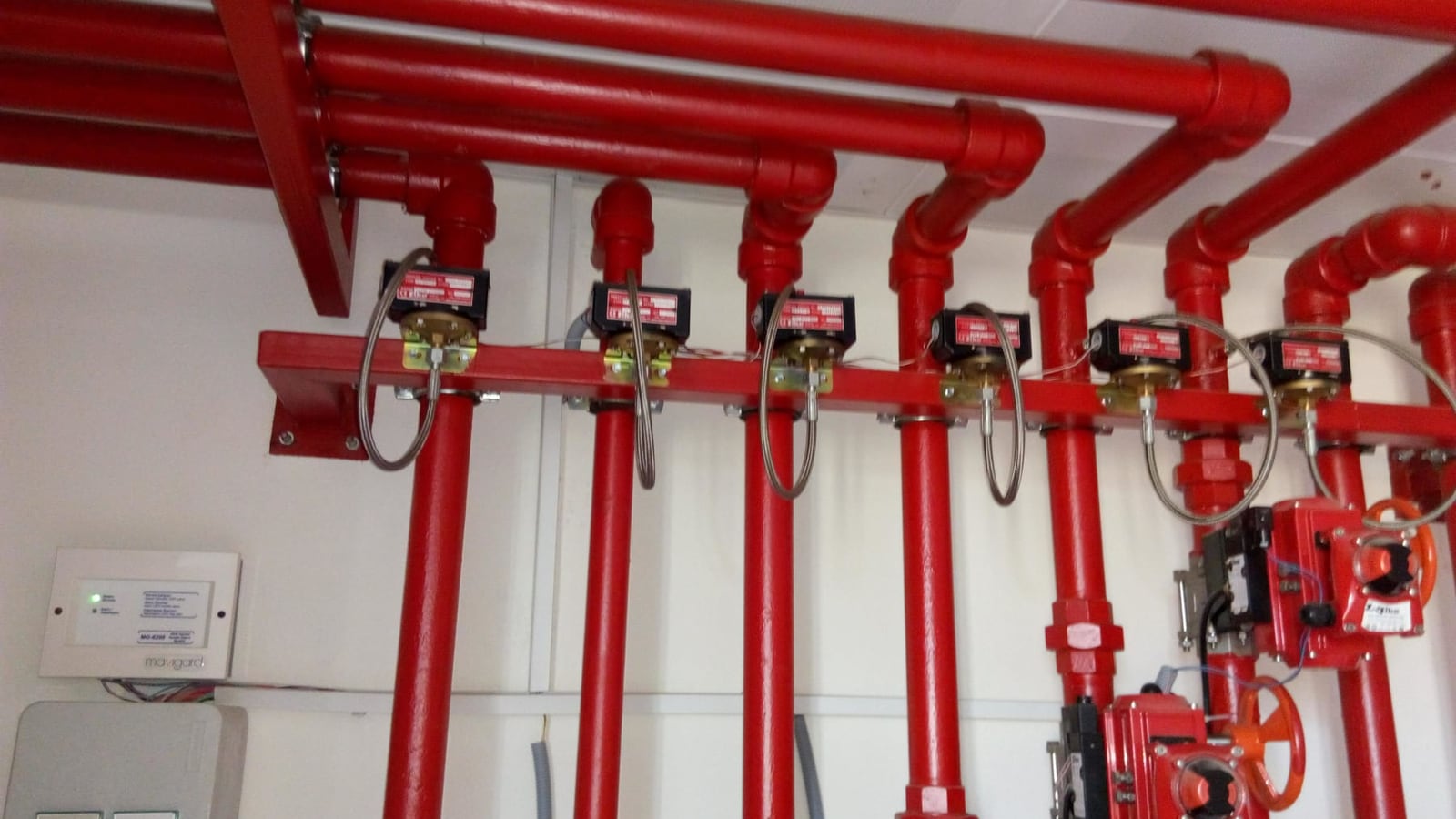
The sprinkler is the most common and most misunderstood system of automatic fire suppression. Each head contains a glass bulb filled with liquid that plugs the pipe; the heat of the fire bursts the bulb, only that head su verir. BYKHY, yapı yüksekliği 30,50 m’yi aşan konut dışı binalardan büyük kapalı otoparklara ve 100’den fazla odalı ya da 200’den fazla yataklı otellere kadar birçok yapıda sprinkler’ı zorunlu kılar (Madde 96/2).
How Sprinklers Work
A sprinkler system consists of a piping network maintained under constant pressure and heads connected to this network. Each head contains a liquid-filled, heat-sensitive glass bulb (or fusible link) that physically blocks water discharge.
The heat from the fire warms the bulb, the liquid inside expands, and the bulb bursts. The plug is removed, pressurized water flows out, and the deflector plate beneath the head distributes water over the fire.
The shape of the head depends on where it is installed: the pendent head facing down from a suspended ceiling, the upright head sitting on top of exposed pipe, the sidewall head throwing water into the room from near the wall, or the concealed head hidden in the ceiling behind a cover plate. Which one is chosen where is explained in detail in our sprinkler head types guide.
Critical point: This is entirely mechanical and localized. The panel cannot open a head; smoke cannot open a head; an alarm cannot open a head. For a head to open, there must be fire heat directly beneath that specific head. This is why only 1–2 heads operate in a typical fire, and water damage remains limited to the fire itself.
The panel's role is limited: a flow switch in the line reports "water is flowing", and the panel starts the alarm. The panel does not start the pump: when the line pressure drops, the pump starts through its own pressure switch.
Bulb Temperature Classes
The bulb color indicates the burst temperature. Temperature is selected at approximately 30 °C above the location's normal maximum temperature — otherwise the head will open spontaneously in summer heat or in a boiler room.
| Bulb color | Temperature | Typical location |
|---|---|---|
| Orange | 57 °C | Cold locations |
| Red | 68 °C | Most common — offices, corridors, parking lots, shops |
| Yellow | 79 °C | Hot locations |
| Green | 93 °C | Near kitchens, attics |
| Blue | 141 °C | Boiler rooms, oven surrounds |
System Types: Wet, Dry, Pre-Action, Deluge
| Type | What is in the pipe | Where | Note |
|---|---|---|---|
| Wet pipe | Water (pressurized) | All heated locations — offices, hotels, shopping centers, hospitals | Simplest, fastest, most common |
| Dry pipe | Pressurized air; water arrives when head opens | Locations with freezing risk — unheated car parks, cold stores, open storage | Water arrives with a delay; pipe volume is limited |
| Pre-action | Air; the valve opens only on a detection signal | Data centers, archives, museums — locations where accidental water is unwanted | An accidentally broken head does not discharge water; single- and double-interlock types exist |
| Deluge | Empty; heads are bulbless/open | Tank farms, transformers, rapid-spread fire risk | When triggered, all heads release water simultaneously |
Attention: "All open at once" is true only for deluge systems — and there it is a deliberate design choice, because flammable liquid fires spread across the entire area in seconds. Normal sprinkler systems do not exhibit such behavior.
Each type has its own control valve at its head: in a wet system, the alarm valve, in a dry system the dry alarm valve, in a deluge system the deluge valve. The valve type also determines how the system is triggered.
Why Pre-Action Systems Exist
In locations like data centers, there are two fears: fire and accidental water. In a pre-action system, the pipe contains no water; water fills the pipe only if the detector triggers and the bulb also bursts before water flows out. If a forklift accidentally breaks a head, no water flows — because the detector has not alarmed. This describes a single-interlock system; the difference of the double-interlock and non-interlock types is explained in detail in our pre-action sprinkler system guide.
Hazard Classification and Water Discharge Rate
The heart of sprinkler design is not head count, but hydraulic calculation. The location is classified by hazard based on fire load, and for each class, the required water density (mm/min) and the assumed simultaneous coverage area are determined:
- LH — Light Hazard: schools, offices, hospital rooms. Low fire load.
- OH — Ordinary Hazard: parking lots, shops, restaurants, manufacturing. Most commercial buildings fall here.
- HH — High Hazard: high-bay storage, plastic/rubber storage, flammable liquids. Highest discharge rate.
In storage facilities, also storage height and rack type directly affect calculations; ceiling heads alone are insufficient for high racks, in-rack heads may be required.
The practical consequence: If a facility's use changes (office → warehouse, warehouse → plastic storage), the existing sprinkler system becomes inadequate. Simply saying "the system already exists" is not sufficient; calculations must be redone for the new fire load.
The pressure at which the design density leaves a head is set by the head's K-factor — the same flow comes from a head with a larger K at a lower pressure.
Fire Pump and Water Tank
A sprinkler system is only as good as the water source behind it. The city water supply alone is not considered adequate; the system requires:
- Fire water tank — sized to deliver the calculated flow for the calculated duration (how is the tank volume calculated?)
- Main pump (electric) + backup pump (diesel) — if the power fails, the system must keep running
- Jockey pump — compensates for minor leaks and maintains pressure in the network; prevents unnecessary operation of the main pump
A "sprinkler system" without a pump room and a water tank is just pipework that delivers water for a few minutes in a fire and then falls silent. We explain how the pump set works on the fire pump page, and how the flow and the pump head are found on the fire pump calculation page. In tall and large buildings, a fire brigade inlet connection is also mandatory, so that the fire brigade can pump water into the system from its own vehicle.
Common Field Mistakes
- Distributing heads without hydraulic calculation — the most common and costliest mistake
- Installing a wet system in a car park at risk of freezing — pipes freeze and burst; a dry system is required there
- Wrong bulb temperature — installing 68 °C heads in a boiler room causes spontaneous opening
- Blocking the head's face — suspended ceilings, ducts, shelves, or curtains prevent the deflector from distributing water; the head opens but water does not reach the fire
- Failing to update calculations when use changes — a system calculated for office use becomes insufficient when converted to storage
- Failing to monitor valves — a closed main valve disables the entire system; valves must be connected to the panel with supervisory switches
- Neglecting pump tests — if the diesel pump does not work, there is no system during a power cut (fire pump testing)
- Spacing hangers too far apart — water-filled pipe overloads the hangers and the line sags; spacings are defined in the standard (hanger spacing)
- Skipping seismic bracing in first- and second-degree earthquake zones — BYKHY Article 96 requires four-way bracing for risers and sway bracing for pipes (seismic bracing)
Regulations
The legal basis for the sprinkler requirement is BYKHY; design and calculations are carried out to EN 12845 (and, depending on the project, NFPA 13). We explain threshold by threshold which buildings fall within scope on our mandatory sprinkler thresholds page. Documents required at acceptance: hydraulic calculation report, pump performance test, and flow test records.
Installation Sequence
Sprinkler installation is not a single job; it is a process that runs intertwined with the other work in the building. Getting the sequence wrong means tearing out work that has already been done.
The rough sequence is: first the main supply line and the pump room, then the floor manifolds, then the branch lines and finally the heads. Heads are installed after the ceiling work is complete; heads installed too early are damaged by paint, plaster and dust.
Clashes with other trades happen most often in the ceiling void. Ventilation ducts, cable trays and sprinkler branch lines share the same narrow space. Resolving these routes together at the design stage is far cheaper than rerouting pipework on site; every detour means extra elbows and extra pressure loss.
The pressure test is carried out before the ceiling is closed. A leak found in the test costs far less than one found after the ceiling is closed. The acceptance document includes the result of this test and is requested during the compliance process.
Commissioning tests three things together: pump start-up, flow at the most unfavorable point, and the flow switch signaling the panel. All three are recorded in the report with measured values.
Frequently Asked Questions
When are sprinkler heads installed?
After the ceiling work is complete. Heads installed too early are damaged by paint, plaster and dust; when the heat-sensitive element gets dirty, its response is delayed.
At what stage is the pressure test carried out?
Before the ceiling is closed. A leak found in the test costs far less than one found after the ceiling is closed; the test record is requested during the compliance process.
Do all sprinklers open at once when the alarm sounds?
No. This is the most common misconception in this sector. Each head opens with its own bulb, only by the fire heat beneath it; the panel, smoke, or alarm cannot open a head. In a typical fire, 1–2 heads operate. The "all at once" behavior exists only in deluge systems and is for special locations such as tank farms.
Can a sprinkler accidentally activate and flood the building with water?
The bulb requires actual fire heat to burst. The risk is physical damage to the head (e.g., forklift impact) — for this, a protective cage is used. Where accidental water is unacceptable (data center, archive), a pre-action system is installed: there is no water in the pipe; the pipe does not fill with water until the detector gives an alarm.
Is a sprinkler installed in a parking garage, and won't the pipe freeze?
Yes, it is installed — but not wet; a dry pipe system is used. In a dry pipe system, there is pressurized air in the pipe; when the head opens, the air is released and water comes. This is mandatory in unheated parking garages, cold storage, and open storage areas.
How many sprinkler heads are needed?
This is the wrong question. Design is not determined by head count, but by hydraulic calculation based on hazard class: required water intensity (mm/min), the assumed area that will operate simultaneously, pipe diameters, and pump capacity. Head count is the result of this calculation, not its input.
Is fire detection also required where sprinklers are present?
Yes. A sprinkler activates when the fire reaches a certain temperature — that is, after the fire has grown. A detection system alerts much earlier and enables occupant evacuation. Additionally, sprinklers are not suitable for kitchen oil, flammable liquids, and electronics; different suppression systems are used in those cases.
I changed the use of my storage facility; is my sprinkler system sufficient?
Probably not. Sprinkler calculation depends on fire load and storage height; a system designed when it was an office becomes inadequate when it becomes a storage facility, and a system designed for general storage becomes inadequate when it becomes plastic storage. The calculation must be repeated when use changes.