GAP irrigation made Şanlıurfa the undisputed leader of Turkey's cotton production; industry is established as a continuation of the field: cotton gin-press facilities that separate fiber from seed, yarn and weaving lines gathered in Şanlıurfa OSB, food factories processing grain, and solar power plants spreading across the steppe. Maintenance follows this system's calendar: main inspections are scheduled according to campaign and harvest windows, teams arrive from Ankara via the Southeast route.
Dust and cotton fiber detectors in Şanlıurfa become contaminated early
Heat reaching 40 degrees in summer, soil that sees no rainfall for months, and fiber suspended in air by harvesting: detector contamination that spans years in western provinces drops to months in Şanlıurfa, and to weeks inside spinning mills. The maintenance schedule here is written by climate. Industry too is a product of the same geography: more than forty percent of the country's cotton now comes from this province's fields; ginning and pressing facilities separate fiber from seed, and factories concentrated in Şanlıurfa OSB process it with fiber preparation, yarn and weaving lines — textiles by far the largest share in provincial industry. Second is food facilities processing grain and legumes; third, solar energy fields that in installed capacity rankings place the province among Turkey's foremost.
This trio enters the maintenance plan as three separate risk profiles. Cotton fiber and dust ignite at low energy and can smolder for days inside a bale. On the food side, mill dust and packaging storage sit under the same roof. In the solar facility area, fire is most often caused by DC arc; it starts in the inverter building and there is neither hydrant nor continuous personnel in the open field.
Spinning mill requires one system, ginning requires another, building requires a third
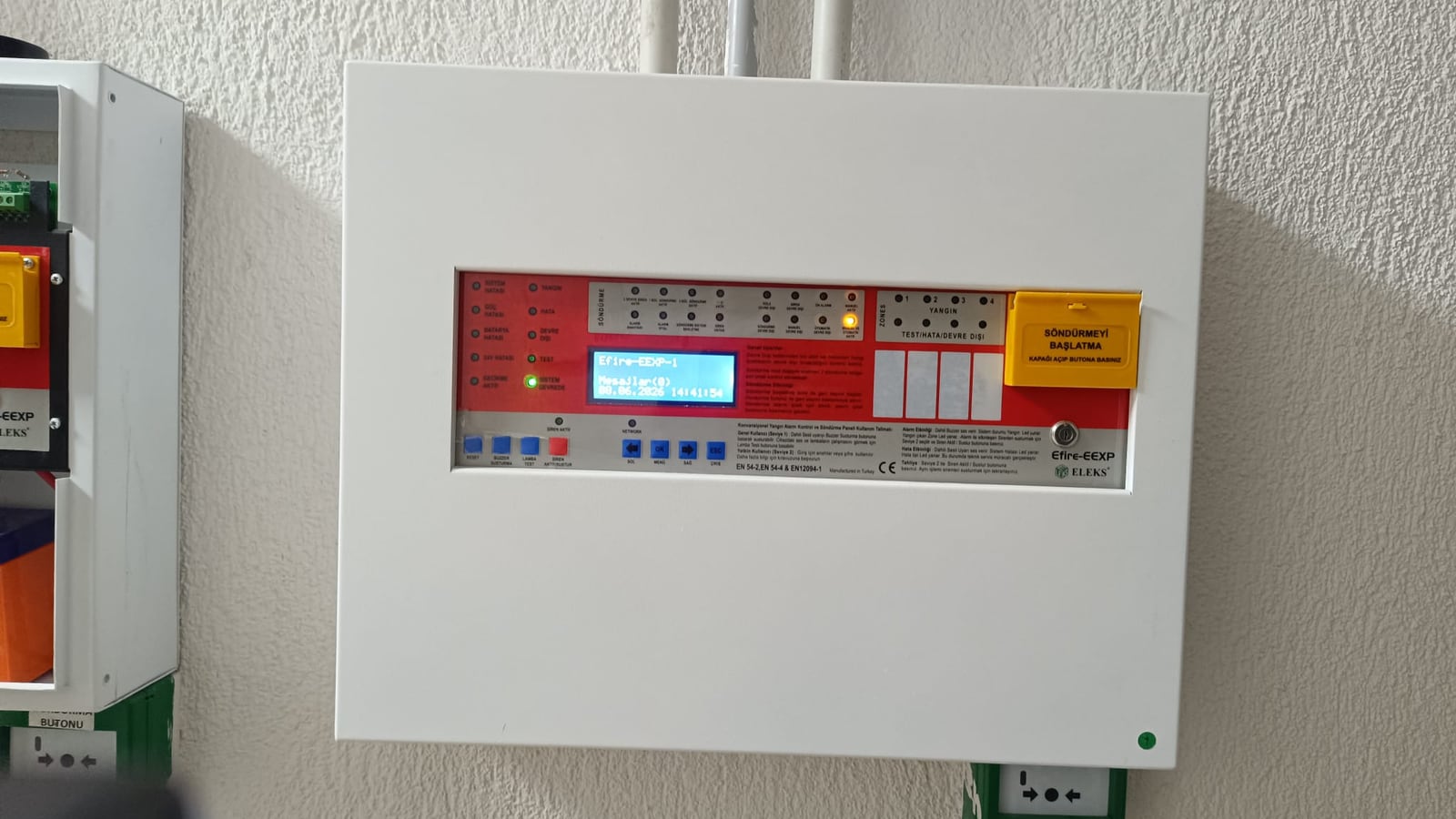
- Fire detection: Suspended fiber in the spinning mill air fills the optical detector chamber within weeks; for this reason in Şanlıurfa the center of gravity of detection maintenance is chamber cleaning and verification testing. In high-ceiling bale storage, beam-type detectors are preferred over point detectors.
- Sprinklers: In bale and fabric storage, stacking height changes each season; whether the design remains valid is checked on the round. For details storage-warehouse solutionsA zone monitoring module connects an entire conventional detector line to the addressable loop. Critical areas are renewed with addressable devices while secondary zones continue to operate with their existing wiring. This provides significant cost advantage in capacity upgrade and renovation projects.
- Hydrant and pump unit: OSB parcels are large, water demand is high; ring line pressure, valve positions and pump activation thresholds are measured. For the production side factory solutionsA zone monitoring module connects an entire conventional detector line to the addressable loop. Critical areas are renewed with addressable devices while secondary zones continue to operate with their existing wiring. This provides significant cost advantage in capacity upgrade and renovation projects.
- Gaseous suppression: Panel rooms feeding yarn machines, compensation and solar facility inverter-transformer buildings fall in this group; cylinder weight and pressure values are monitored by comparison with filling history. See energy and transformer solutionsA zone monitoring module connects an entire conventional detector line to the addressable loop. Critical areas are renewed with addressable devices while secondary zones continue to operate with their existing wiring. This provides significant cost advantage in capacity upgrade and renovation projects.
Dust blinds the detector, internal fire challenges the bale, sun strains the building
1) Detector blinded in the spinning mill
In ring and open-end lines, dust disperses through all space via suction channels and climate control units. Fiber settling in the measurement room insidiously shifts the optical detector's threshold: the device first triggers without cause, and after a time the shift supervisor stops taking the panel seriously; the real danger is that on the day it matters, the same contamination delays the reading of actual smoke. On each visit, every detector chamber is opened, fiber accumulation is cleared, and the device is re-verified with test smoke; contamination approaching the limit is added to the replacement list, and for areas of heavy dust, heat or beam-type alternatives are reported with measurement results. Filter units and ducts are separately reviewed for spark transmission.
2) Unseen fire in the bale storage
A pressed bale looks solid from outside while it can smolder for hours inside; by the time smoke reaches the ceiling, the situation has escalated. In these storage areas, detection type and placement are often more critical than the sprinkler system. On each visit, stacking plan, separation distances and detector coverage are evaluated together; valve positions on the sprinkler line and water tank level are checked.
3) Scorching summer in the solar facility building
In Şanlıurfa's solar facility areas, protection is generally limited to the inverter building and gaseous system in the transformer container. Summer heat raises cylinder pressure, shortens battery life, and puts strain on electronic cards inside the building. On the round, cylinders are weighed, pressure values are interpreted together with ambient temperature, building ventilation and field nozzles are checked; heat traces in DC connection boxes are scanned visually and by measurement.
The same vehicle covers an OSB parcel, bale storage and solar facility building in one day
In GAP geography, industry does not sit at one address: the spinning mill is on a Şanlıurfa OSB parcel, the ginning facility in the district, the solar plant in the middle of the steppe. A fixed office cannot keep up with this spread; we have no service point in Şanlıurfa, the province is served by vehicles departing from Ankara Yenimahalle and carpet, textile and food industry is by far the region's most intensive service point. sharing the same route with, providing coverage. What this arrangement brings to the facility is predictability: the date is written weeks ahead, the same team always knocks on your door, years of reports accumulate in a single folder. How planning is reflected in pricing maintenance prices is explained on the page. On a breakdown day, the schedule does not wait: the panel brand and code on the screen are taken over the phone, and from this information it becomes clear which card and which cylinder will be sent on the dispatched vehicle; emergency repair service explains this flow step by step. For the entire system spanning 81 provinces nationwide service page.
Our principle on the contract side is simple: from the detection panel of the spinning mill to the pump station, from the sprinklers of the bale storage to the gaseous system in the solar facility building, everything that exists in fire is brought under maintenance in a single end-to-end contract; surveillance cameras overlooking the field (CCTV) maintenance is also written into the same scope for facilities that request it.
What can be covered in one round day from the ginning facility to the solar facility building?
| Facility point | Performed that day |
|---|---|
| Spinning mill detection cycle | Detector chambers are opened for fiber accumulation, verification is performed with test smoke; battery, cycle errors and scenario triggering are checked on the panel |
| Bale and fabric storage | Beam detector alignment and lens cleaning, stacking comparison with design height, sprinkler alarm valve testing |
| OSB ring line and pump station | Static-dynamic pressure reading, jokey and main pump activation thresholds, cabinet hose-nozzle inspection and valve maintenance |
| Solar facility building and transformer container | Cylinder weighing, pressure reading together with temperature, solenoid/actuator and nozzle inspection, room sealing and building ventilation review |
| Escape routes | Duration testing on emergency lighting fixtures, battery measurement and visibility check of directional signs |
We read intervals from standards rather than calendar habit: for sprinkler TS EN 12845, for detection CEN/TS 54-14, for gaseous system TS ISO 14520, and whichever frequency the manufacturer's manual requests for each control becomes the period; how this framework is established specific to your facility periodic inspection is explained on the page. A detector blinded by dust replaced with a new one, a cylinder short in weighing filled, and consumable parts such as seals and couplings on the pump line product stock are separated; there is no second trip cost between detection and remedy. The first step is a single-page summary: panel brand, building and cylinder count, bale storage stacking arrangement. Send this from contact form or You can callcall and establish the annual maintenance schedule; let us jointly schedule major maintenance before campaign and solar facility building inspection mid-summer.
To Set Up Your Maintenance Program
One contract, a solution for everything: we provide end-to-end maintenance to fire detection, gas suppression, sprinkler, hydrant, and pump units in their entirety; if you wish, camera (CCTV) system maintenance can also be added to the same contract.
If you do not have the brand, age, and last maintenance record of the existing system on hand, that is not a problem; the first step is anyway inventory and current condition assessment. Setting up an annual program without seeing what is there in the field means selling maintenance for a system that does not exist.
You can examine your system brand's product equivalents in our product catalog ; for requirements specific to your facility's use class, you can visit our sectoral solutions pages.
For survey and quotation you can or send your plan through our write or directly You can call call the number. Survey is free within Ankara; for facilities throughout Turkey, the visit plan is established jointly before contract.
Frequently Asked Questions
Do you base your annual maintenance calendar on the cotton ginning season?
Yes; in Şanlıurfa, the calendar axis is the campaign. With the harvest, cotton ginning runs continuously in the fall; testing and shutdown work is not scheduled during these weeks—only emergency repairs fall due. Main maintenance is scheduled for the summer window when production lines are relatively idle; if you submit your inventory early, the date is confirmed in writing months before the campaign begins.
Our cotton bale storage has sprinklers; is that sufficient on its own?
Most often, no. Bale fires progress from within; smoke and heat reach the ceiling late, and by the time the sprinkler activates, the fire may have grown. For this reason, early detection (beam type or air sampling) is evaluated together with stacking layout in the storage; during the inspection, stack height is compared against the existing design and any discrepancies are documented in the report.
Our renewable energy plant has suppression only in the inverter buildings; what maintenance is performed for the panel field and DC lines?
The gas suppression system in the building and transformer container is the core of the visit: cylinders are weighed, pressure is read along with ambient temperature on that day, solenoids and actuators are inspected. On the plant side, DC collection boxes and connector points are reviewed thermographically, building ventilation and field suppression agents are examined. Providing the building count, cylinder quantity, and coordinates in advance ensures proper visit planning.
In Urfa summers, the pressure in our gas suppression cylinders rises; is this a malfunction?
Pressure rise with temperature is a matter of physics and is not a malfunction in itself; what is critical is the pressure's conformity with the temperature-pressure curve and the cylinder weight. During inspection, weighing and pressure are evaluated together; deviation from the curve indicates a leak, the cylinder enters the refill process, and recommendations for building ventilation are documented in the report.
Our cotton ginery is in the district, our yarn mill in Şanlıurfa Industrial Zone; can both be combined in a single contract?
Yes, they can be. Both addresses are scheduled for the same inspection day; the vehicle visits the cotton ginery in the district in the morning and the mill in the Industrial Zone in the afternoon. Findings for each facility are separated in their own section in a single file delivered; management does not chase two separate documents, and renewal and refill dates progress on the same annual calendar.