
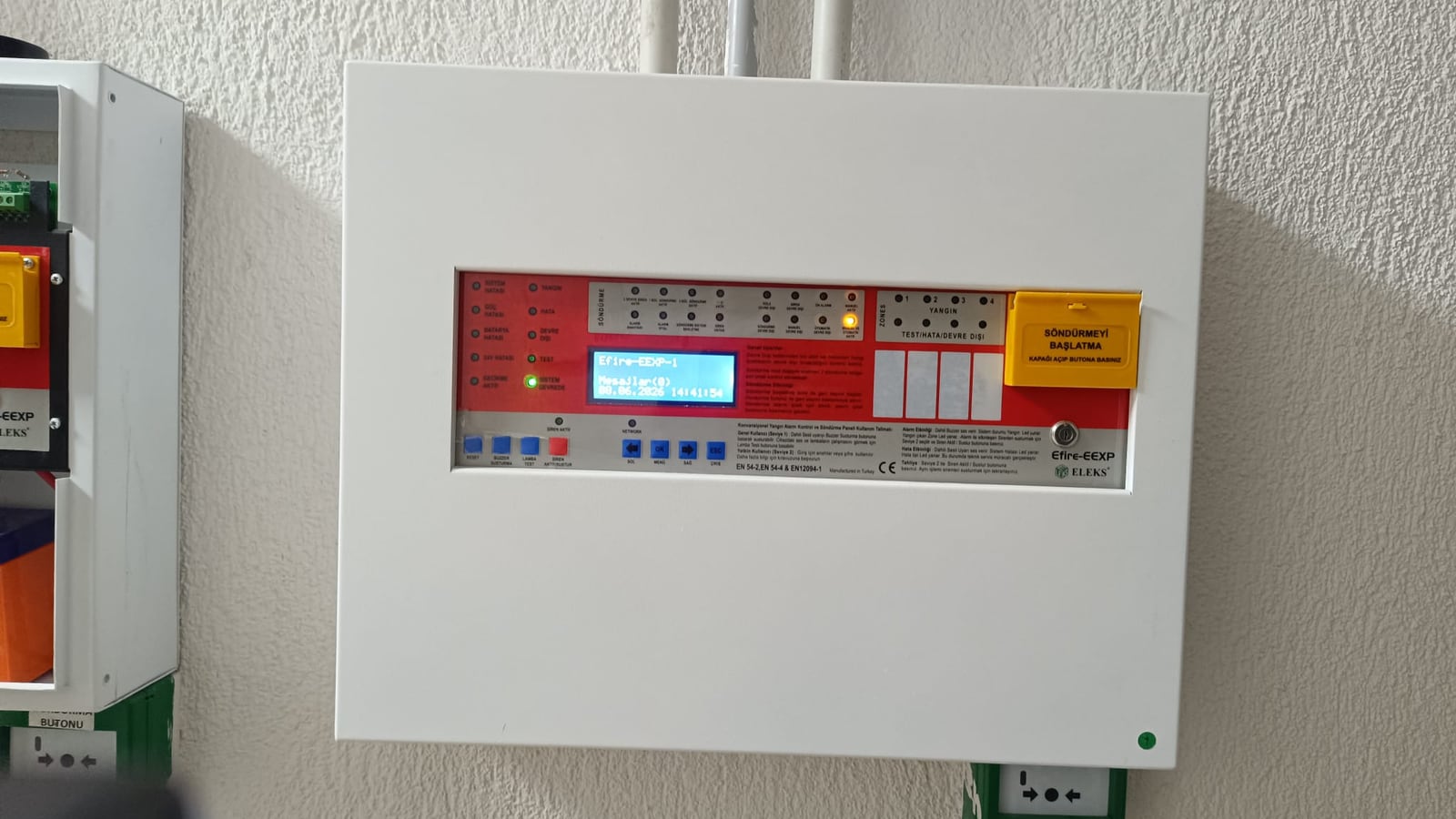
In a conventional fire detection system, the protected area is divided into zones. The panel knows which zone the alarm is coming from; however, it does not know which device in that zone is alarming. It is a simple, economical, and proven architecture — when used in the right application.
What Is a Conventional Fire Detection System?
Each zone is connected to the panel by a separate pair of cables. Multiple detectors and manual call points are connected to a zone line in parallel . A end of line resistor is placed at the end of the line; the panel continuously monitors line continuity through this resistor.
When a detector goes into alarm, it reduces the line resistance, current increases, and the panel reads this as an alarm. The panel indicates which zone is in alarm — not which device .
For this reason, zone size is limited: according to TS CEN/TS 54-14 guidance, a zone should typically cover a single storey, a single fire compartment, and a limited area. Otherwise, locating the fire becomes practically impossible.
Zone Logic and End of Line Resistor
The end of line resistor (End of Line Resistor — EOL) is the conventional system's self-monitoring mechanism:
- Normal condition — The panel reads a low and steady current across the EOL resistor.
- Alarm condition — The detector reduces resistance, current increases significantly.
- Fault (line break) — Current drops to zero, the panel issues a fault.
Typical EOL values are 4K7 or 10K; the value is determined by the panel manufacturer. The EOL resistor must be installed at the last device at the physical end of the line, not at the panel. If this rule is not followed, line supervision becomes meaningless — the panel cannot detect a broken line.
Wiring: 2-wire, 4-wire, and NAC Lines
- 2-wire line — Power and alarm signal share the same pair. This is the classic detector line.
- 4-wire line — Separate power + separate alarm contact. Beam, flame, aspirating, and gas detectors typically operate this way.
- NAC lines — Sounders and beacons, from the detector lines Topology is radial. There is no ring. If a line breaks at any point, all devices downstream of the break are disabled. This is a structural limitation of conventional architecture and must be accepted in design.
Conventional Panel Types Conventional panel types, capacities, and typical applications
Type
| Type | Mini panel | 1–2 zones |
|---|---|---|
| Mini panel | Standard panel | 4 / 8 / 16 zones |
| Villa, small business, school block | Expandable panel | 16 zones and above (with card expansion) |
| Mid-scale facility | Suppression panel | 1–3 detection zones + suppression output |
| Suppression panel | A | repeater panel |
The system may also Conventional Fire Alarm Panels Detectors Used in Conventional Systems Conventional architecture is not more restricted than addressable architecture in terms of detector type.
All of the following devices can operate in a conventional system:
In terms of detector type, conventional architecture is not more limited than addressable architecture is not more limited. Beam detectors
- Smoke detectors — alarm and fault relays in the control unit are connected to the zone line (EN 54-7)
- Heat detectors — virtually all industrial flame detectors ship from the factory as conventional: alarm relay, fault relay, pre-alarm relay, and 4–20 mA analog output (EN 54-5)
- Beam detectors Aspirating detectors
- Flame detectors — almost all industrial flame detectors ship as conventional: alarm relay, fault relay, pre-alarm relay and 4–20 mA analogue output (EN 54-10)
- Linear heat sensing cable Manual call points
- Aspirating detectors Sirens and flashers
- Manual call points (EN 54-11)
- Sounders and beacons monitoring module
. Semi-Addressable Intermediate Solution monitoring module retrofit
projects where existing conventional wiring must be preserved.
Advantages and Disadvantages of Conventional Systems Low initial investment cost No device-level identification — zone resolution only
Advantages and disadvantages of the addressable system
| Disadvantages | Full device-level location information |
|---|---|
| High wiring volume (each zone and each siren line is separate) | Low brand dependency, easy component sourcing |
| No contamination and drift monitoring — false alarms and maintenance blindness | Simple fault diagnosis (can be done with a multimeter) |
| Line break disables the entire zone | Natural compatibility with Ex-proof and industrial devices |
| Cause & effect scenario flexibility is highly restricted | Low total cost of ownership in small facilities |
| No pre-alarm, day/night profile, or alarm verification | Does not scale; expansion capability is weak |
| Which Buildings Are Suitable? | A conventional system is the right choice in these cases: |
| — | Villas, small businesses, single-storey warehouses |
Transformer, generator, and panel rooms
Small gaseous suppression areas (single area protection)
- Budget-constrained retrofit projects
- As a
- field layer
- Budget-constrained retrofit projects
- A conventional system is insufficient for:
high-rise buildings (addressable is mandatory per BYKHY),: multi-storey car parks (çok sayıda bölge gerektirdiği için çoğu zaman elverişsiz), hotels, Shopping Malls, ,factories veri merkezi, ., Converting a Conventional System to Addressable and tunnels.
Conventional or Addressable?
For comparative assessment: For comparative evaluation:, komple bir konvansiyonel dedektör hattını adresli çevrime bağlar. Kritik mahaller adresli cihazlarla yenilenirken, ikincil bölgeler mevcut kablolamasıyla çalışmaya devam eder. Bu, kapasite artırımı ve yenileme projelerinde önemli bir maliyet avantajı sağlar.
Konvansiyonel mi, Adresli mi?
page. Addressable Fire Detection Systems
DTS is frequently confused with linear heat detection cable a different technology: the cable alarms at a threshold temperature, it does not measure temperature on a per-meter basis. For a comparison of the two, linear heat detection (LHD) page.
Frequently Asked Questions
Is the conventional fire detection system compliant with regulations?
Evet. Konvansiyonel sistem, bileşenleri EN 54 sertifikalı olduğu ve BYKHY ile TS CEN/TS 54-14 gerekliliklerine uygun tasarlandığı sürece mevzuata uygundur. Yönetmelik adresli sistemi adıyla zorunlu tutmaz; ancak büyük binalarda bölge ve kablo arızası sınırları konvansiyonel çözümü çok sayıda ayrı hatta böldüğünden adresli sistem tercih edilir.
Why is an end-of-line resistor necessary?
The end-of-line resistor enables the panel to monitor the continuity of the zone line. If the resistor is absent or incorrectly installed, the panel cannot detect a broken line and the system will silently fail to operate. The resistor must be installed on the last device at the physical end of the line.
How many detectors can be connected to one zone?
Panel üreticisinin belirttiği maksimum yük sınırı içinde kalmak kaydıyla, tipik olarak 20–32 cihaz bağlanabilir; TSE CEN/TS 54-14:2018 de bir bölgede 32’den fazla nokta tipi dedektör olmamasını ister. Ayrıca pratik bir sınır da vardır: bölge ne kadar büyükse, alarm anında yangın yerini bulmak o kadar zorlaşır. Bölge sınırları yangın kompartımanlarına ve kat sınırlarına göre çizilmelidir.
Can I use beam or flame detectors in a conventional system?
Yes. Most of these devices already have conventional outputs. The alarm relay in the control unit is connected to the zone line, while the fault relay is connected to a separate fault input. The device power supply is provided from a separate 24 VDC line.
Do I need to replace all cables to upgrade from conventional to addressable system?
No. Existing conventional zone lines can be connected to an addressable loop using a zone monitoring module. This way, critical areas can be renewed with addressable devices while other zones continue to operate with their existing infrastructure.