
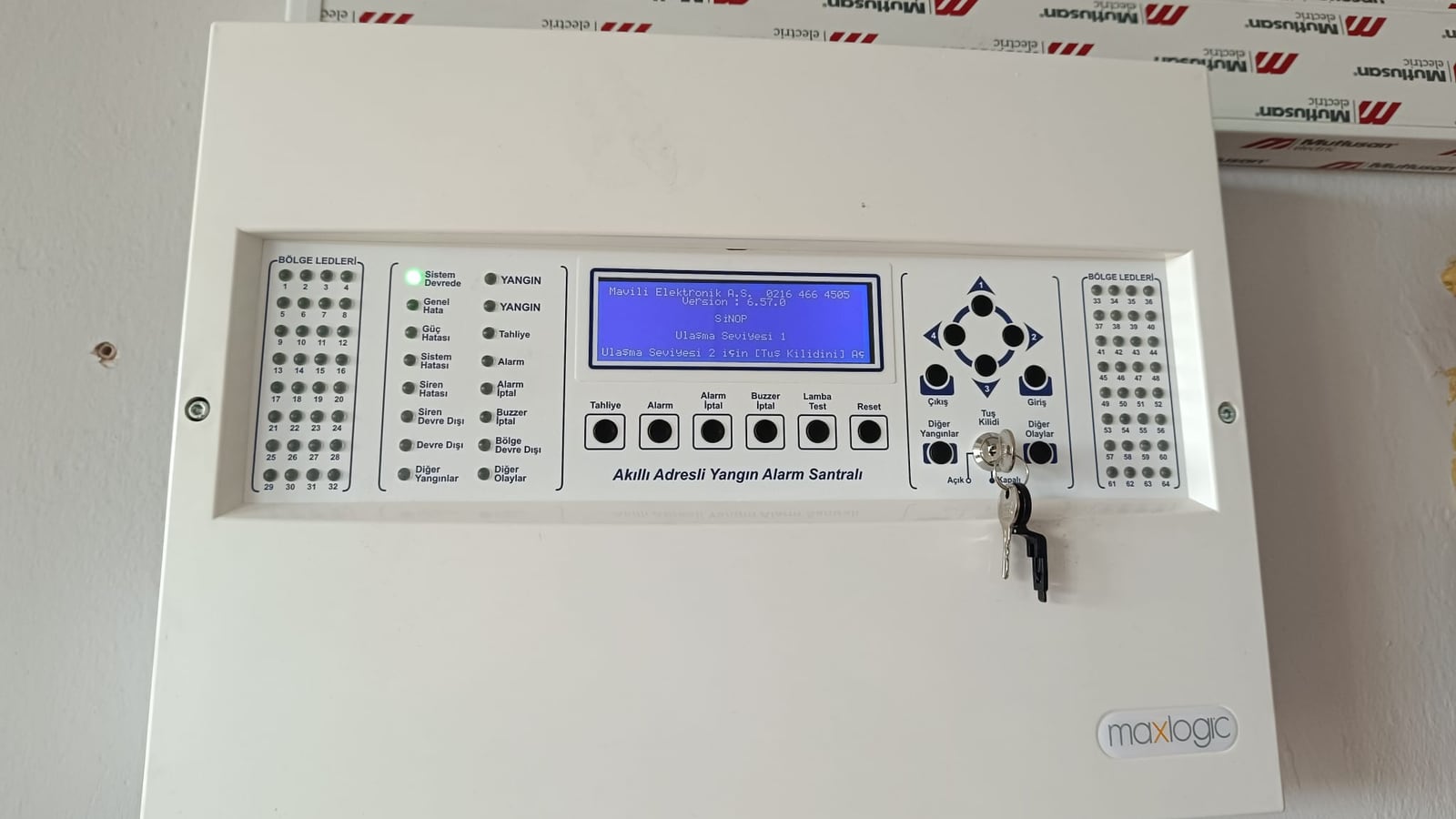
In an addressable fire detection system, each device has a unique address and the panel communicates with the devices over a digital protocol. At the moment of alarm, the panel does not merely say "there is a fire somewhere"; which device, in which location, at which level has triggered an alarm is displayed within seconds.
What is an Addressable Fire Detection System?
In a conventional system, the area is divided into zones and the panel provides information only at zone resolution. In an addressable system, a single cable pair — loop — runs out from the panel, passes through all devices, and returns to the panel. Each device communicates on this line with its own address.
The result is not merely "locating the fire." Addressable architecture opens the door to a series of functions technically impossible in conventional systems: pollution monitoring, drift compensation, pre-alarm, alarm verification, and flexible scenario programming.
The Difference Between Addressable and Analog Addressable
The term "addressable" covers two different generations, and the difference is critical when evaluating proposals.
Addressable (Digital)
The device makes its own alarm decision and sends only an alarm flag to the panel. The alarm threshold is fixed inside the device; the panel does not see raw data.
Analog Addressable ("Intelligent")
The device transmits the raw analog value it measures (smoke density percentage, temperature °C, CO ppm) to the panel. The panel makes the alarm decision. This is what is meant by "addressable system" today.
Specification note: Writing only "addressable system" allows low-cost digital-addressable systems to slip through the door. The specification should use the term "analog addressable" the expression should be used.
Loop Architecture: Class A and Class B
The true advantage of an addressable system emerges when the loop is installed in the correct topology.
| Class A (Closed Loop / Ring) | Class B (Open End / Spur) | |
|---|---|---|
| Wiring | Runs out from the panel, returns to the panel | Runs out from the panel, terminates at the end of the line |
| Line break | The panel feeds from both ends — no device is lost | All devices after the break are disabled |
| Short circuit | Isolators isolate the faulty segment; system continues operating | Loop collapses |
| Cost | Higher (return cable) | Lower |
Critical design rule: An addressable loop wired Class B is not much better than a conventional system in terms of fault tolerance. The benefit paid for the addressable system is obtained with Class A + isolator is taken by.
Typical loop capacity ranges from 99 to 250 addresses depending on manufacturer; typical loop length is 1,500–2,000 meters.
Short Circuit Isolator and Modules
The flexibility of an addressable system comes from the module layer:
- Short circuit isolator (EN 54-17) — Automatically isolates the segment with a short circuit in the loop. Rule: one isolator between each fire compartment and approximately every 20 devices.
- Monitoring (input) module — Monitors a dry contact. Flame detector, beam control unit, linear heat cable control unit, aspiration device relay, sprinkler flow switch, valve monitoring, and gas panel output are integrated into the loop via this module.
- For comparative evaluation: — Connects a complete conventional detector line to the addressable loop. Decisive in Ex areas and retrofit projects.
- Control (output) module — Damper, fan, elevator park, magnetic door holder, suppression triggering, BMS signal.
- Input/output module (EN 54-18)
This is the most misunderstood point in the architecture: The fact that beam, flame, linear heat, and aspiration detectors are "addressable" is largely due to this monitoring module. The device itself remains conventional; only the connection layer changes.
Intelligent Functions of the Addressable System
Drift Compensation
Over years, accumulated dust shifts the detector's baseline. The analog addressable panel automatically compensates for this drift; the detector neither becomes overly sensitive nor becomes blind.
Pollution Monitoring
The panel reports each detector's pollution level as a percentage: "Loop 2 / Address 31 → 78% dirty, clean." This is the basis for predictive maintenance. In a conventional system, this information does not exist.
Pre-alarm
A warning level is defined below the alarm threshold. Personnel can check the location before a full alarm occurs.
Day / Night Sensitivity Profiles
Lower sensitivity during daytime human activity, higher sensitivity at night. A significant portion of false alarms is eliminated by this single feature alone.
Alarm Verification
Upon a single detector alarm, the system waits for a set period, resets the detector, and counts it as a genuine alarm if it continues.
Cause & Effect Programming
Example: "If Loop 1 / Address 12 and Address 13 go into alarm → Damper 4 closes, Fan 2 stops, lower elevators to ground, start gaseous suppression." In gaseous suppression triggering, it is mandatory practice to obtain cross-confirmation (coincidence) from two independent detectors.
Detectors Used in Addressable Systems
| Device | Natively Addressable | Addressable Via Module |
|---|---|---|
| Optical smoke detector | Yes | According to BYKHY, |
| Heat detector | Yes (class adjustable from panel) | According to BYKHY, |
| Multi-sensor detector | Yes | According to BYKHY, |
| Beam (light) detector | Some models (loop-powered) | Common method |
| Flame detector | Rare | Common method |
| Linear heat sensing cable | No | Common method |
| Aspirated detector (ASD) | Yes (with loop card) | Yes |
| Fire alarm manual call point | Yes | According to BYKHY, |
| Siren / flasher | Yes (loop-powered bases) | Yes (output module) |
Protocols and Brand Compatibility
Addressable system protocols are manufacturer-specific and are not compatible with each other. Different brand detectors will not operate on the same loop. Apollo (XP95, Discovery, CoreProtocol), Hochiki (ESP), Notifier, Esser (esserbus), Siemens (FDnet/C-NET), Bosch (LSN), GST, Mavili (Maxlogic), Cooper, Global Fire — each uses its own protocol.
This produces two practical consequences:
- If additions are to be made to an existing system, brand selection is not a preference but a necessity.
- If a specification is to be written, performance should be specified, not brand: "analog addressable; certified to EN 54-2, -4, -7, -17, -18; minimum X address capacity; Class A supported; with pollution monitoring and cause & effect programming features." This approach also ensures compliance with Article 12 of Law No. 4734 on Public Procurement.
Panel Networking, Graphical Software, and BMS Integration
Multiple panels can be networked via RS485, fiber optic, or TCP/IP can be networkedAdvantages and Disadvantages
Advantages and disadvantages of the addressable system
| Disadvantages | Full device-level location information |
|---|---|
| High initial investment cost | Hundreds of devices with a single cable pair — wiring savings |
| Protocol and brand dependency | Fault tolerance with Class A + isolator |
| Commissioning requires expertise | Pollution monitoring and drift compensation — predictive maintenance |
| Spare parts supply dependent on brand | Significant reduction in false alarms |
| Flexible cause & effect scenarios | May not pay for itself in small facilities |
| Flexible cause & effect scenarios | May not justify its cost in a small facility |
| Scalable, BMS integrated | According to BYKHY, |
addressable systems are mandatory in
high-rise buildings. Outside of this, hospitals Apart from this hotelshistoric buildings Shopping Mallshistoric buildings ,factories veri merkezihistoric buildings , metros andhistoric buildings university campusenclosed parking garages , andhistoric buildings enclosed car park and Transition from Conventional to Addressable System An existing conventional system can be migrated to addressable without complete removal.
The zone monitoring module
Migrating from a Conventional to an Addressable System
Addressable or Conventional? For comparative evaluation:For production areas, warehouses, and process lines where point detection is insufficient,
see our page on fire detection design in industrial facilities.
page. Conventional Fire Detection Systems
For situations where point detectors are insufficient in production areas, warehouses, and process lines fire detection design in industrial facilities you can visit our page.
Frequently Asked Questions
Is an addressable system always better than conventional?
Technically yes, economically not always. In a small office or single-story warehouse, a conventional system provides adequate protection and lower total cost of ownership. The advantage of addressable systems becomes apparent as the number of devices increases and rapid fire location identification becomes critical.
Are analog addressable and addressable the same thing?
No. In an addressable system, the device makes the alarm decision. In an analog addressable system, the device sends raw measurement values to the panel and the panel makes the decision. Pollution monitoring, drift compensation and day/night sensitivity profiles are only possible in analog addressable systems.
Can I use detectors from different manufacturers on the same loop?
No. Addressable system protocols are manufacturer-specific and not compatible with each other. If adding to an existing system, the same brand and same protocol series must be used.
Can an addressable system be installed without a short circuit isolator?
Technically yes, but not recommended. Without an isolator, a single short circuit in the loop disables the entire loop. In this case, the fault tolerance advantage of the addressable system is lost.
How many devices can be connected to one loop?
It varies by manufacturer and protocol; typically between 99 and 250 addresses. Loop length is generally 1,500–2,000 meters depending on cable cross-section and device load. In design, the full loop capacity is not filled; capacity is reserved for future additions.